Question
  1. Which segment of electromagnetic waves has highest frequency? How are these waves produced ? Give one use of these waves.
  2. Which em waves lie near the high-frequency end of visible part of em spectrum? Give its one use. In what way this component of light has harmful effects on humans?
Answer

  1. $\gamma\text{ }\text{rays}.$
Produced in nuclear reactions and emitted by radioactive decay of nucleus.
Used in medicine to destroy cancer cells.
  1. Ultra violet rays
Used in LASIK eye surgery, UV lamps to kill germs in water purifier.
Causes sunburn/skin cancer/harms eyes when exposed to direct UV rays.

Need a full question paper?

Generate a complete, print-ready paper with questions like this in minutes — across 16+ boards, with answer keys.

Start Generating Free

Similar questions

A semiconducting material has a band gap of 1eV. Acceptor impurities are doped into it which create acceptor levels 1meV above the valence band. Assume that the transition from one energy level to the other is almost forbidden if kT is less than $\frac{1}{50}$ of the energy gap. Also, if kT is more than twice the gap, the upper levels have maximum population. The temperature of the semiconductor is increased from 0K. The concentration of the holes increases with temperature and after a certain temperature it becomes approximately constant. As the temperature is further increased, the hole concentration again starts increasing at a certain temperature. Find the order of the temperature range in which the hole concentration remains approximately constant.
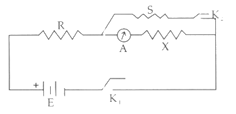
The reading of the $($ideal$)$ ammeter, in the circuit shown here, is equal too. 
Image

$i$. when key $K_1$ is closed but key $K_2$ is open.
$ii.$  $\frac{I}{n}$ when both keys $K _1$ and $K _2$ are closed.
Find the expression of the resistance of $X$ in terms of the resistances of $R$ and $S$.
A wave pulse is travelling on a string with a speed v towards the positive X-axis. The shape of the string at t = 0 is given by $\text{g(x)}=\text{A}\sin\big(\frac{\text{x}}{\text{a}}\big),$ where A and a are constants.
  1. What are the dimensions ot A and a?
  2. Write the equation of the wave for a general time t, if the wave speed is v.
The sunlight reaching Earth has maximum electric field of $810\ Vm^{-1}.$ What is the maximum magnetic field in this light?
A small telescope has an objective lens of focal length $144 \ cm$ and an eyepiece of focal length $6.0 \ cm$. What is the magnifying power of the telescope? What is the separation between the objective and the eyepiece?
The stopping potential in a photoelectric experiment is linearly related to the inverse of the wavelength $\Big(\frac{1}{\lambda}\Big)$ of the light falling on the cathode. The potential difference applied across an $X-$ray tube is linearly related to the inverse of the cutoff wavelength$\Big(\frac{1}{\lambda}\Big)$ of the $X-$ray emitted. Show that the slopes of the lines in the two cases are equal and find its value.
A violin player riding on a slow train plays a $440\ Hz$ note. Another violin player standing near the track plays the same note. When the two are close by and the train approaches the person on the ground, he hears $4.0$ beats per second. The speed of sound in air $= 340m/s.$
  1. Calculate the speed of the train.
  2. What beat frequency is heard by the player in the train?
A resistance R and a capacitor C are connected in series to an ac source $\text{V}=\text{V}_0\sin\omega\text{t}.$
  1. Obtain the expression for the instantaneous current (I) in the circuit.
  2. Show graphically variations of V and I as a function of $\omega\text{t}.$
Obtain the answers $(a)$ to $(b)$ in Exercise $7.13$ if the circuit is connected to a high frequency supply $(240V, 10kHz).$ Hence, explain the statement that at very high frequency, an inductor in a circuit nearly amounts to an open circuit. How does an inductor behave in a dc circuit after the steady state?
Given $n$ resistors each of resistance $$R, how will you combine them to get the $(i)$ maximum $(ii)$ minimum effective resistance? What is the ratio of the maximum to minimum resistance?