Question
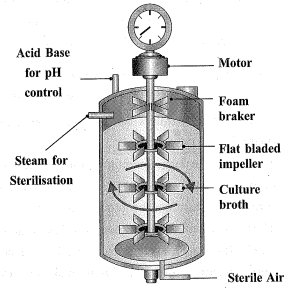
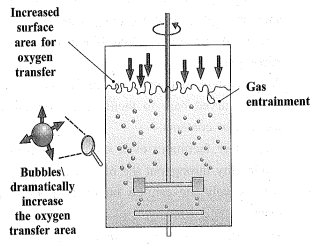
Explain bioreactor with diagram.

Need a full question paper?

Generate a complete, print-ready paper with questions like this in minutes — across 16+ boards, with answer keys.

Start Generating Free

Similar questions

Explain incomplete dominance in dog flower (snapdragon or Antirrhinum sp.) with the help of a chart.###During monohybrid experiment, in F 2 generation, the ratio of phenotype & genotype remains same - explain by giving suitable example (chart is necessary).
Explain innate immunity in detail
Read the following and answer any four questions from (i) to (v) given below:
IUCN maintains a Red Data Book or Red List which is a catalogue of taxa facing risk of extinction. The IUCN Red List (2004) documents the extinction of 784 species in the last 500 years. Some examples of recent extinctions include the dodo, quagga, thylacine and Steller's sea cow. The last twenty years alone have witnessed the disappearance of 27 species. Red List has eight categories of species.
  1. Dodo, an extinct taxon, belongs to which country?
  1. Mauritius
  2. Africa
  3. Australia
  4. Russia
  1. To which of the following categories of IUCN, Berberis nilghiriensis belongs?
  1. Extinct.
  2. Extinct in wild.
  3. Endangered.
  4. Critically endangered.
  1. Steller's sea cow and passenger pigeon became extinct due to:
  1. Alien species invasion.
  2. Over-exploitation.
  3. Coextinctions.
  4. Intensive agriculture.
  1. Bali, Javan and Caspian are:
  1. Species of tiger.
  2. Species of cheetah.
  3. Subspecies of cheetah.
  4. Subspecies of tiger.
  1. Select the correct term for the following definitions (i, ii, iii, iv).
  • The taxon is liable to become extinct if not allowed to realise its full biotic potential by providing protection from exotic species/ human exploitation/habitat deterioration/depletion of food.
  • The taxon has been completely eliminated or died out from earth, e.g., Dodo.
  • The taxon is facing a high risk of extinction in the wild in the near future due to decrease in its habitat, excessive predation or poaching.
  • They are species with naturally small populations, either localised or thinly scattered, which are always at risk from pests/ pathogens/ predators/ exotic species.
 
(i)
(ii)
(iii)
(iv)
(a)
Threatened
Extinct
Endangered
Rare
(b)
Endangered
Extinct
Threatened
Rare
(c)
Extinct
Rare
Threatened
Endangered
(d)
Threatened
Extinct
Rare
Endangered
Read the following and answer any four questions from (i) to (v) given below:
Reerna, Jai and Ankit are suffering from autoimmune diseases of adrenal cortex, joints and thyroid gland, respectively. Their immune system failed to recognise self and non-self and started destroying their body's own proteins. They are seeking proper medical help for their conditions but their condition cannot be cured completely.
Based on the above information, answer the following questions.
  1. Select the option that correctly identifies autoimmune diseases of Reema, Jai and Ankit.
S no.
Reema
Jai
Ankit
(a)
Diabetes
Grave's disease
Rheumatic fever
(b)
Pernicious anaemia
Multiple sclerosis
Myasthenia gravis
(c)
Addison's disease
Rheumatoid arthritis
Hashismoto's thyroiditis
(d)
Systemic lupus erythematosus
Severe combined immunodeficiency disease
AIDS
  1. Reema's autoimmune condition is characterised by
  1. Undersecretion of insulin.
  2. Destruction of RB Cs and low RB C count.
  3. Undersecretion of adrenal cortex hormones.
  4. Low production of intrinsic factor required for absorption of $B_{12}$
  1. What do you think is the major cause of Jai's condition?
  1. Deterioration of myelin sheath around nerve cells, leading to loss of precise muscle control
  2. Destruction of heart cells, leading to weakening of entire heart wall.
  3. Destruction of beta cells, leading to undersecretion of insulin.
  4. Deposition of immune complexes of IgM, IgG and complement in joints thereby inflaming joints, destroying articular cartilage and fusing bones.
  1. How do you think Ankit's condition got diagnosed?
  1. Low level of thyroid hormone and elevated levels of TSH in Ankit's blood.
  2. Presence of antibodies against thyroid pen oxidase (TPO antibodies) in Ankit's blood.
  3. Elevated erythrocyte sedimentation rate (ESR), reduced C-reactive protein (CRP) in Ankit.
  4. Both (a) and (b)
  1. Assertion: Immunosuppressive drugs often reduce the severity of autoimmune disorders.
Reason: Monoclonal antibodies have been successfully used in the treatment of autoimmune disease.
  1. Both assertion and reason are true, and reason is the correct explanation of assertion.
  2. Both assertion and reason are true, but reason is not the correct explanation of assertion.
  3. Assertion is true, but reason is false.
  4. Both assertion and reason are false.
Read the following and answer any four questions from (i) to (v) given below:
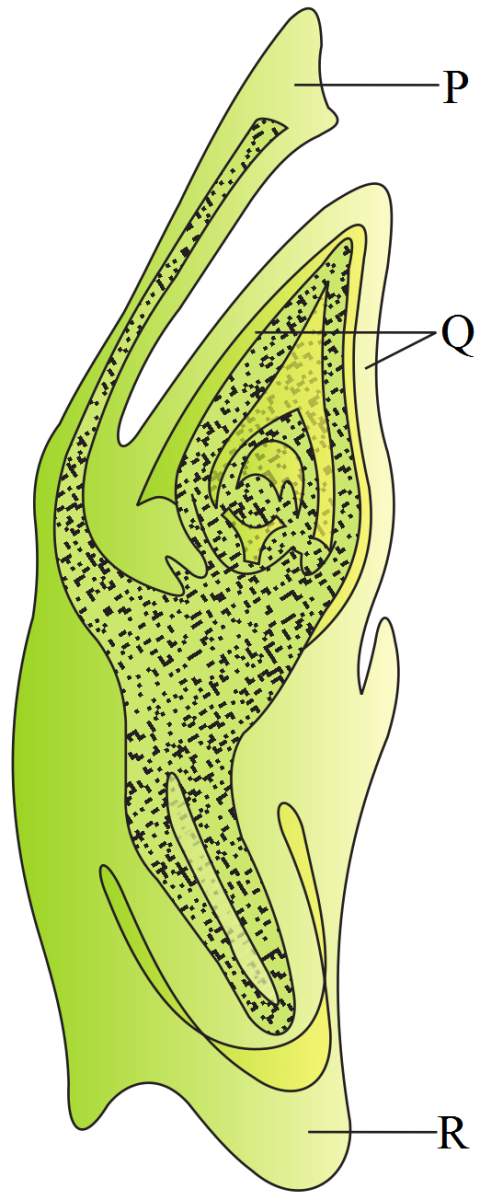
Embryo develops at the micropylar end of the embryo sac, where the zygote is situated. Most zygotes divided only after certain amount of endosperm is formed. The early stages of embryo development are similar in both monocotyledons and dicotyledons. The zygote gives rise to the proembryo and subsequently to the globular heart-shaped and mature embryo. A typical dicotyledonous embryo consists of an embryonal axis and two cotyledons. Embryo of monocotyledons possess only one cotyledon.
  1. True embryo develops as a result of fusion of:
  1. Two polar nuclei of embryo sac.
  2. An egg cell and a male gamete.
  3. Synergid and male gamete.
  4. A male gamete and antipodals.
  1. Refer to the given diagram of the embryo of an angiospermous plant with parts labelled P, Q and R. Select the correct statement(s) regarding this.
  1. Part 'P' supplies nutrition to the developing embryo.
  2. Part 'Q' is the protective sheath of radicle and root cap.
  3. Part 'R' is the protective sheath of shoot apex and leaf primordia.
  4. The embryo shown in the diagram is present in members of Family Poaceae.
  1. (IV) only.
  2. (II) and (III) only.
  3. (I) and (IV) only.
  4. (I), (II), (III) and (IV).
  1. Which of the given statements are true?
  1. During the development of a dicot embryo, heart-shaped embryo is followed by globular embryo.
  2. The part of embryonal axis above the level of cotyledons is epicotyl, while the part below the level of cotyledons is hypocotyl.
  3. Monocot seeds possess a single cotyledon, represented by scutellum.
  1. (I) and (II).
  2. (II) and (III).
  3. (I) and (III).
  4. (I), (II) and (III).
  1. Consider the following parts of an embryonal axis of a dicot seed.
  1. Hypocotyl.
  2. Epicotyl.
  3. Radicle.
  4. Plumule.
In which of the following the above parts are correctly arranged from top to base?
  1. (III) → (I) → (II) → (IV).
  2. (II) → (I) → (III) → (IV).
  3. (IV) → (II) → (I) → (III).
  4. (III) → (IV) → (II) → (I).
  1. In grass family, the cotyledon, is called:
  1. Epiblast.
  2. Plumule.
  3. Scutellum.
  4. Perisperm.
Read the following and answer any four questions from (i) to (v) given below:
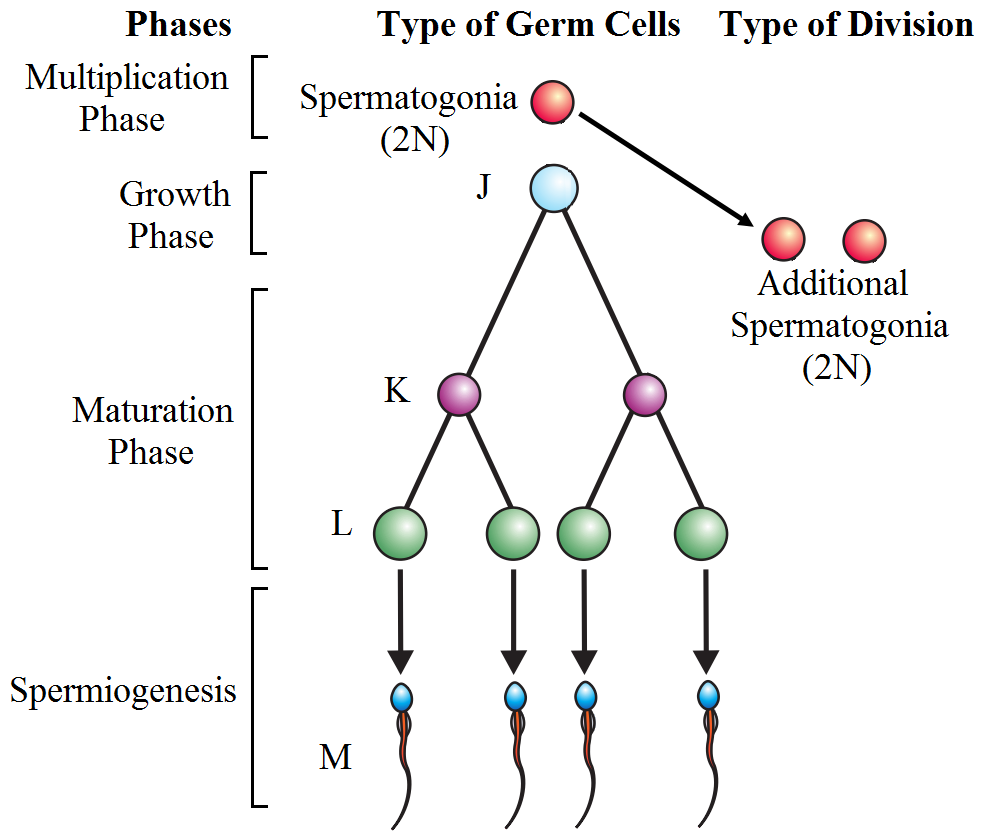
In testis, the immature male germ cells produce sperms by spermatogenesis that begins at puberty. It occurs in the seminiferous tubules of the testes. Seminiferous tubules are lined by germinal epithelium. Study the schematic representation of spermatogenesis and answer the following questions.
  1. Which cell division occurs during multiplication phase?
  1. Mitosis.
  2. Meiosis I.
  3. Meiosis II.
  4. Both (b) and (c).
  1. How many chromosomes are present in secondary spermatocyte and spermatid, respectively?
  1. 46, 23
  2. 46, 46
  3. 23, 23
  4. 23, XY
  1. Transformation of L into M is known as:
  1. Spermiation.
  2. Spermateliosis.
  3. Spermatogenesis.
  4. None of these.
  1. Select the correct option.
  1. Type A spermatogonia grows to larger primary spermatocyte.
  2. One spermatogonium forms two spermatids.
  3. Spenniation is the release of sperms from seminiferous tubules.
  4. Primary spermatocyte undergoes mitosis to form secondary spermatocytes.
  1. Which hormone acts on spermatogonia to stimulate sperm production?
  1. LH.
  2. GnRH.
  3. ABP.
  4. FSH.
Read the following and answer any four questions from 6(i) to 6(v) given below:
Rama lives in a society where a robbery occurred last night. Robbers came into the flat and murdered the old lady residing there. Police came and restricted the entry into the flat. They took samples from the room, where the dead body was found. While examining, they found that there is some blood and tissue in the nails of old lady. According to their observation, police filtered out their inspection to three suspects viz. servant, cook and milkman. Finally after two days of robbery, police caught the criminal. It was the old lady's cook. Rama was amazed to see that how quickly police completed and shut the case. She asked the inspector that how they did it? The police man told her that it become possible due to the sample collected from the victim, that lead them to the criminal. TI1e sample taken from nail scraping was amplified using PCR and then tested.
  1. What technique was used by the police to identify the criminal?
  1. DNA fingerprinting.
  2. Gel electrophoresis.
  3. Molecular diagnosis.
  4. Clonning.
  1. In PCR, the temperature used to denature the DNA is about:
  1. 76º
  2. 25º
  3. 95º
  4. 40º
  1. Which of the following statements regarding PCR is correct?
  1. Taq polymerase, which is isolated from bacterium Thermus aquaticus is stable at low temperature only.
  2. With the help of DNA ligase, the complementary sticky ends of the DNA are joined to produce a rDNA.
  3. Since the sequence of primers are complementary to 5' end of the template DNA, they anneal to it.
  4. DNA purified from the cell is precipitated by adding hot ethanol.
  1. Taq polymerase synthesises DNA region between the primers using:
  1. $Mg^{2+}$
  2. dNTPs
  3. DNA ligase
  4. Both (a) and (b).
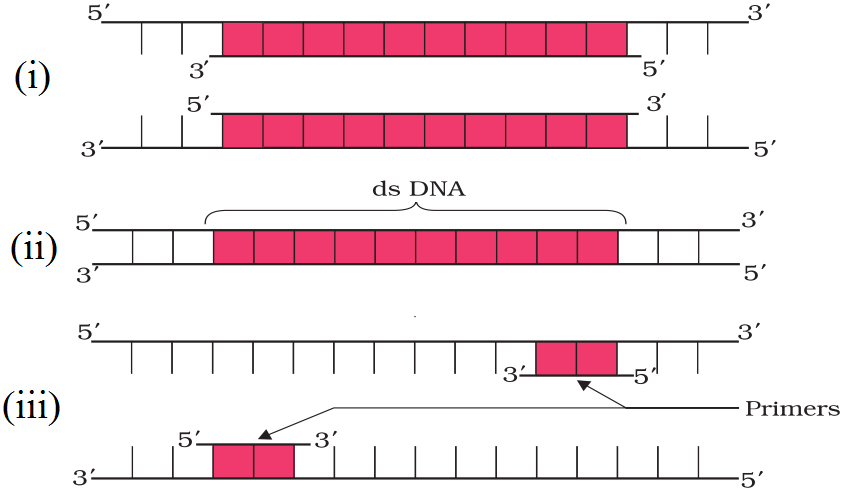
  1. Given below are steps of polymerase chain reaction.


Select the option that correctly mention the sequence in which they occur.
  1. (ii) → (iii) → (i)
  2. (i) → (ii) → (iii)
  3. (iii) → (i) → (ii)
  4. (ii) → (i) → (iii)
Read the following text carefully and answer the questions that follow:
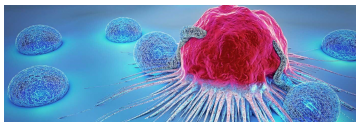
Cancer refers to any one of a large number of diseases characterized by the development of abnormal cells that divide uncontrollably and have the ability to infiltrate and destroy normal body tissue. Cancer often has the ability to spread throughout your body. Cancer is the second-leading cause of death in the world.
Image
i. How does a cancerous cell differ from a normal cell? (1)
ii. Benign tumor is less dangerous than malignant tumor. Why? (1)
iii. Describe causes of cancer. (2)
OR
Mention two methods of treatment of the disease. (2)
Read the following and answer any four questions from (i) to (v) given below:
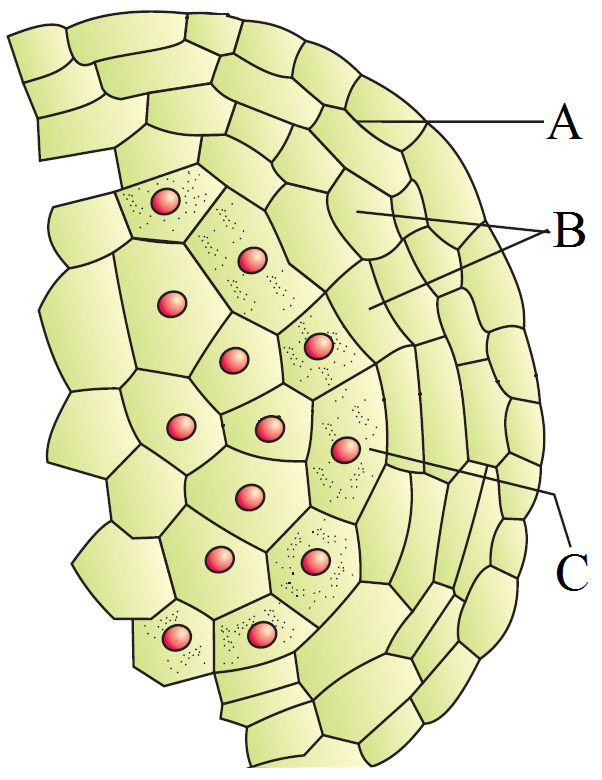
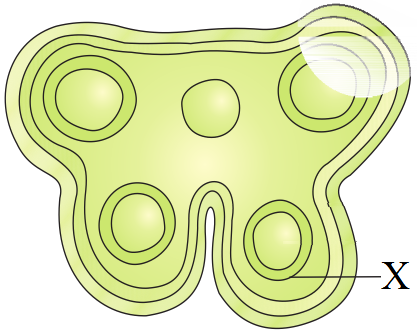
The anther is a four-sided structure consisting of four microsporangia located at the corners, two in each lobe. TI1e microsporangia develop further and become pollen sacs. In a transverse section, a typical microsporangium appears near circular in outline. It is generally surrounded by four wall layers-the epidermis, endothecium, middle layers and the tapetum.
  1. A dithecous another consists of (A) microsporangia, (B) in each lobe.
Select the option that correctly fills the blanks.
S. No
A
B
(a)
Four
Two
(b)
Two
One
(c)
Two
Two
(d)
Four
One
  1. The given diagram shows microsporangium of a mature anther. Identify A, B and C.
(a)
A-Middle layer
B-Endothecium
C-Tapetum
(b)
A-Endothecium
B-Tapetum
C- Middle layer
(c)
A-Endothecium
B-Middle layer
C-Tapetum
(d)
A-Tapetum
B-Middle layer
C-Endothecium
  1. The function of labelled part X is:
  1. Dehiscence.
  2. Mechanical.
  3. Nutrition.
  4. Protection.
  1. Select the incorrect statement.
  1. Microsporangium is generally surrounded by four wall layers-epidermis, endothecium, middle layers and tapetum.
  2. Outer three layers perform functions of protection and dehiscence of anthers.
  3. Cells of tapetum possess dense cytoplasm and generally have more than one nucleus.
  4. Cells of tapetum undergo meiosis and produce microspore tetrads.
  1. Which function oftapetum is correct?
  1. Helps in pollen wall formation.
  2. Transportation of nutrients to inner side of another.
  3. Synthesis of callase enzyme for separation of microspore tetrads.
  4. All of these.
Read the following and answer any four questions from (i) to (v) given below:
A woman unable to conceive after many years of regular unprotected coitus went to specialised infertility clinic. On complete examination, woman was found to be normal, while male partner was diagnosed with infertility. Male partner is unable to copulate the female. Couple was advised to opt for assisted reproductive technology (ART).
  1. Which ART could have been useful for this couple?
  1. ZIFT
  2. IUT
  3. AI
  4. GIFT
  1. In which of the following infertility issues could this technique be used?
  1. Anovulation.
  2. Oligospermia.
  3. Low fructose content in seminal fluid.
  4. All of these.
  1. Which among the following techniques is useful to conceive when there is very low sperm count?
  1. GIFT
  2. Test-tube baby
  3. IUT
  4. JCSI
  1. Assertion: Artificial insemination (AI) is intra-uterine insemination.
Reason: In Al, sperms collected from donor are introduced into the uterus.
  1. Both assertion and reason are true, and reason is the correct explanation of assertion.
  2. Both assertion and reason are true, but reason is not the correct explanation of assertion.
  3. Assertion is true, but reason is false.
  4. Both assertion and reason are false
  1. Success rate of artificial insemination technique is:
  1. 20-40%
  2. 60-70%
  3. 40-50%
  4. 5-7%