Question
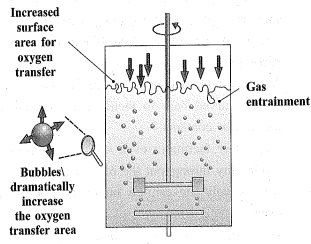
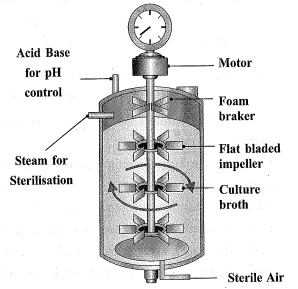
Explain bioreactor with diagram.

Need a full question paper?

Generate a complete, print-ready paper with questions like this in minutes — across 16+ boards, with answer keys.
Start Generating Free

Similar questions

Nematode specific genes were introduced into the tobacco host plant using a vector:
  1. pBR 322.
  2. Plasmid.
  3. Bacteriophage.
  4. Agrobacterium.
Write a short note on pollination by wind.
Read the following and answer any four questions from (i) to (v) given below:

Tools used in the formation of recombinant DNA are of three types. These are enzymes, cloning vectors and competent host. lysing enzymes are used to extract DNA for experimental purpose from the cells. Cleaving enzymes break the DNA molecules. TI1ey are of three types : exonucleases, endonucleases and restriction endonucleases. A competent host is required for transformation with recombinant DNA and cloning vectors help to propagate DNA.

  1. Which of the following is an example of natural Iysing activity in a human body?
  1. Lysozyme present in tears dissolve the bacterial cell wall.
  2. Conversion of starch to maltose in the buccal cavity
  3. Absorption of digested food into the intestinal cells.
  4. Conversion of protein molecules into amino acids in the stomach.
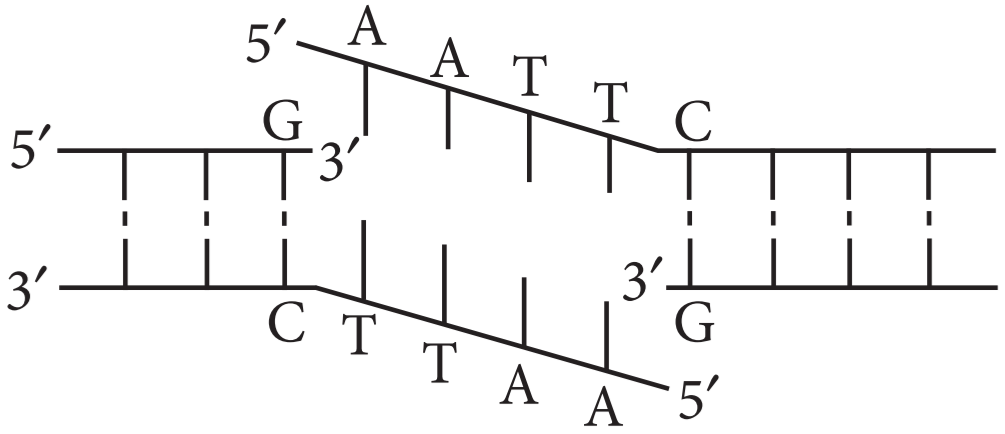
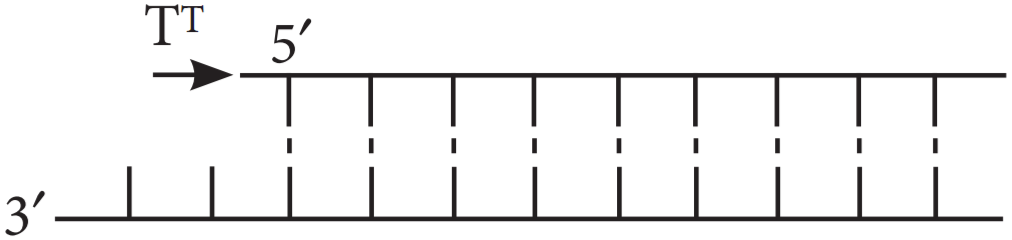
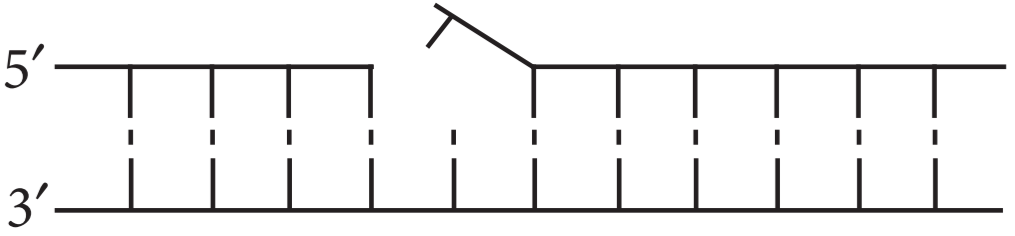
  1. Which of the following depicts exonuclease activity?
  1.  

  1.  

  1.  


  1. All of these
  1. Cloning vectors are the DNA molecules that.
  1. Carry foreign DNA segment but do not replicate inside the host cell.
  2. Carry foreign DNA segment and replicate inside the host cell.
  3. Transfer nuclear DNA form nucleus to the cytoplasm of the same cells.
  4. Help in sealing gaps in DNA segments.
  1. Transfer of DNA into a eucaryotic cell is called:
  1. Transformation.
  2. Transduction.
  3. Transfection.
  4. Electroporation.
  1. Assertion: Type I restriction enzymes are not used in rDNA technology.

Reason: Biotechnology mostly involves cutting and pasting of desired DNA fragments.

  1. Both assertion and reason are true and reason is the correct explanation of assertion.
  2. Both assertion and reason are true but reason is not the correct explanation of assertion.
  3. Assertion is true but reason is false.
  4. Both assertion and reason are false.
Explain pBR322 with its cloning sites, enzymes with well labeled diagram.###Explain: cloning sites. (Diagram is not necessary)
Read the following and answer any four questions from (i) to (v) given below:

The process of copying genetic information from template strand of DNA into RNA is called transcription. It is mediated by RNA polymerase. Transcription takes place in the nucleus of eukaryotic cells. In transcription, only a segment of DNA and only one of the strands is copied into RNA.

  1. What are regions of transcription unit in a DNA molecule?
  1. Promoter
  2. Structural gene
  3. Terminator
  4. All of these
  1. Monocistronic structural genes are found in which organisms?
  1. Prokaryotes
  2. Bacteria
  3. Viruses
  4. Eukaryotes
  1. Which enzyme helps in tailing or polyadenylation?
  1. Poly-A polymerase
  2. Exonuclease
  3. RNA polymerase I
  4. RNA polymerase II
  1. Assertion: A single RNA polymerase in prokaryotes synthesis all types of RNAs.

Reason: Prokaryotic RNA polymerase has sigma $(\sigma)$ factor.

  1. Both assertion and reason are true, and reason is the correct explanation of assertion.
  2. Both assertion and reason are true, but reason is not the correct explanation of assertion.
  3. Assertion is true, but reason is false.
  4. Both assertion and reason are false.
  1. Read the given list of materials.
  1. RNA polymerase enzyme
  2. DNA template.
  3. DNA template.
  4. Okazaki segments.
  5. Four types of ribonucleotides triphosphates.
  6. Divalent metal ions Mg2+ as a cofactor.

Which of the above given materials are required for transcription?

  1. (1) (2) (3) and(4)
  2. (1) (2) (3) (5) and(6)
  3. (1) (2) (5) and(6)
  4. All of these
Read the following and answer any four questions from (i) to (v) given below:

DNA replication is a complex multistep process that requires enzymes, protein factors and metal ions. DNA replication in eukaryotes occurs in the nucleus during the S-phase of the cell cycle. It is semidiscontinuous in eukaryotes. in prokaryotes, replication takes place in the cytoplasm. DNA replication in bacteria occurs prior to fission. Nucleoid or viral chromosome is a single molecule of nucleic acid, it may be linear of circular. Nucleic acid in a virus is either DNA or RNA but never both.
  1. In viral DNA, how many origin of replication are present?
  1. Single
  2. Twice
  3. Multiple
  4. None
  1. Select the main enzyme involved in DNA replication.
  1. DNA ligase
  2. DNA dependent DNA polymerase
  3. Topoisomerase
  4. Helicase
  1. Read the given statement and select the option that correctly fill in the blanks. Enzyme (i) acts over the Ori site and unwinds the two strands of DNA by destroying (ii) bonds.
  1. (i)-Helicase (ii) Glycosidic
  2. (i)-Helicase (ii)-Hydrogen
  3. (i)-Unwindase (ii)-Phosphodiester
  4. (i)-Unwindase (ii)-Glycosidic
  1. DNA strand, built up of Okazaki fragments, is called.
  1. Lagging strand.
  2. Leading strand.
  3. Complementary strand.
  4. Parental strand.
  1. Select the incorrect statement about DNA polymerase in eukaryotes.
  1. Polymerase $\alpha$ is required for initiation of replication.
  2. When the RNA primer gets removed the gap is filled by DNA polymerase $\beta$ in eukaryotes.
  3. Polymerase $\in$ helps in elongation of lagging strand.
  4. Polymerase $\delta$ is largest and main enzyme for DNA replication in eukaryotes.
Describe different outbreeding devices in detail.###Describe different devices to discourage self pollination.###Describe different devices to encourage cross pollination.
Read the following and answer any four questions from (i) to (v) given below:
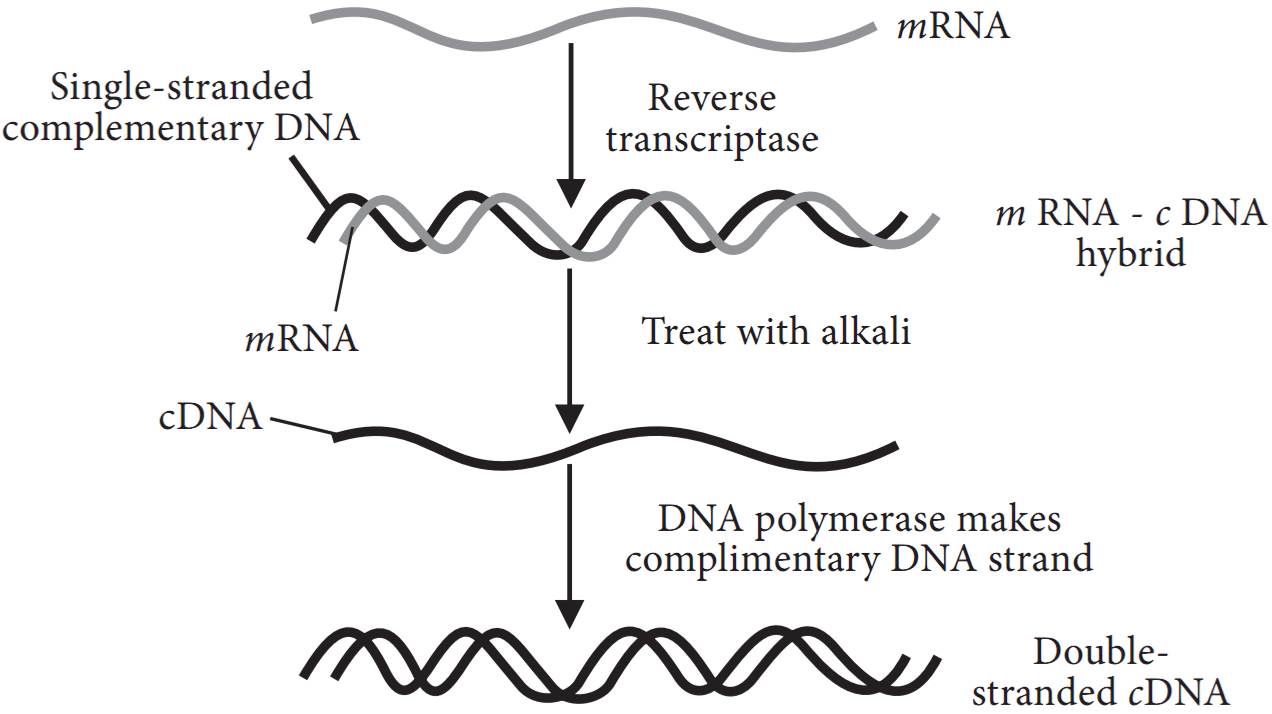
The DNA, which is transferred from one organism into another by joining it with the vehicle DNA is called passenger or foreign DNA. Generally three types of passenger DNAs are used. These are complementary DNA (cDNA), synthetic DNA (sDNA) and random DNA. Complementary DNA (cDNA) is synthesized on RNA template (usually mRNA) with the help of reverse transcriptase. Synthetic DNA (sDNA) is synthesized on DNA template or without a template. Random DNA are small fragments fanned by breaking a chromosome of an organism in the presence of restriction endonucleases.

  1. Reverse transcriptase enzyme was discovered by:
  1. Temin and Baltimore.
  2. Cohen and Boyer.
  3. Arber and Nathan.
  4. Paul Berg.
  1. During cDNA formation, what would happen if DNA formed by reverse transcriptase is not treated with the alkali?
  1. cDNA will not be digested.
  2. mRNA will not be digested.
  3. Hydrogen bonds will not form between base pairs.
  4. rnRNA will not be formed.
  1. Enzyme that helps in the formation of double stranded cDNA is:
  1. DNA synthetase
  2. Ligase
  3. DNA polymerase
  4. Helicase.
  1. DNA polymerase can be obtained form:
  1. Retrovirus.
  2. Agrobacteriurn.
  3. Tobacco mosaic virus.
  4. Thermus aquaticus.
  1. DNA synthesised without a template is referred to as:
  1. Complementary DNA.
  2. Random DNA.
  3. Synthetic DNA.
  4. Z-DNA..
Explain- Restriction enzymes.
Draw a schematic diagram of typical anatropous ovule and describe structure of megasporangium in detail.###With a neat, labelled diagram, describe the parts of a typical angiosperm ovule.