Question
Explain- Restriction enzymes.

Answer

Empty → In the year 1963, the two enzymes responsible for restricting the growth of bacteriophage in Escherichia coli were isolated.
→ One of these added methyl groups to DNA, while the other cut DNA.
→ The later was called restriction endonuclease.
→ The first restriction endonuclease Hind - II, whose functioning depended on a specific DNA nucleotide sequence.
→ Hind -II was isolated and characterised five years later.
→ It was found that Hind II always cut DNA molecules at a particular point by recognising a specific sequence of six base pairs.
→ This specific base sequence is known as the recognition sequence for Hind II.
→ Besides Hind II, today we know more than 900 restriction enzymes that have been isolated from over 230 strains of bacteria each of which recognise different recognition sequences.
Nomenclature :
→ The convention for naming these enzymes is the first letter of the name comes from the genus and the second two letters come from the species of the prokaryotic cell from which they were isolated.
e.g., EcoRI
→ It comes from Escherichia coli RY 13.
→ In EcoRI, the letter 'R' is derived from the name of strain.
→ Roman numbers following the names indicate the order in which the enzymes were isolated from that strain of bacteria.
TYPES :
→ Restriction enzymes belong to a larger class of enzymes called nucleases. These are of two kinds.
(a) Exonucleases
(b) Endonucleases.
(1) Exonucleases remove nucleotides from the ends of the DNA.
(2) Endonucleases make cuts at specific positions within the DNA.
→ Each restriction endonuclease functions by 'inspecting' the length of a DNA sequence.
→ Once it finds its specific recognition sequence, it will bind to the DNA and cut each of the two strands of the double helix at specific points in their sugar -phosphate backbones.
PALINDROMIC SEQUENCE :
→ Each restriction endonuclease recognises a specific palindromic nucleotide sequences in the DNA.
→ The palindrome in DNA is a sequence of base pairs that reads same on the two strands when orientation of reading is kept the same. For example, the following sequences reads the same on the two strands in 5'→3' This is also true if read in the 3' → 5' direction. 5' direction.
5' ____ GAATTC _____ 3'
3' ____ CTTAAG _____ 5'
Mechanism of action :
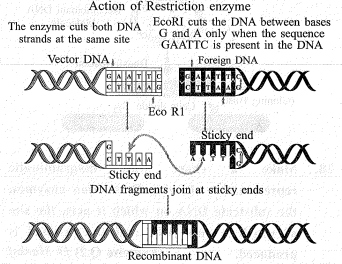
→ Restriction enzymes cut the strand of DNA a little away from the centre of the palindrome sites, but between the same two bases on the opposite strands.
→ This leaves single stranded portions at the ends.
→ There are overhanging stretches called sticky ends on each strand.
Image
→ When cut by the same restriction enzyme, the resultant DNA fragments have the same kind of 'sticky-ends' and, these can be joined together using DNA ligases.
→ Unless one cuts the vector and the source DNA with the same restriction enzyme, the recombinant vector molecule cannot be created.
→ Restriction endonucleases are used in genetic engineering to form 'recombinant' molecules of DNA, which are composed of DNA from different sources/genomes.

Need a full question paper?

Generate a complete, print-ready paper with questions like this in minutes — across 16+ boards, with answer keys.

Start Generating Free

Similar questions

Read the following and answer any four questions from (i) to (v) given below:
A 23 year old Sahil has been diagnosed with an infection of reproductive tract caused by bacteria. He complains about burning sensation during urination, pus-containing discharge and pain around genitalia. This infection has incubation period of 2-5 days but can be cured.
  1. From which disease is Sahil suffering?
  1. Chlamydiasis.
  2. Herpes.
  3. Gonorrhoea.
  4. Syphilis.
  1. Which among the following reproductive tract infections is transmitted by bacteria?
  1. Trichomoniasis.
  2. Chancroid.
  3. Genital warts.
  4. Both (a) and (b).
  1. Which mode of treatment would be useful for Sahil?
  1. Cryosurgery.
  2. Use of Podophyllum preparation.
  3. Use of antibiotic ampicillin.
  4. It cannot be treated.
  1. What technique was used to diagnose Sahil's disease?
  1. Gram staining of discharge and culture.
  2. ELISA Test.
  3. Antibody detection.
  4. Antigen test.
  1. Find the odd one out.
  1. Treponema pallidum.
  2. Neisseria gonorrhoeae.
  3. Haernophilus ducreyi.
  4. Trichomonas vaginalis.
Write a self-explanatory note on biopatent.
Read the following and answer any four questions from (i) to (v) given below:

Oral administration of small doses of hormones is contraceptive method used by the females. They are used in the form of tablets and hence called the pills. The oral pills are two types; mini pills and combined pills.

  1. Mini pills contain:
  1. Estrogen only.
  2. Progestin only.
  3. Combination of progesterone-estrogen.
  4. Inhibin.
  1. How do hormonal pills prevent pregnancy?
  1. By phagocytosing the sperms.
  2. By inhibiting ovulation.
  3. By preventing sperms from entering the vagina.
  4. All of these.
  1. Pill containing non-steroidal preparation, centchroman is:
  1. Mala D.
  2. Mala N.
  3. I-Pill.
  4. Saheli.
  1. Which among the following is incorrect for oral contraceptives?
  1. Oral pills alter the uterine endometrium and make it unsuitable for implantation.
  2. Oral pills have to be taken daily for 7 days starting within first five days of menstrual cycle.
  3. Oral pills increase the risk of intravascular clotting.
  4. Oral pills contain either progestin alone or combination of progestogen and estrogen.
  1. Assertion: Mala D, a combined contraceptive pill, have to be taken daily without a break.

Reason: Mala D contains synthetic progesterone and estrogen.

  1. Both assertion and reason are true, and reason is the correct explanation of assertion.
  2. Both assertion and reason are true, but reason is not the correct explanation of assertion.
  3. Assertion is true, but reason is false.
  4. Both assertion and reason are false.
How interesingly Gene is amplified by using PCR? Explain with diagram.
Read the following and answer any four questions from (i) to (v) given below:

Deoxyribonucleic acid (DNA) and ribonucleic acid (RNA) are the two types of nucleic acids found in the living systems. DNA acts as the genetic material in most of the organisms. Although, RNA also acts as a genetic material in some organisms.

  1. In which of the following organisms, RNA acts as a genetic material?
  1. Escherichia coli
  2. $\text{Q}\beta$ Bacteriophage
  3. Tobacco Mosaic viruses
  4. Both (b) and (c)
  1. What is the reason for the additional stability of DNA in comparison to RNA?
  1. Presence of thymine
  2. Presence of uracil
  3. Presence of OH group
  4. Presence of deoxyribose sugar
  1. Which of the following criteria a molecule must fulfill to act as a genetic material?
  1. It should be able to generate its replica.
  2. It should be stable chemically and structurally.
  3. It should be able to express itself in the form of Mendelian character.
  4. All of these
  1. Assertion: RNA is liable and easily degradable.

Reason: The 2'- OH group present at every nucleotide in RNA is a reactive group

  1. Both assertion and reason are true, and reason is the correct explanation of assertion.
  2. Both assertion and reason are true, but reason is not the correct explanation of assertion.
  3. Assertion is true, but reason is false.
  4. Both assertion and reason are false.
  1. Read the given statement and select the option that correctly fill in the blanks. Pyrimidines present in DNA are (i) and (ii) while pyrimidines present in RNA are (iii) and (iv).
  1. (i)-Adenine (iii)-Guanine (iii)-Cytosine, (iv)-Thymine
  2. (i)-Cytosine (iii)Thymine (iii)-Cytosine, (iv)-Uracil
  3. (i)-Cytosine (iii)-Uracil (iii)-Adenine, (iv)-Guanine
  4. (i)-Cytosine (iii)-Uracil (iii)-Cytosine, (iv)-Thymine
Explain the life cycle of Plasmodium (with diagram).
Explain Species-Area relationships graph.
What is chromosomal disorder? Explain any two aneuploidy with characters in humans.###Mention any two autosomal genetic disorders with their symptoms.
Read the following and answer any four questions from (i) to (v) given below:

Unlike animals, plants cannot runaway for their defence, therefore, they have evolved an astonishing variety of morphological and chemical defences against herbivores. Thorns are the most common morphological means of defence. Many plants produce and store chemicals that make the herbivore sick when they are eaten, inhibit feeding or digestion, disrupt its reproduction or even kill it. Some plants produce highly poisonous chemicals and that is why no cattle or goats browse on those plants. A wide variety of chemical substances that we extract from plants on a conunercial scale are produced by them actually as defence against grazers and browsers.

  1. Why you never see cattle or goats browsing on weed Calotropisl?
  1. It produces highly poisonous tannins.
  2. It produces quinine which is bitter in taste.
  3. It produces poisonous cardiac glycosides.
  4. It bears prickles.


  1. What could be the possible reason for invasive growth of the prickly pear cactus introduced in Australia?
  1. Absence of predators.
  2. New mycorrhizal association.
  3. Abundant water availability.
  4. All of these.
  1. Which of the following is most likely to sick by consuming chemicals produced by plants?
  1. Frog
  2. Goat
  3. Human
  4. Pigeon
  1. Plant evolve variety of morphological and chemical defences against.
  1. Prey
  2. Predator
  3. Commenal
  4. Mutualist
  1. Assertion: Some plant functions as predator in nature.

Reason: Phytoph ago us insects feed on plant sap.
  1. Both assertion and reason are true and reason is the correct explanation of assertion.
  2. Both assertion and reason are true but reason is not the correct explanation of assertion.
  3. Assertion is true but reason is false.
  4. Both assertion and reason are false.
Give a detailed description of human male reproductive system. (Diagram required)