Gujarat BoardEnglish MediumSTD 12 SciencePhysicsMOVING CHARGES AND MAGNETISM2 Marks
Question
Explain Biot$-$Savart Law.
✓
Answer
$\rightarrow$ Law : "The intensity of magnetic field due to an electric current element I $\overrightarrow{d l}$ at a point having position vector $\vec{r}$ with respect to the electric current element is given by the formula, $d \overrightarrow{ B }=\frac{\mu_0}{4 \pi}=\frac{ I \overrightarrow{d l} \times \hat{ r }}{r^2}, \because$
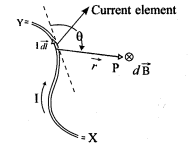
$\rightarrow$ As shown in the figure, a finite conductor $XY$ carries current $I.$
$\rightarrow A$ point $P$ is located at some distance from the conductor. We want to find magnetic field at point $P .$ For this, consider the conductor as divided in to an small elements and choose one small current element $I d \vec{l}$ from conductor.
$\rightarrow \vec{r}$ is the position vector of point $P$ from this current element $I d \vec{l}$. The angle between $I d \vec{l}$ and the position vector $\vec{r}$ is $\theta$.
$\rightarrow$ According to Biot$-$Savart's law, the magnitude of magnetic field $d \overrightarrow{ B }$ is proportional to the current $I$ , the element length $\mid \vec{d} \vec{l}$ and inversely proportional to the square of the distance $r$. It's direction is perpendicular to the plane of $d \vec{l}$ and $\vec{r}$.
$\rightarrow$ The direction of the magnetic field can be found using the right hand screw rule.
$\rightarrow$ Vector form,
$\text { Vector form, }$
$\qquad d \overrightarrow{ B } \propto \frac{ I d \vec{l} \times \vec{r}}{r^3}$
$\therefore d\overrightarrow{ B }=\frac{\mu_0}{4 \pi} \cdot \frac{ I d \vec{l} \times \vec{r}}{r^3}$
Where, $\frac{\mu_0}{4 \pi}$ is a constant of proportionality and its $SI$ unit has the exact value,
$\frac{\mu_0}{4 \pi}=10^{-7} \frac{ Tm }{ A }$
$\mu_0=$ the permeability of free space.
Equation $(1)$ holds when the medium is only vacuum.
$\rightarrow$ The magnitude of this field is :
$d B =\frac{\mu_0}{4 \pi} \cdot \frac{ I d l r \sin \theta}{r^3}$
$\therefore d B =\frac{\mu_0}{4 \pi} \cdot \frac{ I d l \sin \theta}{r^2}$
$\rightarrow$ To obtain the total magnetic field at point $P$ due to entire wire, equation $(1)$ has to be integrated.
$\overrightarrow{ B } =\int d \overrightarrow{ B }$
$\overrightarrow{ B } =\frac{\mu_0}{4 \pi} \int \frac{ I d \vec{l} \times \hat{r}}{r^2}$
Need a full question paper?
Generate a complete, print-ready paper with questions like this in minutes — across 16+ boards, with answer keys.