Question
Explain boiling point of alkyl halides.

Answer

→ Molecules of organic halogen compounds are generally polar.
→ Due to greater polarity as well as higher molecular mass as compared to the parent hydrocarbon, the intermolecular forces ofattraction (dipole-dipole and van der Waals) are
stronger in the halogen derivatives.
→ That is why the boiling points of chlorides, bromides and iodides are considerably higher than those of the hydrocarbons of comparable molecular mass.
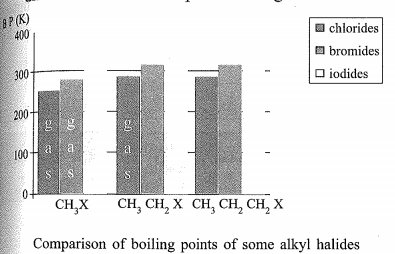
→ The pattern of variation of boiling points of different halides is depicted in Fig.
Image
→ For the same alkyl group, the boiling points of alkyl halides decrease in the order: RI> RBr> RCI> RF.
→ This is because with the increase in size and mass of halogen atom, the magnitude of van der Waal forces increases.
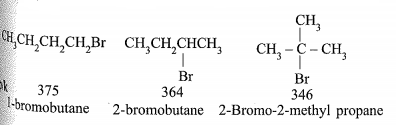
→ The boiling points of isomeric haloalkanes decrease with increase in branching (1°>2°>3°).
→ For example, 2-bromo-2- methylpropane has the lowest boiling point among the three isomers.
Image

Need a full question paper?

Generate a complete, print-ready paper with questions like this in minutes — across 16+ boards, with answer keys.

Start Generating Free

Similar questions

Write the structures of the major products expected from the following reactions:
$a.$ Mononitration of $3-$methylphenol
$b.$ Dinitration of $3-$methylphenol
$c.$ Mononitration of phenyl methanoate
Give the reaction of chlorobenzene with Hydroxyl group.

Predict the products of the following reactions:
Complete the following chemical equations$:$
  1. $\ce{Cr_2O_7^{2-} + 6 Fe^{2+} + 14H^+\rightarrow}$
  2. $\ce{2CrO^{2-}{}_{4 } + 2H^+\rightarrow}$
  3. $\ce{2MnO^-_{4 } + 5C_2O_4^{2- } + 16H^+\rightarrow}$
The rate constant for a first order reaction is $60s^{-1}.$ How much time will it take to reduce the concentration of the reactant $\frac{1}{10}$th its initial value?
The decomposition of $NH_3$ on platinum surface is zero order reaction. If rate constant $(k)$ is $4 \times 10^{-3} Ms^{-1},$ how long will it take to reduce the initial concentration of $NH_3$ from $0.1M$ to $0.064M$.
What happens when?
(i) Acetaldehyde is heated with bleaching powder.
(ii) Ethyl bromide is heated with KCN.
(iii) Ethyl alcohol is oxidised.
An optically active compound having molecular formula C6H12O6 is found in two isomeric forms (A) and (B) in nature. When (A) and (B) are dissolved in water, they show the following equilibrium.
$(\text{A})\ \ \ \ \rightleftharpoons\ \ \ \ \text{Equilibrium mixture}\ \ \ \ \rightleftharpoons\ \ \ \ \text{(B)}\\ [\alpha]_{\text{D}}=111^\circ\ \ \ \ \ \ \ \ \ \ \ \ \ \ 52.2^\circ\ \ \ \ \ \ \ \ \ \ \ \ \ \ \ \ \ \ \ \ \ \ \ \ \ \ 19.2^\circ$
  1. What are such isomers called?
  2. Can they be called enantiomers? Justify your answer.
  3. Draw the cyclic structure of isomer (A).
The $\pi-$complexes are known for transition metals only. Why?
Among the isomeric alkanes of molecular formula $\ce{C_5H_{12}},$ identify the one that on photochemical chlorination yields,
  1. A single monochloride.
  2. Three isomeric monochlorides.
  3. Four isomeric monochlorides.