Question
Give the reaction of chlorobenzene with Hydroxyl group.

Answer

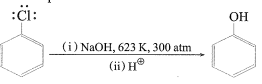
$\rightarrow$ Chlorobenzene can be converted into phenol by heating in aqueous sodium hydroxide solution at a temperature of $623K$ and a pressure of $300$ atmospheres.
Image
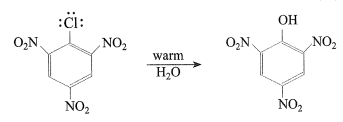
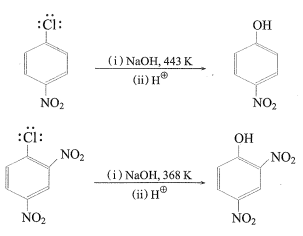
$\rightarrow$ The presence of an electron withdrawing group $(-NO_2)$ at ortho$-$ and para$-$ positions increases the reactivity of haloarenes.​​​​​​​
Image
Image
$\rightarrow$ The effect is pronounced when $(-NO_2)$ group is introduced at ortho$-$ and para positions.
​​​​​​​However, no effect on reactivity of haloarenes is observed by the presence of electron withdrawing group at meta$-$position.

Need a full question paper?

Generate a complete, print-ready paper with questions like this in minutes — across 16+ boards, with answer keys.
Start Generating Free

Similar questions

Note on: Cyclic structure of glucose.
Why is cryolite ore used during the extraction of Al metal?
Compare the general characteristics of the first series of the transition metals with those of the second and third series metals in the respective vertical columns. Give special emphasis on the following points:Electronic configurations:
(a) Out of t-butyl alcohol and n-butanol, which one will undergo acid catalysed dehydration faster and why?
(b) Carry out the following conversions :
(i) Phenol to Salicylaldehyde
(ii) t-butylchloride to t-butyl ethyl ether
(iii) Propene to Propanol
The rate of a particular reaction triples when temperature changes from $50^\circ C$ to $100^\circ C$. Calculate the activation energy of the reaction.$[\log 3 = 0.4771; R = 8.314 \ JK^{-1} \ mol^{-1}].$
Explain nucleophilic addition reaction of aldehydes and ketones with hydrogen cyanide $\ce{(HCN)}.$
Why do compounds having similar geometry have different magnetic moment?
Discuss structure of the carbonyl group.
What is spectrochemical series? Explain the difference between a weak field ligand and a strong field ligand.
An aromatic compound $A ($Molecular formula $C_8H_8O)$ gives positive $2, 4-DNP$ test. It gives a yellow precipitate of compound $B$ on treatment with iodine and sodium hydroxide solution. Compound $A$ does not give Tollen's or Fehling's test. On drastic oxidation with potassium permanganate it forms a carboxylic acid $C ($Molecular formula $C_7H_6O_2),$ which is also formed along with the yellow compound in the above reaction. Identify $A, B$ and $C$ and write all the reactions involved.