Question
Explain briefly the process of charging a parallel plate capacitor when it is connected across a d.c. battery. A capacitor of capacitance ‘C’ is charged to ‘V’ volts by a battery. After some time the battery is disconnected, and the distance between the plates is doubled. Now a slab of dielectric constant, 1 < k < 2, is introduced to fill the space between the plates. How will the following be affected:
  1. The electric field between the plates of the capacitor.
  2. The energy stored in the capacitor.
Justify your answer by writing the necessary expressions.

Answer

Process of charging:

The electrons, from the plate of the capacitor, which is connected to the positive terminal of the battery, move towards the battery. The reverse happens at the other plate. Hence, the plates get positively and negatively charged respectively.

Effect of dielectric:

  1. Electric fields decreases Justification.

Because initially $\text{E}_{1} = \frac{\sigma}{\varepsilon}_{\circ}$ and finally $\text{E}_{2} =\frac{1}{\text{k}}.\frac{\sigma}{\varepsilon}_{\circ}$

$\text{E} = \frac{\text{E}_{1}}{\text{K}}$

  1. Energy stored increases:

New capacitance$\text{C} = \bigg(\frac{\varepsilon_\circ\text{A}}{2\text{d}}\bigg)\text{k}$

$ = \frac{\text{K}}{2}\text{C}_{\circ} , $

$\therefore\text{C} < \text{C}_{\circ}$

Initially Energy $ = \frac{\text{Q}^{2}}{2\text{c}}$ and Energy $ = \frac{\text{Q}^{2}}{\text{c}}.\frac{2}{\text{k}}\text{as }1 < \text{K} < 2.$

Need a full question paper?

Generate a complete, print-ready paper with questions like this in minutes — across 16+ boards, with answer keys.

Start Generating Free

Similar questions

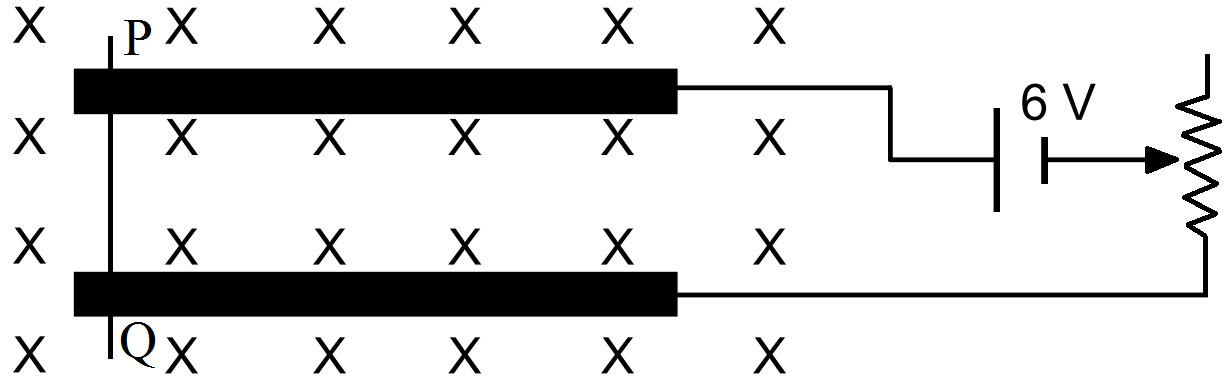
A metal wire PQ of mass 10g lies at rest on two horizontal metal rails separated by 4.90cm A vertically-downward magnetic field of magnitude 0.800T exists in the space. The resistance of the circuit is slowly decreased and it is found that when the resistance goes below 20.0Ω, the wire PQ starts sliding on the rails. Find the coefficient of friction.

State the principle of a cyclotron. Show that the time period of revolution of particles in a cyclotron is independent of their speeds. Why is this property necessary for the operation of a cyclotron?
In a pure semiconductor, the number of conduction electrons is 6 × 10¹⁹ per cubic metre. How many holes are there in a sample of size 1cm × 1cm × 1mm?
An ac genrator is made from area of cross section $3 m^2$ and a coil of 100 turns which is rotated by a constant angular velocity of $60 rad / s$ in a magnetic field of 0.04 T . Resistance of the coil is $500 \Omega$ Calculate: (i) maxumum current obtained from the generator and (ii) maximum power dissipated in the coil.
The work function of caesium is $2.14 eV$. Find (a) the threshold frequency for caesium, and (b) the wavelength of the incident light if the photocurrent is brought to zero by a stopping potential of $0.60 V$.
Show that a force that does no work must be a velocity dependent force.
The absolute refractive index of air is 1.0003 and the wavelength of yellow light in a vacuum is $6000 \stackrel{\circ}{A}$ . Find the thickness of air column which will contain one more wavelength of yellow light than in the same thickness of vacuum.
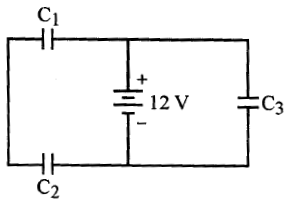
Three identical capacitors C1, C2 and C3 of capacitance 6 µF each are connected to a 12 V battery as shown.

Find:

  1. charge on each capacitor.
  2. equivalent capacitance of the network.
  3. energy stored in the network of capacitors.
Two particles have equal masses of 5.0g each and opposite charges of +4.0 × 10-5 C and -4.0 × 10-5C. They are released from rest with a separation of 1.0m between them. Find the speeds of the particles when the separation is reduced to 50cm.