Question
Show that a force that does no work must be a velocity dependent force.

Answer

To show that a force that does no work must be a velocity dependent force, then we have to assume that work done by force is zero. As shown by the equation below:
$\text{dW}=\vec{\text{F}}.\vec{\text{dI}}=0$
We can write, $\vec{\text{dI}}=\vec{\text{v}}\text{dt But}\text{ dt}\neq0 $
$\Rightarrow\ \vec{\text{F}}.\vec{\text{v}}\text{dt}=0$
$\Rightarrow\ \vec{\text{F}}.\vec{\text{v}}=0$
So we can say that force F must be velocity dependent, this implies that angle between F and v is 90°. If the direction of velocity changes, then direction of force will also change.

Need a full question paper?

Generate a complete, print-ready paper with questions like this in minutes — across 16+ boards, with answer keys.

Start Generating Free

Similar questions

Find the energy liberated in the reaction:
223Ra → 209Pb + 14C.
The atomic masses needed are as follows.
223Ra 209Pb 14C
22.018u 208.981u 14.003u
An object is placed at (i) $10 cm$, (ii) $5 cm$ in front of a concave mirror of radius of curvature $15 cm$. Find the position, nature, and magnification of the image in each case.
A wheel of moment of inertia 0.500kg-m2 and radius 20.0cm is rotating about its axis at an angular speed of 20.0rad/s. It picks up a stationary particle of mass 200g at its edge. Find the new angular speed of the wheel.
A wire carries an alternating current $\text{i}=\text{i}_0\sin\omega\text{t}.$ Is there an electric field in the vicinity of the wire?
  1. A giant refracting telescope at an observatory has an objective lens of focal length 15 m. If an eyepiece of focal length 1.0 cm is used, what is the angular magnification of the telescope?
  2. If this telescope is used to view the moon, what is the diameter of the image of the moon formed by the objective lens? The diameter of the moon is 3.48 × 10m, and the radius of lunar orbit is 3.8 × 10m.
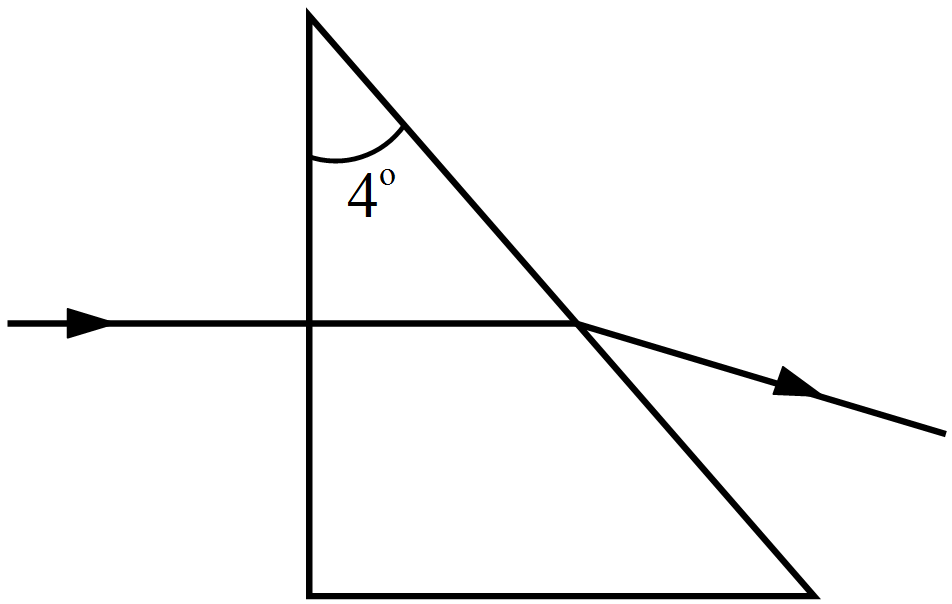
Find the angle of deviation suffered by the light ray shown in figure. The refractive index $\mu=1.5$ for the prism material.

Write the expression for the magnetic force acting on a charged particle moving with velocity n in the presence of magnetic field B.

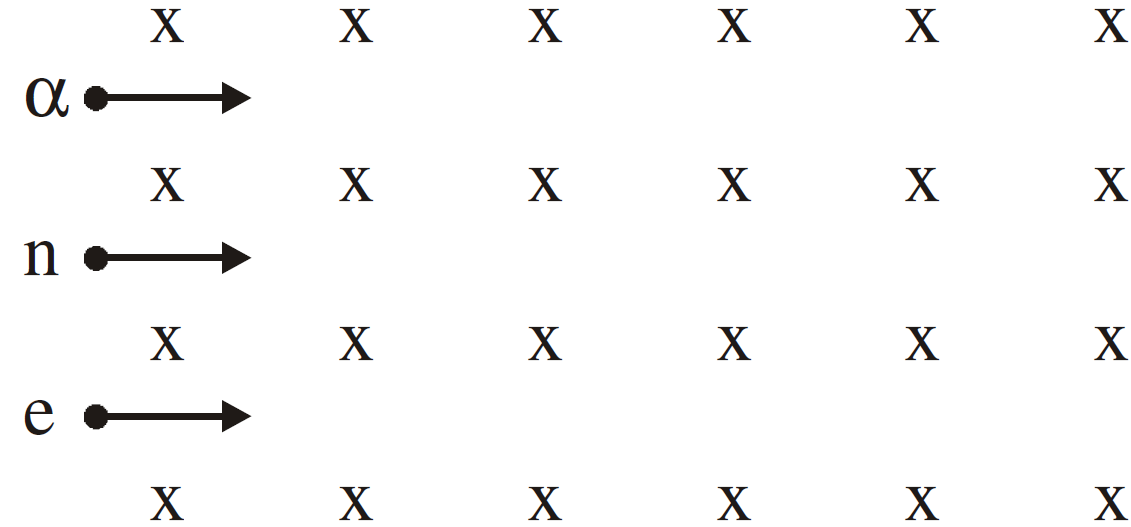
A neutron, an electron and an alpha particle moving with equal velocities, enter a uniform magnetic field going into the plane of the paper as shown. Trace their paths in the field and justify your answer.

A (i) series (ii) parallel combination of two given resistors is connected, one by one, across a cell. In which case will the terminal potential difference, across the cell have a higher value?
Consider a head-on collision between two particles of masses m1 and m2. The initial speeds of the particles are u1 and u2 in the same direction. The collision starts 2 at t = 0 and the particles interact for a time interval $\triangle\text{t}.$ During the collision, the speed of the first particle varies as.

$\text{v}(\text{t})=\text{u}_1+\frac{\text{t}}{\triangle\text{t}}(\text{v}_1-\text{u}_1).$

Find the speed of the second particle as a function of time during the collision.

Plot a graph showing the variation of binding energy per nucleon as a function of mass number. Which property of nuclear force explains the approximate constancy of binding energy in the range 30 < A < 170? How does one explain the release of energy in both the processes of nuclear fission and fusion from the graph?