Question
Explain, by taking a suitable example, how the arithmetic mean alters by:
$i.$ Adding a constant $k$ to each term.
$ii.$ Subtracting a constant $k$ from each term.
$iii.$ Multiplying each term by a constant $k.$
$iv.$ Dividing each term by non-zero constant $k.$
Answer

Let say numbers are $3, 4, 5$
$\therefore$ mean$=\frac{\text{Sum of numbers}}{\text{Total numbers}}$
$=\frac{ 3+ 4+5}{3}$
$=4$
$i.$ Adding constant term $k = 2$ in each term.
New numbers are $= 5, 6, 7$
$\therefore$ mean$=\frac{\text{Sum of numbers}}{\text{Total numbers}}$
$=\frac{ 5+ 6+7}{3}$
$\therefore$ New mean will be $2$ more than the original mean.
$ii.$ Subtracting constant term $k = 2$ in each term.
New numbers are $= 1, 2, 3$
$\therefore$ mean$=\frac{\text{Sum of numbers}}{\text{Total numbers}}$
$=\frac{ 1+ 2+3}{3}$
$\therefore$ New mean will be $2$ less than the original mean.
$iii.$ Multiplying by constant term $k = 2$ in each term.
New numbers are $= 6, 8, 10$
$\therefore$ mean$=\frac{\text{Sum of numbers}}{\text{Total numbers}}$
$=\frac{ 6+ 8+10}{3}$
$=8=4\times2$
$\therefore$ New mean will be $2$ times of the original mean.
$iv.$ Divide the constant term $k = 2$ in each term.
New numbers are $= 1.5, 2, 2.5.$
$\therefore$ mean$=\frac{\text{Sum of numbers}}{\text{Total numbers}}$
$=\frac{ 1.5+ 2+2.5}{3}$
$=2=\frac{4}{2}$
$\therefore$ New mean will be half of the original mean.

Need a full question paper?

Generate a complete, print-ready paper with questions like this in minutes — across 16+ boards, with answer keys.

Start Generating Free

Similar questions

Two circles with centres $O$ and $O'$ intersect at two points $A$ and $B$. $A$ line $PQ$ is drawn parallel to $OO'$ through $A$ or $B$, intersecting the circles at $P$ and $Q$. Prove that $PQ = 2OO'$.
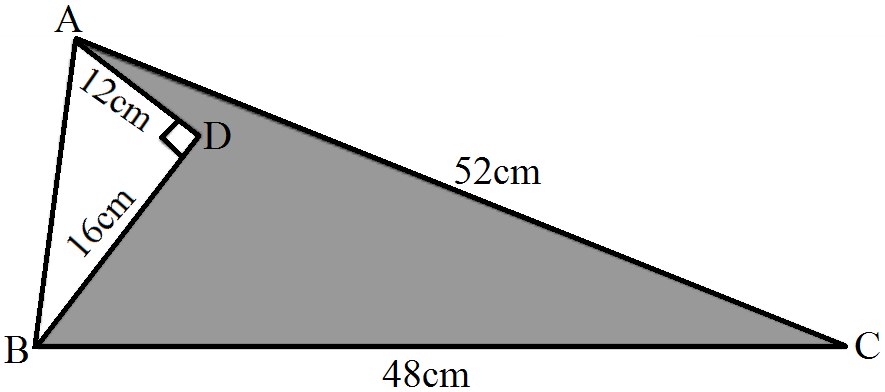
Find the area of the shaded region in the figure given below..
 
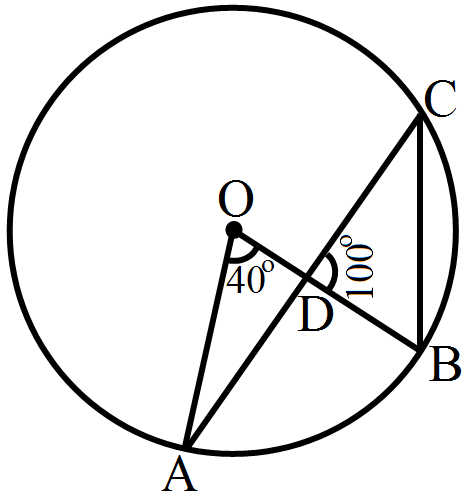
In the given figure, $O$ is the centre of a circle, $\angle\text{AOB}=40^\circ$ and $\angle\text{BDC}=100^\circ,$ find $\angle\text{OBC}.$
The length of the sides of a triangle are in the ratio $3 : 4 : 5$ and its perimeter is $144 \ cm.$ Find the area of the triangle and the height corresponding to the longest side
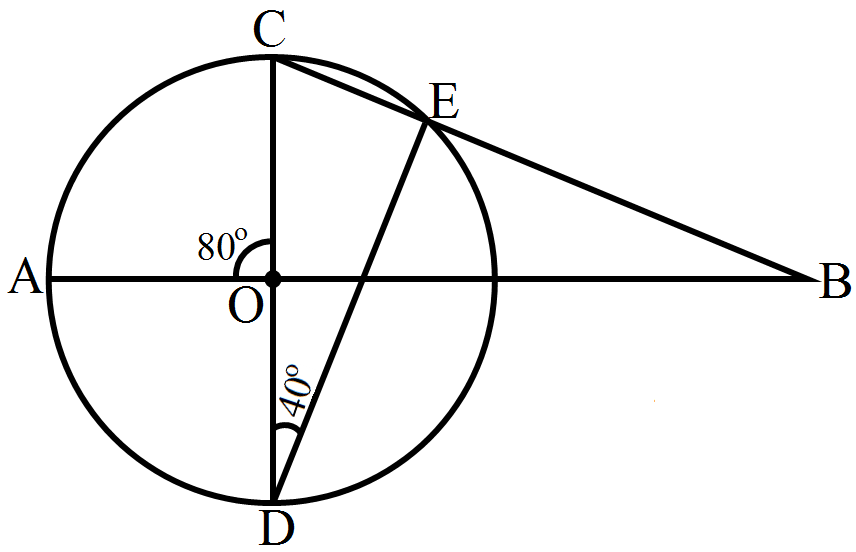
In the given figure, $AB$ and $CD$ are straight lines through the centre $O$ of a circle. If $\angle\text{AOC}=80^\circ$ and $\angle\text{CDE}=40^\circ,$ find
$i. \angle\text{DCE}$
$ii. \angle\text{ABC}$
How many cubic centimetres of iron are there in an open box whose external dimension are $36\ cm, 25\ cm$ and $16.5\ cm$, the iron being $1.5\ cm$ thick throughout? If $1cm^3$ of iron weighs $15g$, find the weight of the empty box in kilograms.
Simplify the following expressions: $\big(\text{x}+\text{y}+\text{z}\big)^2+\Big(\text{x}+\frac{\text{y}}{2}+\frac{\text{z}}{3}\Big)^2-\Big(\frac{\text{x}}{2}+\frac{\text{y}}{3}+\frac{\text{z}}{4}\Big)^2$
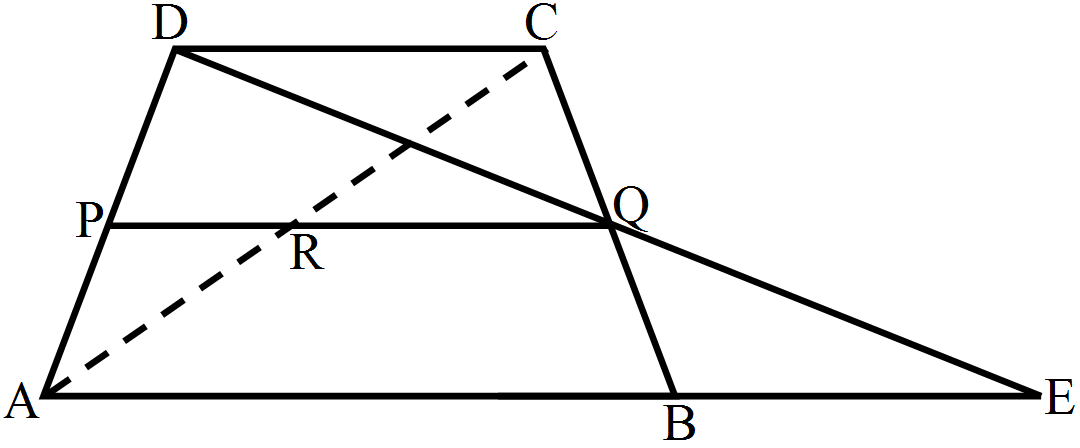
In the adjoining figure, $\text{ABCD}$ is a trapezium in which $AB\ \|\ DC$ and $P, Q$ are the midpoints of $AD$ and $BC$ respectively. $DQ$ and $AB$ when produced meet at $E$. Also, $AC$ and $PQ$ intersect at $R$. Prove that:
$i. DQ = QE,$
$ii. PR \| AB,$
$iii. AR = RC.$
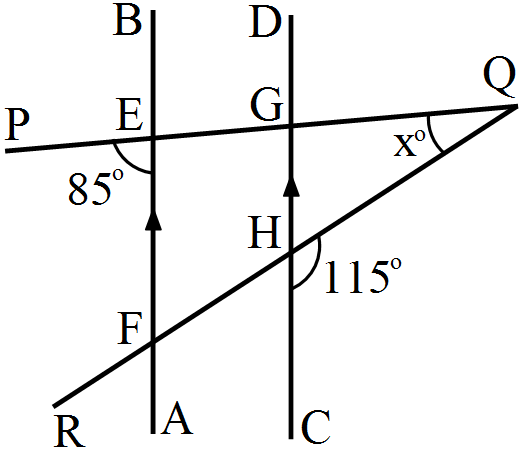
In the given figure, $AB\ ||\ CD$. Find the value of $x$.
If $p(x) = 5 - 4x + 2x^2$, find:
$i. p(0)$
$ii. p(3)$
$iii. p(-2)$