Question
Explain, by taking a suitable example, how the arithmetic mean alters by:
  1. Adding a constant k to each term.
  2. Subtracting a constant k from each term.
  3. Multiplying each term by a constant k.
  4. Dividing each term by non-zero constant k.
Answer

Let say numbers are 3, 4, 5$\therefore\text{Mean}=\frac{\text{Sum of numbers}}{\text{Total numbers}}$
$=\frac{ 3+ 4+5}{3}$
$=4$
  1. Adding constant term k = 2 in each term.
New numbers are = 5, 6, 7
$\therefore\text{Mean}=\frac{\text{Sum of numbers}}{\text{Total numbers}}$
$=\frac{ 5+ 6+7}{3}$
$\therefore$ New mean will be 2 more than the original mean.
  1. Subtracting constant term k = 2 in each term.
New numbers are = 1, 2, 3
$\therefore\text{Mean}=\frac{\text{Sum of numbers}}{\text{Total numbers}}$
$=\frac{ 1+ 2+3}{3}$
$\therefore$ New mean will be 2 less than the original mean.
  1. Multiplying by constant term k = 2 in each term.
New numbers are = 6, 8, 10
$\therefore\text{Mean}=\frac{\text{Sum of numbers}}{\text{Total numbers}}$
$=\frac{ 6+ 8+10}{3}$
$=8=4\times2$
$\therefore$ New mean will be 2 times of the original mean.
  1. Divide the constant term k = 2 in each term.
New numbers are = 1.5, 2, 2.5.
$\therefore\text{Mean}=\frac{\text{Sum of numbers}}{\text{Total numbers}}$
$=\frac{ 1.5+ 2+2.5}{3}$
$=2=\frac{4}{2}$
$\therefore$ New mean will be half of the original mean.

Need a full question paper?

Generate a complete, print-ready paper with questions like this in minutes — across 16+ boards, with answer keys.

Start Generating Free

Similar questions

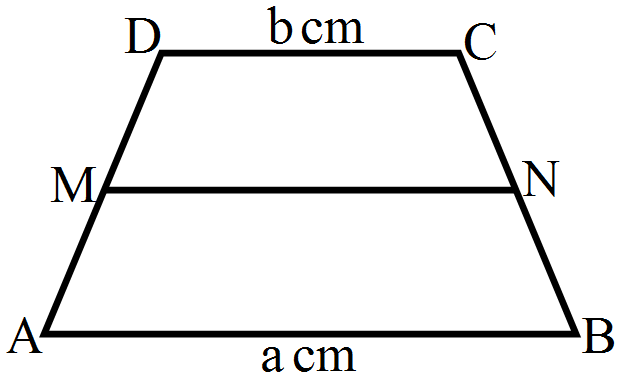
In a trapezium ABCD, AB || DC, AB = acm, and DC = bcm. If M and N are the midpoints ofthe nonparallel sides, AD and BC respectively then find the ratio of
ar(DCNM) and ar(MNBA).
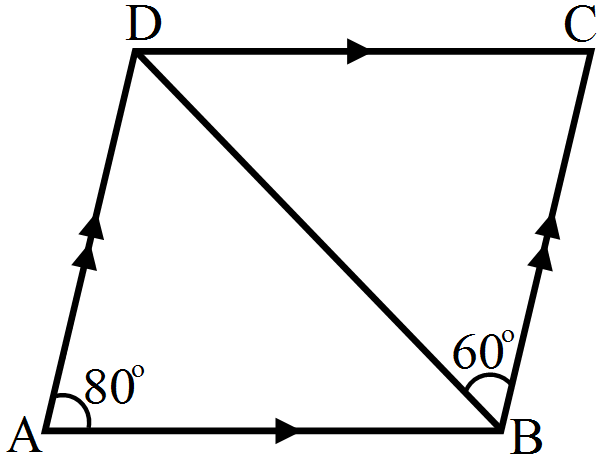
In the adjoining figure, ABCD is a parallelogram in which $\angle\text{DAB}=80^{\circ}$ and $\angle\text{DBC}=60^{\circ}.$ Calculate $\angle\text{CDB}$ and $\angle\text{ADB}.$
The mean salary of 20 workers is ₹10,250. If the salary of office superintendent is added, the mean will increase by ₹ 750. Find the salary of the office superintendent.
Construct ∆XYZ such that XY = 6.7 cm, YZ = 5.8 cm, XZ = 6.9 cm. Construct its incircle.
On a number line, co-ordinates of P, Q, R are 3,-5 and 6 respectively. State with reason whether the following statements are true or false.
i. d(p, Q) + d(Q, R) = d(P, R)
ii. d(P, R) + d(R, Q) = d(P, Q)
iii. d(R, P) + d(P, Q) = d(R, Q)
iv. d(P, Q) – d(P, R) = d(Q, R)
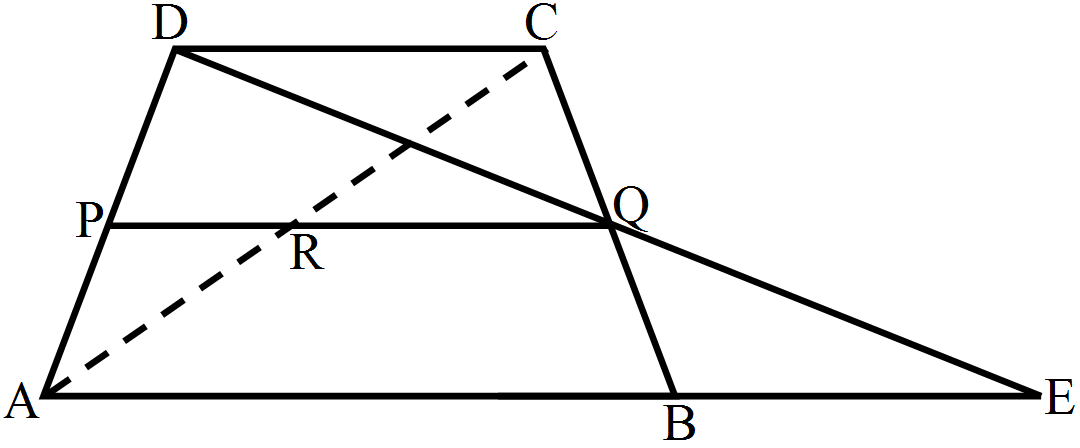
In the adjoining figure, ABCD is a trapezium in which AB || DC and P, Q are the midpoints of AD and BC respectively. DQ and AB when produced meet at E. Also, AC and PQintersect at R. Prove that:
  1. DQ = QE,
  2. PR || AB,
  3. AR = RC.
​​​​​​​
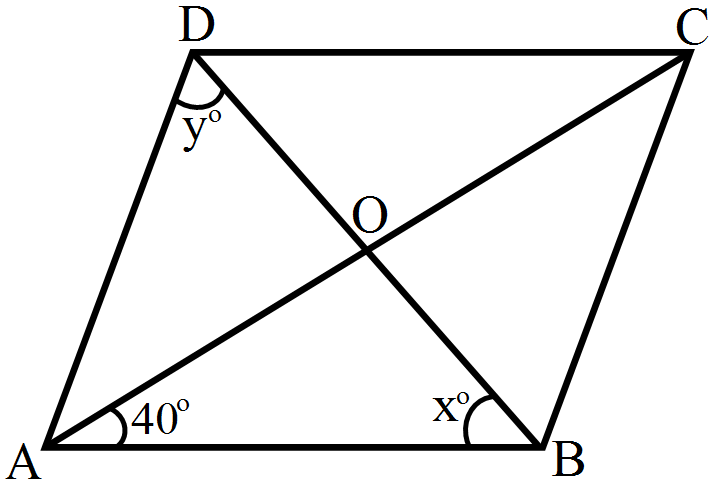
In each of the figures given below, ABCD is a rhombus. Find the value of x and y in each case.
Give a geometrical construction for finding the fourth point lying on a circle passing through three given points, without finding the centre of the circle. Justify the construction.
The point Q( -3, -2) lies on a line parallel to the Y-axis. Write the equation of the line and draw its graph.
Construct ∆XYZ, such that YZ = 7.4 cm, ∠XYZ = 45° and XY – XZ = 2.7 cm.