Question
Give a geometrical construction for finding the fourth point lying on a circle passing through three given points, without finding the centre of the circle. Justify the construction.
Answer

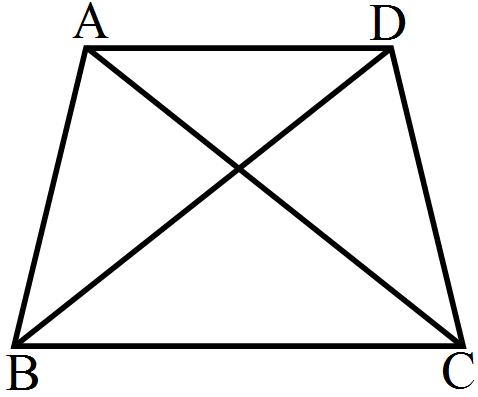
Let A, B and C be the given points. With B as the centre and a radius equal to AC, draw an arc. With C as the centre and AB as radius, draw another arc, which cuts the previous arcat D. Then D is the required point BD and CD. In $\triangle\text{ABC}$ and $\triangle\text{DCB}$ AB = DC AC = DB BC = CB [Common]$\therefore\ \triangle\text{ABC}\cong\triangle\text{DCB}$ [By SSS]
$\Rightarrow\ \angle\text{BAC}=\angle\text{CDB}$ [C.P.C.T.]
Thus, BC subtends equal angles, $\angle\text{BAC}$ and $\angle\text{CDB}$ on the same side of it.$\therefore$ Points A, B, C, D are concyclic.

Need a full question paper?

Generate a complete, print-ready paper with questions like this in minutes — across 16+ boards, with answer keys.
Start Generating Free

Similar questions

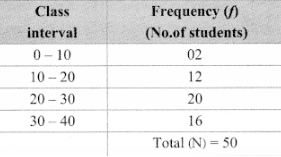
The following information is regarding marks in mathematics, obtained out of 40, scored by 50 students of 9th std. ¡n the first unit test.

Image
From the table, fill in the blanks in the following statements.
i. For class interval 10 – 20 the lower class limit is _____ and upper class limit is _____
ii. How many students obtained marks less than 10? 2
iii. How many students obtained marks less than 20? 2 + ____ = 14
iv. How many students obtained marks less than 30? ______ + _____ = 34
v. How many students obtained marks less than 40? ______ + ______ =50
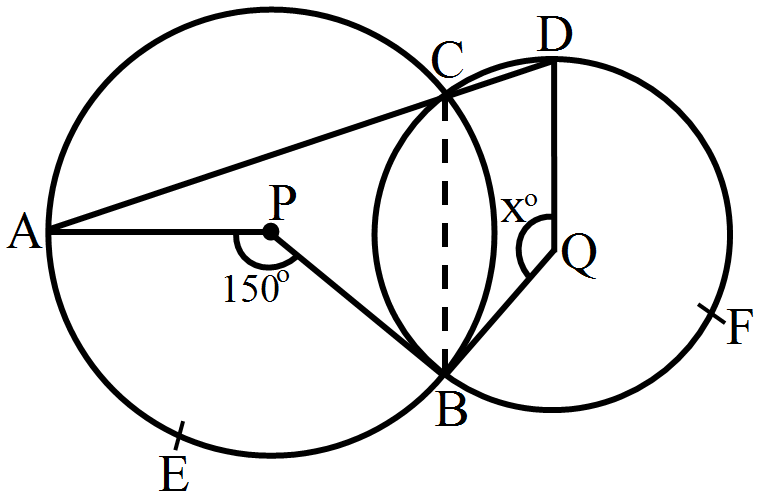
In the figure given below, P and Q are centres of two circles, intersecting at B and C, and ACD is a straight line.

If $\angle\text{APB}=150^\circ$ and $\angle\text{BQD}=\text{x}^\circ,$ find the value of x.
Compute the income tax payable by following individuals.
i. Mr. Kadam who is 35 years old and has a taxable income of ₹13,35,000.
ii. Mr. Khan is 65 years of age and his taxable income is ₹4,50,000.
iii. Miss Varsha (Age 26 years) has a taxable income of ₹2,30,000.
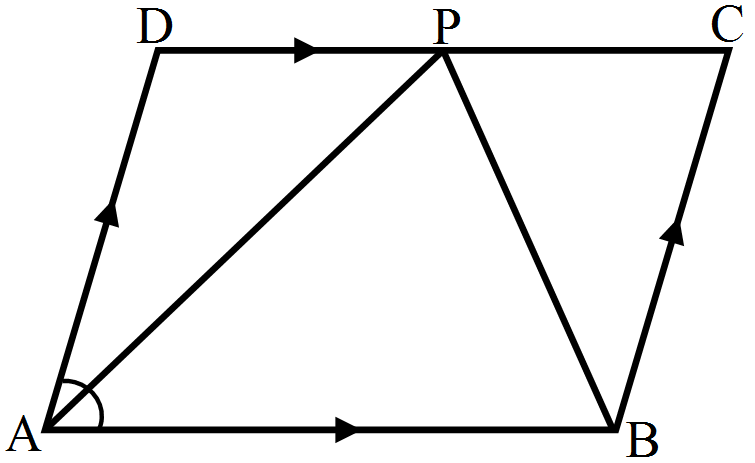
In the adjoining figure, ABCD is a parallelogram in which $\angle\text{A}=60^{\circ}.$ If the bisectors of $\angle\text{A}$ and $\angle\text{B}$ meet DC at P, prove that
  1. $\angle\text{APB}=90^{\circ},$
  2. AD = DP and PB = PC = BC,
  3. DC = 2AD.
​​​​​​​
In figure, ABCD and AEFD are two parallelograms. Prove that:
  1. $\text{PE}=\text{FQ}$
  2. $\text{ar}(\triangle\text{APE}) : \text{ar}(\triangle\text{PFA})\\=\text{ar}(\triangle\text{QFD}): \text{ar}(\triangle\text{PFD})$
  3. $\text{ar}(\triangle\text{PEA})=\text{ar}(\triangle\text{QFD})$
Construct ∆ABC, such that BC = 6 cm, ∠ABC = 100° and AC – AB = 2.5 cm.
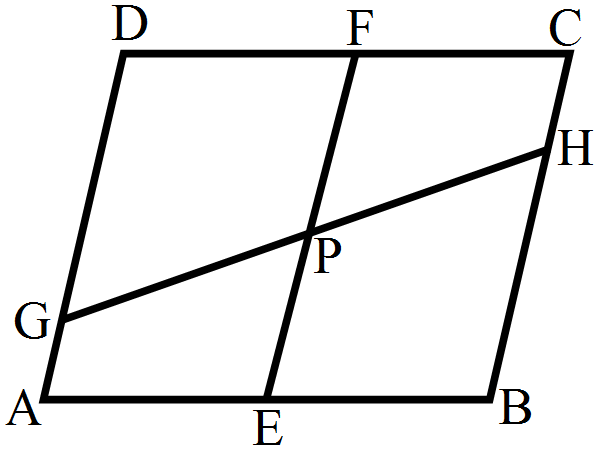
In the adjoining figure, ABCD is a || gm in which E and F are the midpoints of AB and CDrespectively. If GH is a line segment that cuts AD, EF and BC at G, P and H respectively, prove that GP = PH.
Solve.
$A B C D$ is a parallelogram. The ratio of $\angle A$ and $\angle B$ of this parallelogram is $5: 4$. FInd the measure of $\angle B$.
Show that the quadrilateral formed by joining the midpoints of the pairs of adjacent sides of a square is a square.
In a quadrilateral ABCD, show that (AB + BC + CD + DA) > (AC + BD).