Question
Explain Cassegrain telescpoe with the help of figure.

Answer

Image
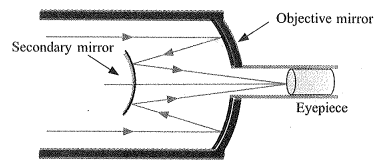
→Figure shows construction of cassegrain telescope. It uses two mirrors. Among them, the concave mirror called the object mirror (main mirror) and the convex mirror is called the secondary mirror.
→An object mirror has a larger focal length and a secondary mirror has a less focal length.
→As shown in figure, rays from a distant object are reflected by the objective mirror and focussed at the principal focus.
→But another small convex mirror is placed in the path of these rays. The rays reflected by this mirror are observed through the eyepiece.

Need a full question paper?

Generate a complete, print-ready paper with questions like this in minutes — across 16+ boards, with answer keys.
Start Generating Free

Similar questions

Write an expression for resistance and resistivity of a conductor in terms of number of free electrons per unit volume and relaxation time.
Arrange the following electromagnetic waves in the order of their increasing wavelength :
a. $\gamma$-rays
b. Microwaves
c. X-rays
d. Radio waves
How are infra-red waves produced? What role does infra-red radiation play in
i. maintaining the Earth's warmth and
ii. physical therapy?
Write the expression for Lorentz magnetic force on a particle of charge 'q' moving with velocity$\overrightarrow{\text{v}}$ in a magnetic field $\overrightarrow{\text{B}}.$ Show that no work is done by this force on the charged particle.
A sample of $\ce{HCl}$ gas is placed in an electric field of $3 \times 10^4 N / C$. The dipole moment of each molecule of $\ce{HCl}$ is $6 \times 10^{-30} C \times m$. What will be the maximum torque acting on the molecule?
A non-ideal battery is connected to a resistor. Is work done by the battery equal to the thermal energy developed in the resistor? Will your answer change if the battery is ideal?
Let $\vec{\text{A}}=3\vec{\text{i}}+4\vec{\text{j}}.$ Write four vector $\overrightarrow{\text{B}}$ such that $\overrightarrow{\text{A}}\neq\overrightarrow{\text{B}}$ but A = B.
Define electric flux. Write its S.I. units. A spherical rubber balloon carries a charge that is uniformly distributed over its surface. As the balloon is blown up and increases in size, how does the total electric flux coming out of the surface change? Give reason.
A nearsighted person cannot clearly see beyond 200cm. Find the power of the lens needed to see objects at large distances.
The de Broglie wavelengths, associated with a proton and a neutron, are found to be equal. Which of the two has a higher value for kinetic energy?
How does the energy stored in a capacitor change if after disconnecting the battery, the plates of a charged capacitor are moved farther?