Question
Explain characteristic X-rays. Calculate minimum wavelength of X-rays emitted from X-ray tube operating at 5 kV.

Answer

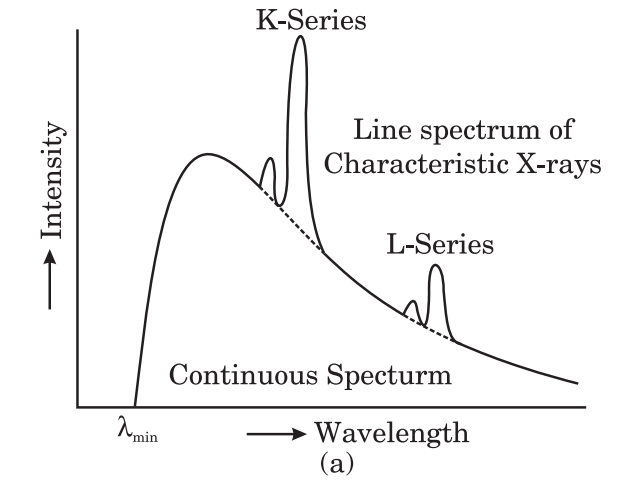
Characteristic X-rays : When the continuous spectrum was examined with Bragg's spectrometer precisely, some sharp peaks were observed in intensity-wavelength curve. The reason for these peaks are some characteristic wavelengths found in continuous spectrum of X-rays and these are the characteristics of the material of the target. The X-rays corresponding to these particular wavelengths are called characteristic X-rays. [Fig. (a)] Most of the elements show in their X-ray spectra two series of lines, known as K-series and L-series. Each series contains a small number of lines designated as $K _\alpha, K _\beta, \ldots \ldots$,$L _\alpha, L _\beta \ldots \ldots .$.The wavelengths of K-series are generally less than 1 Å, while those of L-series are roughly ten times larger. Heavier elements (Z > 66) show further series known as M-, N-, O- series.
Kossel explained the origin of the characteristic X-ray line spectrum on the basis of the shell structure of the atom. An atom is built up of a central positively-charged nucleus with discrete aggregates of electrons, known as K-shell, L-shell, M-shell, N-shell, etc. The maximum number of electrons which the K, L, M, N,......... shells can hold are 2, 8, 18, 32, The electrons in the K-shell are attracted by the positive nucleus with the greatest force, and to eject them from the atom maximum energy is required. Less energy is required to eject an electron from the L-shell, still less from M-shell, and so on.
Image
Now, in an X-ray tube an electron emitted from the cathode strikes the target with a tremendous velocity so that it penetrates well inside the atoms of the target. If it ejects an electron from the K-shell of the atom, a vacancy is created in the K-shell. Immediately an electron from one of the outer shells, say L-shell jumps to the K-shell, emitting an X-ray photon of energy equal to the difference in the binding energies of the electron in the K and L shells. Similarly, if an electron from the M-shell jumps to the K-shell, X-ray photon of higher energy is emitted. The X-ray photons emitted due to the jump of electrons from the L, M, N, ..... shell to the K-shell give $K _\alpha, K _\beta, K _\gamma \ldots \ldots$ lines of the K-series of the spectrum.
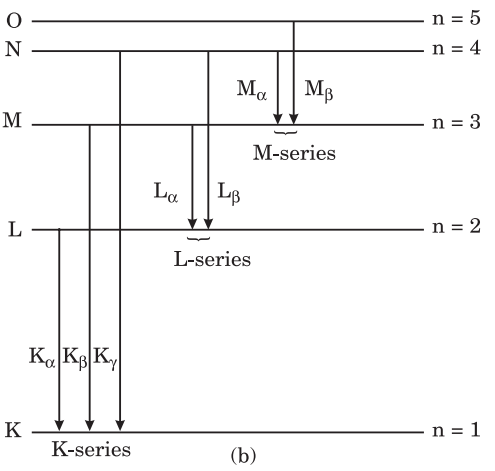
Energy Level Diagram : The formation of spectral series of characteristic X-rays on an energy level diagram is shown in Fig. (b). In X-ray energy levels zero energy level is assigned to the normal state of the atom.
Image
If one of the most firmly bound electrons of the K-shell is removed, the atom is said to be in K-level. An electron from any one of the outer levels L, M, N,...... then falls into the K-level with the emission of a K-series line. Similarly, the formation of other series lines can be explained.
First, second, third, line of each series is assigned the subscript $\alpha, \beta, \gamma, \ldots \ldots$. respectively [Fig. (b)].
Solution of Numerical : Minimum Wavelength of X-ray :
$\lambda_{\min }=\frac{h c}{e V}=\left[\frac{\left(6.6 \times 10^{-34}\right)\left(3 \times 10^8\right)}{\left(1.6 \times 10^{-19}\right)\left(5 \times 10^3\right)}\right] m$
$=2.475 \times 10^{-10} m$ = 2.475 Å

Need a full question paper?

Generate a complete, print-ready paper with questions like this in minutes — across 16+ boards, with answer keys.

Start Generating Free

Similar questions

A charge Q is placed at the centre of an uncharged, hollow metallic sphere of radius a:
  1. Find the surface charge density on the inner surface and on the outer surface.
  2. If a charge q is put on the sphere, what would be the surface charge densities on the inner and the outer surfaces?
  3. Find the electric field inside the sphere at a distance x from the centre in the situations (a) and (b).
Figure, shows water in a container having $2.0\ mm$ thick walls made of a material of thermal conductivity $0.50\text{Wm}^{-1}{^{\circ}}\text{C}^{-1}.$ The container is kept in a melting$-$ice bath at $0^\circ C.$ The total surface area in contact with water is $0.05m^2.$ A wheel is clamped inside the water and is coupled to a block of mass $M$ as shown in the figure. As the block goes down, the wheel rotates. It is found that after some time a steady state is reached in which the block goes down with a constant speed of $10\ cms^{-1}$ and the temperature of the water remains constant at $1.0^\circ C.$ Find the mass $M$ of the block. Assume that the heat flows out of the water only through the walls in contact. Take $g = 10\ ms^{-2}.$
Figure. shows two vessels $A$ and $B$ with rigid walls containing ideal gases. The pressure, temperature and the volume are $p_A, T_A, V$ in the vessel $A$ and $p_B, T_B, V$ in the vessel $B$. The vessels are now connected through a small tube. Show that the pressure $p$ and the temperature $T$ satisfy $\frac{\text{p}}{\text{T}}=\frac{1}{2}\Big(\frac{\text{P}_\text{A}}{\text{T}_\text{A}}+\frac{\text{p}_\text{B}}{\text{T}_\text{B}}\Big)$ when equilibrium is achieved.
The electric potential existing m space is V(x, y, z) = A(xy + yz + zx).
  1. Write the dimensional formula of A.
  2. Find the expression for the electric field.
  3. If A is 10 SI units, find the magnitude of the electric field at (1m, 1m, 1m).
Three point charges of $+2\mu\text{C}, -3\mu\text{C}$ and $-3\mu\text{C}$ are kept at the vertices $A, B$ and $C$ respectively of an equilateral triangle of side $20\ cm$ as shown in figure. What should be the sign and magnitude of charge to be placed at the midpoint $M$ of side $BC$ so that charge at $A$ remains in equilibrium?
  1. The magnetic field in a region varies as shown in figure. Calculate the average induced emf in a conducting loop of area $2.0 \times 10^{-3}m^2$ placed perpendicular to the field in each of the $10\ ms$ intervals shown.
  2. In which intervals is the emf not constant? Neglect the behaviour near the ends of $10\ ms$ intervals.
A particle $A$ with a mass $m_A$ is moving with a velocity $v$ and hits a particle $B \ ($mass $m_B)$ at rest $($one dimensional motion$)$. Find the change in the de Broglic wavelength of the particle $A$. Treat the collision as elastic.
Three bulbs, each with a resistance of $180\Omega,$ are connected in parallel to an ideal battery of emf 60V. Find the current delivered by the battery when.
(a) all the bulbs are switched on, (b) two of the bulbs are switched on and (c) only one bulb is switched on.
A load resistor of $2\text{k}\Omega$ is connected in the collector branch of an amplifier circuit using a transistor in common-emitter mode. The current gain $\beta=50.$ The input resistance of the transistor is $0.50\text{k}\Omega.$ If the input current is changed by $50\mu\text{A}.$
  1. By what amount does the output voltage change?
  2. By what amount does the input voltage change?
  3. What is the power gain?
An ac voltage $V = V _{ m } \sin \omega t$ is applied to a series $\text{LCR}$ circuit. Obtain an expression for the current in the circuit and the phase angle between the current and voltage. What is resonance frequency?