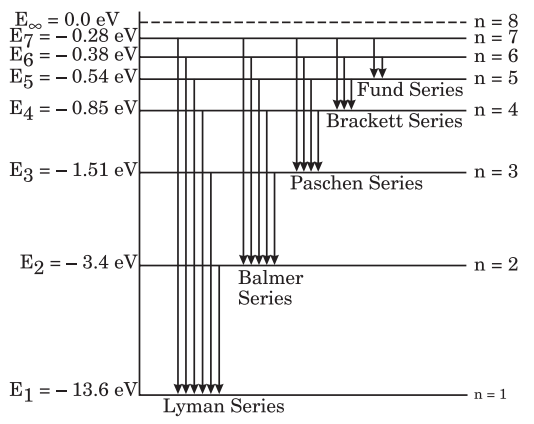
Question 15 MarksExplanation hydrogen spectrum on the basis of Bohr's principle.AnswerExplanation of Hydrogen spectrum on the basis of Bohr's principle:In general the energy of electron in nth orbit of the hydrogen atom is given by: $E _n=-\left(13.6 / n^2\right) eV$.$E_1=-\left(13.6 / 1^2\right) eV =-13.6 eV$$E _2=-\left(13.6 / 2^2\right) eV =-1.51 eV$$E_3=-\left(13.6 / 3^2\right) e V=-0.85 e V$$E _4=-\left(13.6 / 4^2\right) eV =-0.54 eV$$E _5=-\left(13.6 / 5^2\right) eV =-0.37 eV$...................................................................$E_{\infty}=-\left(13.6 / \infty^2\right) e V=0$From these values it is obvious that the electron in hydrogen atom can have only certain discrete values of energy while revolving in different orbits. It is also obvious that the first orbit corresponds to the lowest energy and is called ground state. As $n$ increases, the energy becomes less negative i.e, goes on increasing. When $n$ becomes very large $(n \rightarrow \infty)$ the energy becomes zero. This zero level represents the state of maximum energy. The minimum energy required to remove an electron from n = 1 to n = ∞ is called ionisation energy of H2 atom and it is equal to difference of E1 and $E_{\infty}$ infty i.e., it is 13.6 eV. Zero energy state is called ionisation state of the atom. It is also obvious that with increasing value of $n$ the difference between the energy of different states goes on decreasing.Taking all the above points into account if a diagram is drawn in which the energies of the different orbits (energy states) of H2 atom are represented by parallel horizontal lines with some suitable energy scale, this diagram is called energy level diagram of H2 atom. In this diagram the transitions corresponding to different spectral series of hydrogen atom are also shown.formula :$\frac{1}{\lambda}= R \left(\frac{1}{n_1^2}-\frac{1}{n_2^2}\right)$ ...(1)On the basis of this formula production of all the five spectral series can be explained as follows :(1) Lymann Series : When the electron of hydrogen atom transits from some higher energy level to the first energy level (lowest energy level), (i.e., n1 = 1 and n2 = n = 2 ,3,4,....) then the emitted spectral lines are obtained in the ultraviolet region of the spectrum and make the Lymann series. Hence the wavelength of these lines can be found by the following form of the above equation (1),$\frac{ 1 }{\lambda}= R \left(\frac{ 1 }{ 1 ^2}-\frac{ 1 }{ n ^2}\right), \quad$ where $n=2,3,4, \ldots$Where R is Rydberg's constant and its value is 1.097$\times 10^7 m^{-1}$. Somewhere it is also denoted by RH.The series lies in the ultra-violet. Lymann, in 1916, photographed the lines of this series of hydrogen spectrum. Hence this series is named 'Lymann series'. The longest wavelength of this series (for n = 2 ) is 1216 Å and the shortest wavelength (for n = ∞ ) is 912 Å. The wavelength (912 Å) corresponding to n = ∞ is called the 'series limit'.(2) Balmer Series : Its wavelengths are given by$\frac{1}{\lambda}= R \left(\frac{1}{2^2}-\frac{1}{n^2}\right),(n=3,4,5, \ldots)$ ...(2)The lines of this series were seen and studied for the first time by Balmer in 1885. Hence this series is named as Balmer series. The longest wavelength of this series (for n = 3 ) is 6563 Å and the shortest wavelength (for n = ∞) is 3646 Å.For n = 3 4, 5, 6, ...the spectral lines of Balmer series were termed as $H _\alpha, H _\beta, H _\gamma, H _\delta, \ldots$ and so on.(3) Paschen Series : Its wavelengths are given by$\frac{1}{\lambda}= R \left(\frac{1}{3^2}-\frac{1}{n^2}\right),(n=4,5,6, \ldots$ ...(3)The series lies in the near infrared region.This series was discovered by Paschen. The greatest wavelength of this series is 18751 Å and the shortest is 8107 Å.(4) Brackett Series : Its wavelengths are given by$\frac{1}{\lambda}= R \left(\frac{1}{4^2}-\frac{1}{n^2}\right),(n=5,6,7, \ldots$ ...(4)The series lies in the far infrared region.This series was discovered by Brackett in 1922. The greatest wavelength of this series is 40500 Å and the shortest is 14516 Å.(5) Pfund Series : Its wavelengths are given by$\frac{1}{\lambda}= R \left(\frac{1}{3^2}-\frac{1}{n^2}\right),(n=6,7,8, \ldots)$ ...(5)The series lies in far infrared region.This series was discovered by Pfund is 1924. The largest wavelength of this series is 74000 Å and shortest is 23673 Å.View full question & answer→
Question 25 MarksWhat are X-rays? If a X-ray tube is operated at V volt then prove that the minimum wavelength of X-rays emitted from the tube is given by: $\lambda_{min}=(12375/V)Å$AnswerX-rays : When an high energetic beam of electrons (i.e., beam of fast moving electrons) known as cathode rays strikes a solid target of metal of high atomic weight and high melting point then an invisible high penetrating radiations are produced which affected the photographic plate. In 1815 Roentgen first discovered these radiations he called these radiations as X-rays. These are also called Roentgen rays.Minimum wavelength of X-rays : The emission of continuous spectrum can be explained by the classical theory. When the energetic electrons emitted from the cathode of the X-ray tube strike the target, they are deflected by the strong fields of force of the nuclei of the target atoms. Such electrons, according to classical theory, emit pulses of radiation of all possible wavelengths which form the continuous spectrum. The theory, however, fails to explain the occurrence of the short wavelength limit, which can be explained only by the quantum theory.According to the quantum theory, radiation is emitted (or absorbed) in discrete packets of energy, called 'photons', the energy of each photon being $h v$, where $v$ is the frequency of the radiation and $h$ is 'Planck's constant'. Now, when an electron of charge $e$ emitted from the cathode of X-ray tube is accelerated through the voltage V applied across the tube, it acquires kinetic energy eV. When this electron collides with an atom of the target, it loses most, or whole, of its energy, which is re-emitted as an X-ray photon. It is obvious that $h v$ will be less than eV.Before coming to rest, electron collides with a number of atoms of target resulting in a loss in the energy of emitted photons. Besides, if electron gives its whole energy eV to only one atom in the collision then the photon with the maximum energy $h v_{\max }$ is emitted. Thus, there will be a continuous range of frequencies and the maximum frequency will be $v_{\max }$ in the X-rays emitting from the target. This accounts for the continuous spectrum of X-rays.When the operating voltage of X-ray tube is V volt, n then it will be the accelerating voltage for the electron striking the target. Therefore, the kinetic energy of this electron will be eV. For the most favourable collision in be which the electron loses its whole energy in a single collision to the target atom, the maximum energy $h v_{\max }$ of X-ray photon emitted from target will be equal to eV. Hence $h v_{\max }$ = eV.Hence, the maximum frequency of the X-rays produced by X-ray tube operating by the voltage V is given by :$v_{\max }=\frac{e V}{h}$ ...(1)But we know that wavelength of a photon $\lambda=c / v$.Hence, the wavelength of X-rays corresponding to the maximum frequency vmax will be minimum. Let it be represented by $\lambda_{\min }$.Then $\lambda_{\min }=\frac{c}{v_{\max }}$ ...(2)where $c$ is the velocity of light i.e., of X-ray photon on substituting the value of vmax from equation (1) in equation (2), we get$\lambda_{\min }=\frac{c}{e V / h}$$\Rightarrow \quad \lambda_{\min }=\frac{ h c }{ e V }$ ...(3)But Planck's constant $h=6.6 \times 10^{-34} Js$, speed of light $c=3.0 \times 10^8 m / s$ and charge on electron $e=1.6 \times 10^{-19} C$, Substituting these values in equation (3), we get$\lambda_{\min }=\left[\frac{6.6 \times 10^{-34} \times 3 \times 10^8}{\left(1.6 \times 10^{-19}\right) \times V }\right] m$$=\left(\frac{12375 \times 10^{-10}}{V}\right) m$$\lambda_{\min }=\left(\frac{12375}{V}\right) Å$ (Hence Proved.)View full question & answer→
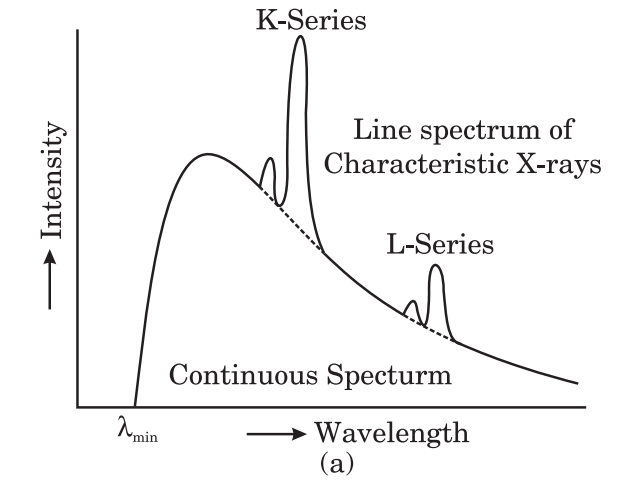
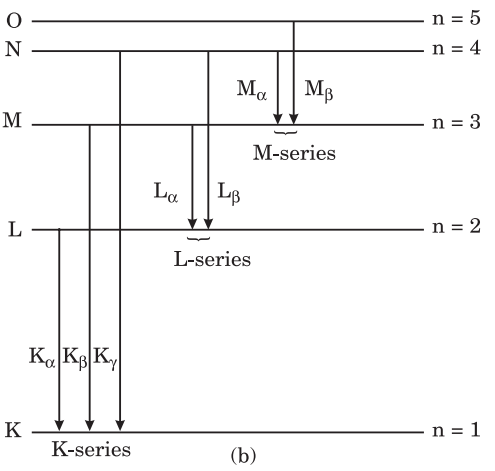
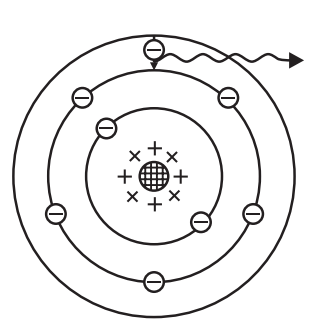
Question 35 MarksExplain characteristic X-rays. Calculate minimum wavelength of X-rays emitted from X-ray tube operating at 5 kV.AnswerCharacteristic X-rays : When the continuous spectrum was examined with Bragg's spectrometer precisely, some sharp peaks were observed in intensity-wavelength curve. The reason for these peaks are some characteristic wavelengths found in continuous spectrum of X-rays and these are the characteristics of the material of the target. The X-rays corresponding to these particular wavelengths are called characteristic X-rays. [Fig. (a)] Most of the elements show in their X-ray spectra two series of lines, known as K-series and L-series. Each series contains a small number of lines designated as $K _\alpha, K _\beta, \ldots \ldots$,$L _\alpha, L _\beta \ldots \ldots .$.The wavelengths of K-series are generally less than 1 Å, while those of L-series are roughly ten times larger. Heavier elements (Z > 66) show further series known as M-, N-, O- series.Kossel explained the origin of the characteristic X-ray line spectrum on the basis of the shell structure of the atom. An atom is built up of a central positively-charged nucleus with discrete aggregates of electrons, known as K-shell, L-shell, M-shell, N-shell, etc. The maximum number of electrons which the K, L, M, N,......... shells can hold are 2, 8, 18, 32, The electrons in the K-shell are attracted by the positive nucleus with the greatest force, and to eject them from the atom maximum energy is required. Less energy is required to eject an electron from the L-shell, still less from M-shell, and so on.Now, in an X-ray tube an electron emitted from the cathode strikes the target with a tremendous velocity so that it penetrates well inside the atoms of the target. If it ejects an electron from the K-shell of the atom, a vacancy is created in the K-shell. Immediately an electron from one of the outer shells, say L-shell jumps to the K-shell, emitting an X-ray photon of energy equal to the difference in the binding energies of the electron in the K and L shells. Similarly, if an electron from the M-shell jumps to the K-shell, X-ray photon of higher energy is emitted. The X-ray photons emitted due to the jump of electrons from the L, M, N, ..... shell to the K-shell give $K _\alpha, K _\beta, K _\gamma \ldots \ldots$ lines of the K-series of the spectrum.Energy Level Diagram : The formation of spectral series of characteristic X-rays on an energy level diagram is shown in Fig. (b). In X-ray energy levels zero energy level is assigned to the normal state of the atom.If one of the most firmly bound electrons of the K-shell is removed, the atom is said to be in K-level. An electron from any one of the outer levels L, M, N,...... then falls into the K-level with the emission of a K-series line. Similarly, the formation of other series lines can be explained.First, second, third, line of each series is assigned the subscript $\alpha, \beta, \gamma, \ldots \ldots$. respectively [Fig. (b)].Solution of Numerical : Minimum Wavelength of X-ray :$\lambda_{\min }=\frac{h c}{e V}=\left[\frac{\left(6.6 \times 10^{-34}\right)\left(3 \times 10^8\right)}{\left(1.6 \times 10^{-19}\right)\left(5 \times 10^3\right)}\right] m$$=2.475 \times 10^{-10} m$ = 2.475 ÅView full question & answer→
Question 45 MarksWrite Bohr's postulates of hydrogen atom.AnswerBohr's Postulates : (i) An atom consists of a very tiny positively charged nucleus. Nearly the entire mass of the atom is concentrated in the nucleus. (ii) The electrons in an atom revolve around the nucleus in certain permitted circular orbits. The electrostatic force of attraction between the electron and the nucleus provides the necessary centripetal force. (iii) An electron can revolve only in those orbits for which its orbital angular momentum is an integral multiple of $\frac{h}{2 \pi}$. Here, h is a universal constant known as Planck's constant $=6.63 \times 10^{-34} Js$If $r$ is the radius of a permitted orbit, $m$ is the mass of the electron and $v$ is the velocity of the electron in that orbit, then$m v r=n\left(\frac{h}{2 \pi}\right)$where $n$ is an integer known as principle quantum number and has integral values 1, 2, 3, ...This relation is regarded as a quantisation condition for the angu-lar momentum of the electron(iv) An electron revolving in a permitted orbit does not radiate energy though it is accelerating. So, the total energy of the electron remains constant. The permitted orbits are called stationary or non-radiating orbits. By introducing the concept of stationery orbit, Bohr could explain the stability of the atomic structure.(v) When an electron jumps from higher orbit to lower orbit, electromagnetic radiation is emitted.On the other hand, there is absorption of energy when an electron jumps from lower orbit to higher orbit. Consider two orbits of principle quantum numbers n1 and n2 Let En1 and En2 be the energies associated with respective orbits. The frequency of the emitted radiation is given by$h \nu= E _{n_2}- E _{n_1}$$\Rightarrow \quad v=\left(\frac{E_{n_2}-E_{n_1}}{h}\right)$It is obvious that emission of energy from a atom takes place only when an electron jumps from higher energy level to any lower level. Hence in the energy emitted by an atom has only some definite frequency waves. If the spectrum of this energy it taken it is obtained as a line spectrum, in which there are many sharp lines.View full question & answer→