Question
Explain clearly, with examples, the distinction between :
(a) magnitude of displacement (sometimes called distance) over an interval of time, and the total length of path covered by a particle over the same interval;
(b) magnitude of average velocity over an interval of time, and the average speed over the same interval.
[Average speed of a particle over an interval of time is defined as the total path length divided by the time interval]. Show in both (a) and (b) that the second quantity is either greater than or equal to the first. When is the quality sign true? [For simplicity, consider one-dimensional motion only].
Answer

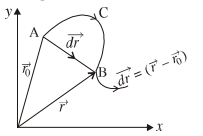
(a) The magnitude of displacement means the total length of the line i.e. the distance between the initial and final points. Suppose a body travels from A to B on a linear path and comes back to A. In this case distance = AB + BA = 2AB but displacement = zero.
 Image
(b) If the time taken for the body to come back to A is t
$\begin{array}{l}\text { mean speed }=\frac{2 AB }{ t } \\ \text { and mean velocity }=\frac{0}{ t }=0\end{array}$
And the magnitude of mean speed is greater than the magnitude of mean velocity.
$\mid$ Mean speed $|>|$ Mean velocity $\mid$
The magnitude of displacement will be maximum when the body moves in a straight line path without changing direction.

Need a full question paper?

Generate a complete, print-ready paper with questions like this in minutes — across 16+ boards, with answer keys.

Start Generating Free

Similar questions

When charcoal is prepared from a living tree, it shows a disintegration rate of 15.3 disintegrations of 14C per gram per minute. A sample from an ancient piece of charcoal shows 14C activity to be 12.3 disintegrations per gram per minute. How old is this sample? Half-life of 14C is 5730y.
Locate the image formed by refraction in the situation shown in figure.

A metre stick is balanced on a knife edge at its centre. When two coins, each of mass 5 g are put one on top of the other at the 12.0 cm mark, the stick is found to be balanced at 45.0 cm. What is the mass of the metre stick?
The earth-moon distance is about 60 earth radius. What will be the diameter of the earth (approximately in degrees) as seen from the moon?
The centre of mass is defined as $\overrightarrow{\text{R}}=\frac{1}{\text{M}}\sum\limits_\text{i}\text{m}_\text{i}\overrightarrow{\text{r}_{\text{i}}}.$ Suppose we define "centre of charge" as $\overrightarrow{\text{R}}_\text{c}=\frac{1}{\text{Q}}\sum\limits_\text{i}\text{q}_\text{i}\overrightarrow{\text{r}_{\text{i}}}$ where qi represents the ith charge placed at $\overrightarrow{\text{r}_\text{i}}$ and Q is the total charge of the system.
  1. Can the centre of charge of a two-charge system be outside the line segment joining the charges?
  2. If all the charges of a system are in X-Y plane, is it necessary that the centre of charge be in X-Y plane?
  3. If all the charges of a system lie in a cube, is it necessary that the centre of charge be in the cube?
A body covers 200cm in the first 2 seconds and 220cm in the next two seconds. What will be its velocity at the end of 7 seconds? Also, find the displacement in 7 seconds?
In a soccer practice session the football is kept at the centre of the field 40 yards from the 10ft high goalposts. A goal is attempted by kicking the football at a speed of 64ft/s at an angle of 45° to the horizontal. Will the ball reach the goal post?
In long jump, does it matter how high you jump? What factors determine the span of the jump?
A moving neutron with speed $10^6 m / s$ collides with a deuteron at rest and sticks to it. Find the speed of the combination if masses of the neutron and deuteron are $1.67 \times 10^{-27} kg$ and $3.34 \times 10^{-27} kg$, respectively.
Consider a sunlike star at a distance of 2 parsecs. When it is seen through a telescope with 100 magnification, what should be the angular size of the star? Sun appears to be $\Big(\frac{1}{2}\Big)^0$ from the earth. Due to atmospheric fluctuations, eye can’t resolve objects smaller than 1 arc minute.