Question types

PART - 1 CH - 2 Motion in a Straight Line question types

122 questions across 9 question groups — pick any mix to generate a Physics paper with step-by-step answer keys.

122
Questions
9
Question groups
5
Question types
Sample Questions

PART - 1 CH - 2 Motion in a Straight Line questions

One sample from each question group in this chapter. Select any group above to see the full set with answer keys.

When a body thrown vertically upward from the earth's surface is at its maximum height, then its :
  • A
    velocity is maximum
  • B
    acceleration is zero
  • C
    acceleration is maximum
  • velocity is zero

Answer: D.

View full solution
When an object covers equal distances in equal time intervals, then its speed is:
  • A
    slow motion
  • B
    accelerated pace
  • C
    uneven motion
  • uneven motion

Answer: D.

View full solution
If the distance covered by an object is directly proportional to time, then we can say that the object :
  • A
    moves with zero velocity
  • B
    moving at a constant speed
  • C
    acceleration is constant
  • has the same velocity

Answer: D.

View full solution
A ball thrown vertically upwards from the earth's surface. After reaching a height, it returns to the earth after some time, then its distance will be ................ and displacement will be ................ .
View full solution
A stone thrown vertically upward from the earth's surface, when the stone
(a) Is moving on its upward path.
(b) If it is moving in downward motion, then in which direction are its velocity and acceleration acting?
View full solution
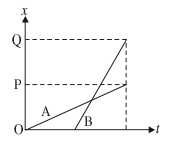
The position-time (x-t) graphs for two children A and B returning from their school O to their homes P and Q respectively are shown in Fig. Choose the correct entries in the brackets below :
(a) (A/B) lives closer to the school than (B/A)
(b) (A/B) starts from the school earlier than (B/A)
(c) (A/B) walks faster than (B/A)
(d) A and B reach home at the (same/different) time
(e) (A/B) overtakes (B/A) on the road (once/twice).
Image
View full solution
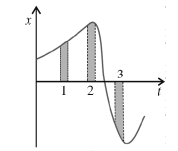
Figure gives the x – t plot of a particle in one dimensional motion. Three different equal intervals of time are shown. In which interval is the average speed greatest, and in which is it the least? Give the sign of average velocity for each interval.
Image
View full solution
If the initial velocity of a particle is $u$ and the acceleration in the same direction changes with time as $\alpha t$, then what will be the velocity at time $t$ ?
View full solution
Position $x$ dependents on time
$
x(t)=8+4 t-t^2
$
where distance is measured in meters and time in second. Find the value of instantaneous velocity of the particle at time $t=2 sec$.
View full solution
Q 263 Marks Question3 Marks
Explain clearly, with examples, the distinction between :
(a) magnitude of displacement (sometimes called distance) over an interval of time, and the total length of path covered by a particle over the same interval;
(b) magnitude of average velocity over an interval of time, and the average speed over the same interval.
[Average speed of a particle over an interval of time is defined as the total path length divided by the time interval]. Show in both (a) and (b) that the second quantity is either greater than or equal to the first. When is the quality sign true? [For simplicity, consider one-dimensional motion only].
View full solution
Q 273 Marks Question3 Marks
A car moving along a straight highway with speed of $126$ $km h ^{-1}$ is brought to a stop within a distance of 200 m. What is the retardation of the car (assumed uniform), and how long does it take for the car to stop?
View full solution
Q 303 Marks Question3 Marks
A police van moving on a highway with a speed of $30$ $km h ^{-1}$ fires a bullet at a thief's car speeding away in the same direction with a speed of $192$ $km h ^{-1}$. If the muzzle speed of the bullet is $150$ $m s ^{-1}$, with what speed does the bullet hit the thief's car?
View full solution
Q 314 Marks Question4 Marks
Read the statement below carefully and state with reasons and examples, if it is true or false.
A particle in one-dimensional motion
(a) with zero speed at an instant may have non-zero acceleration at that instant.
(b) with zero speed may have non-zero velocity.
(c) with constant speed must have zero acceleration.
(d) with positive value of acceleration must be speeding up.
View full solution
Q 324 Marks Question4 Marks
A drunkard walking in a narrow lane takes 5 steps forward and 3 steps backward followed again by 5 steps forward and 3 steps backward, and so on. Each step is 1 m long and requires 1 s. Plot the x - t graph of his motion. Determine graphically and otherwise how long the drunkard takes to fall in a pit 13 m away from the start.
View full solution
Q 334 Marks Question4 Marks
A woman starts from her home at 9.00 am, walks with a speed of $5$ $km h ^{-1}$ on a straight road up to her office 2.5 km away, stays at the office up to 5.00 pm , and return home by an auto with a speed of $25$ $km h ^{-1}$. Choose suitable scales and plot the $x-t$ graph of her motion.
View full solution
Q 344 Marks Question4 Marks
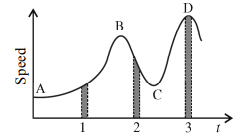
Figure gives a speed-time graph of a particle in motion along a constant direction. Three equal intervals of time are shown. In which interval is the average acceleration greatest in magnitude? In which interval is the average speed greatest? Choosing the positive direction as the constant direction of motion, give the signs of $v$ and a in the three intervals. What are the accelerations at the points A, B, C and D?
 Image
View full solution
(I)(II)
1. Acceleration a = dv/dt =(A) $1: 3$
2. How to find the acceleration of a moving object?(B) In one-dimensional motion when the direction of the body does not change
3. If the mutual graph of two quantities is a straight line, then both the quantities are:(C) By the slope of veloc- ity-time graph
4. The ratio of the distances covered by a freely falling object in its first and second second is(D) Directly Proportional
5. In which position of the body, the value of displacement is equal to the distance travelled by the body?(E)$\tan \theta$
View full solution
(I)(II)
1. For a circular path, if an object moves from A and comes back to A, what will be the value of displacement?(A) displacement
2. When a body moves in a straight line with a constant velocity in the same direction, then what will be the value of acceleration of the body?(B) $\tan \theta$
3. In case of unequal velocity, the displacement and time diagram will have to be made in addition to the straight line.(C) Zero
4. In the velocity-time graph, the area between the curve and the time axis is equal to which quantity of the body?(D) Zero
5 Acceleration a = dv/dt =(E) of any shape
View full solution
A ball is dropped from a height of 90 m on a floor. At each collision with the floor the ball loses one tenth of its speed. Plot the speed-time graph of its motion between t = 0 to 12 s.
View full solution
A player throws a ball upwards with an initial speed of $29.4$ $m s ^{-1}$.
(a) What is the direction of acceleration during the upward motion of the ball?
(b) What are the velocity and acceleration of the ball at the highest point of its motion?
(c) Choose the $x = 0 ~ m$ and $t = 0 ~ s$ to be the location and time of the ball at its highest point, vertically downward direction to be the positive direction of $x$-axis, and give the signs of position, velocity and acceleration of the ball during its upward, and downward motion.
(d) To what height does the ball rise and after how long does the ball return to the player's hands?
(Take $g =9.8 ms^{-2}$ and neglect air resistance.)
View full solution
We have carefully distinguished between average speed and magnitude of average velocity. No such distinction is necessary when we consider instantaneous speed and magnitude of velocity. The instantaneous speed is always equal to the magnitude of instantaneous velocity. Why?
View full solution
A man walks on a straight road from his home to a market 2.5 km away with a speed of 5 km $h ^{-1}$. Finding the market closed, he instantly truns and walks back home with a speed of $7.5$ $km h ^{-1}$. What is the
(a) magnitude of average velocity, and
(b) average speed of the man over the interval of time
(i) 0 to 30 min, (ii) 0 to 50 min, (iii) 0 to 40 min ?
View full solution

Generate a PART - 1 CH - 2 Motion in a Straight Line paper free

Pick question groups from the list above, set marks and difficulty, and export a branded PDF with step-by-step answer keys. First 3 chapters free — no signup.
Download App