Question
$i.$ Explain clearly with examples the distinction between magnitude of displacement over an interval of time and the total length of the path covered by a particle over the same interval.
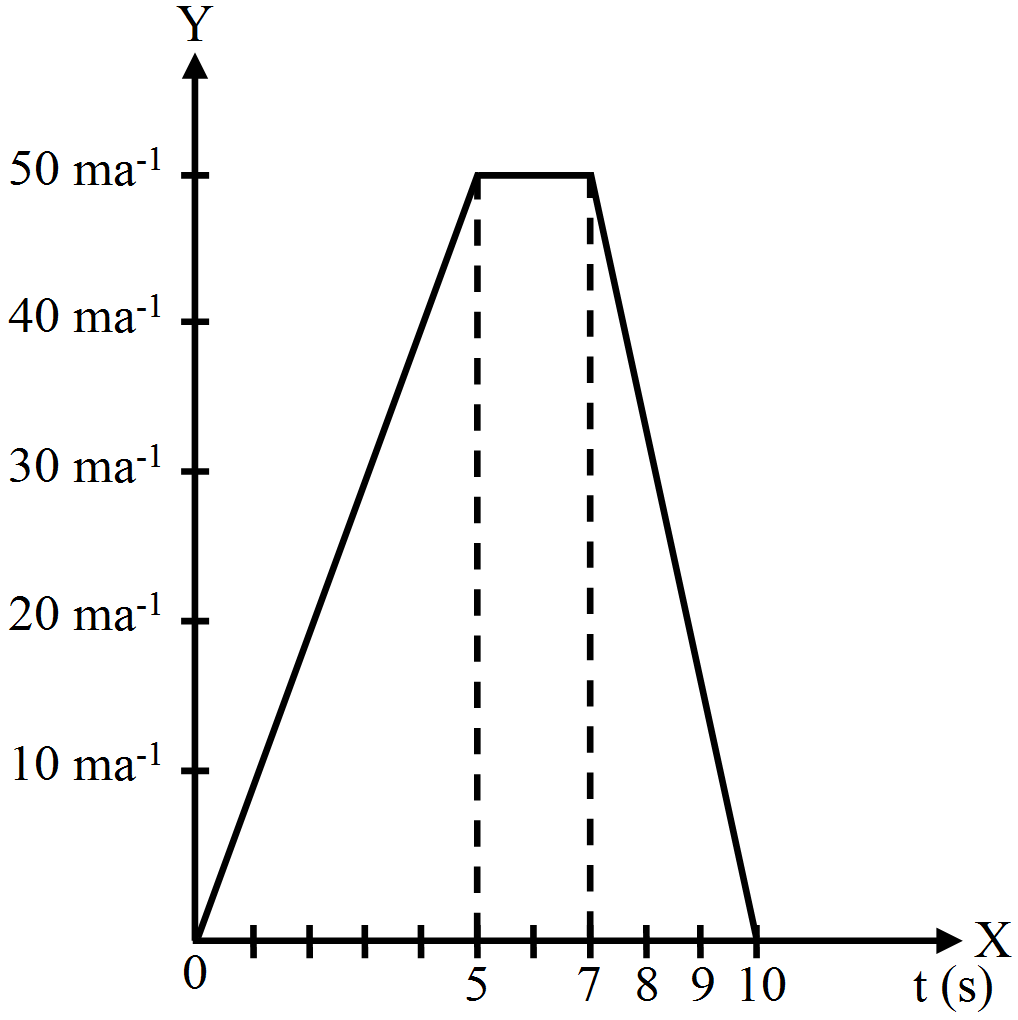
$ii.$ A body starting from rest accelerates uniformly along a straight line at the rate of $10\  ms^{-2}$ for $5 s$ . It moves for $2 s$ with uniform velocity of $50\  ms^{-1}$. Then it retards uniformly and comes to rest in $3 s$ . Draw velocity$-$time graph of the body and find the total distance travelled by it.
Answer

$i.$ Magnitude of displacement of a particle in motion force given time is the shortest distance between the initial and final positions, while total length of path or $($path length$)$ is the length of actual path traversed by the particle in the given time.
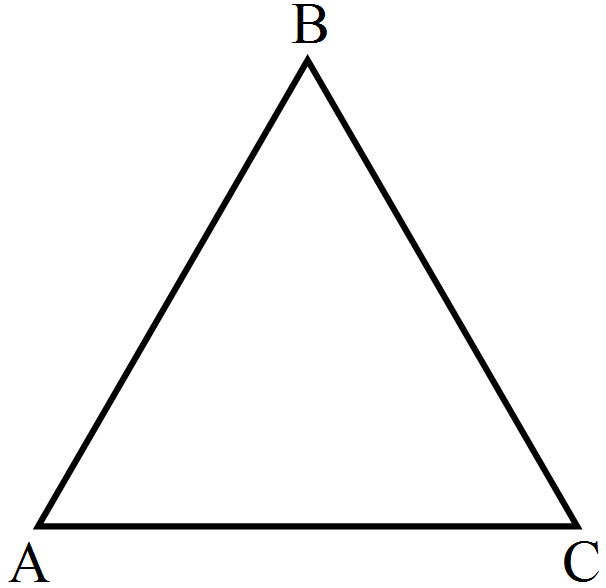
Suppose an object goes from $A$ to $C$ following the path $A B C$, in a certain time $t$
Total length of path $=A B+B C$
When an object goes on the path $A B C$, then the displacement of the object is $(\overrightarrow{A C})$. The arrow head at $A C$ shows that the object is displaced from $A$ to $C$ .
  1. Given: $a = 10ms^{-2}, u = 0$
$t = 5$
$\therefore$ $v = 0 + 10 \times 5$
$v = 50 = ms^{-1}$
Area below $v-t $ graph gives distance travelled in the straight line
$\therefore$ Distance $=\frac{1}{2}(50)\times(10+2)=300\text{m}$

Need a full question paper?

Generate a complete, print-ready paper with questions like this in minutes — across 16+ boards, with answer keys.

Start Generating Free

Similar questions

From a cloud at an angle of 30° to the horizontal, we hear the thunder clap 8 s after seeing the lightening flash. What is the height of the cloud above the ground if the velocity of sound in air is 330m/s?
A body starts accelerating uniformly with a from a velocity ‘u' and travels in a straight line. Prove that it covers a length of $\text{u}+\frac{\text{a}}{2}(2\text{t}-1)$ in the $t^{th}$ second of motion.
A U-tube contains water and methylated spirit separated by mercury. The mercury columns in the two arms are in level with $10.0cm$ of water in one arm and $12.5cm$ of spirit in the other. What is the specific gravity of spirit?
Distinguish clearly between the three modes of heat transmission.
A straight wire of length l can slide on two parallel plastic rails kept in a horizontal plane with a separation d. The coefficient of friction between the wire and the rails is $\mu.$ If the wire carries a current i, what minimum magnetic field should exist in the space in order to slide the wire on the rails?
A capacitor is connected to an alternating-current source. Is there a magnetic field between the plates?
A molecule in a gas container hits a horizontal wall with speed $200ms^{-1}$ and angle 30° with the normal, and rebounds with the same speed. Is momentum conserved in the collision? Is the collision elastic or inelastic?
Calculate the ratio of the angular momentum of the earth about its axis due to its spinning motion to that about the sun due to its orbital motion. Radius of the earth = $6400km$ and radius of the orbit of the earth about the sun = $1.5 \times 10^8km$.
A wire of length 1m and radius 0.1mm has a resistance of $100\Omega.$ Find the resistivity of the material.
A vector $\overrightarrow{\text{A}}$ makes an angle of 20° and $\overrightarrow{\text{B}}$ makes an angle of 110° with the X-axis. The magnitudes of these vectors are 3 m and 4 m respectively. Find the resultant.