Question
Explain colour in coordination compounds.

Answer

→ One of the most distinctive properties of transition metal complexes is their wide range of colours.
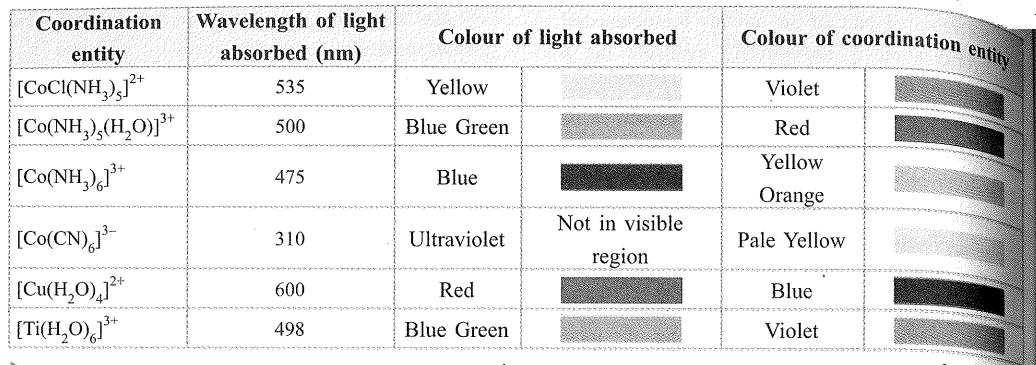
→ This means that some of the visible spectrum is being removed from white light as it passes through the sample, so the light that emerges is no longer white.
→ The colour of the complex is complementary to that which is absorbed.
→ The complementary colour is the colour generated from the wavelength left over; if green light is absorbed by the complex, it appears red.
Relationship between the Wavelength of Light absorbed and the Colour observed in some Coordination Entities
Image
→ The colour in the coordination compounds can be readily explained in terms of the crystal field theory.
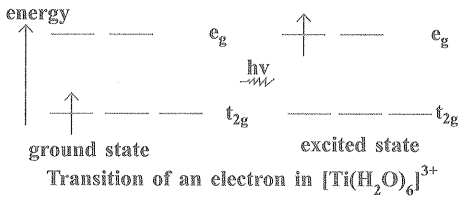
→ Consider, for example, the complex $\left[ Ti \left( H _2 O \right)_6\right]^{3+}$, which is violet in colour.
→ This is an octahedral complex where the single electron $\left( Ti ^{3+}\right.$ is a $3 d^1$ system $)$ in the metal d orbital is in the $t_{2 g}$ level in the ground state of the complex.
→ The next higher state available for the electron is the empty $e _{ g }$ level. If light corresponding to the energy of blue green region is absorbed by the complex, it would excite the electron from $t_{2 g}$ level to the e $e _{ g }$ level $\left( t _{2 g}^1 e _{ g }^{\circ} \rightarrow i _{2g}^{\circ} e _g^1\right)$
→ Consequently, the complex appears violet in colour
Image
→ The crystal field theory attributes the colour of the coordination compounds to d-d transition of the electron.
→ It is important to note that in the absence of ligand, crystal field splitting does not occur and hence, the substance is colourless.
→ For example, removal of water from $\left[ Ti \left( H _2 O \right)_6\right] Cl _3$ on heating renders it colourless.
→ Similarly, anhydrous $CuSO _4$ is white, but $CuSO _4 \cdot 5 H _2 O$ is blue in colour.
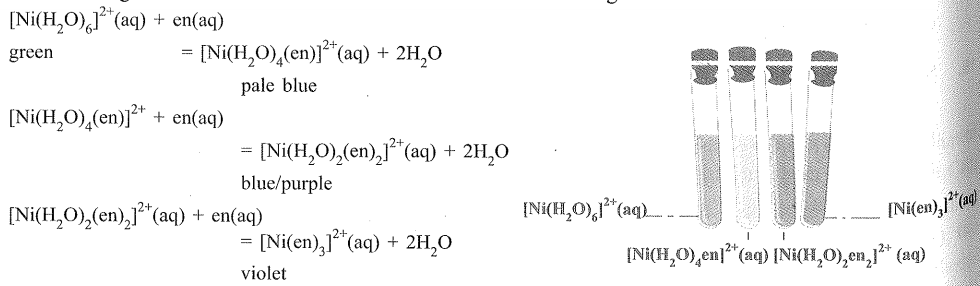
→ The influence of the ligand on the colour of a complex may be illustrated by considering the $\left[ Ni \left( H _2 O \right)_6\right]^{+2}$ complex, which forms when nickel(II) chloride is dissolved in water.
→ If the didentate ligand, ethane-1,2-diamine(en) is progressively added in the molar ratios en:Ni, 1:1, 2:1, 3:1, the following series of reactions and their associated colour changes occur :
Image

Need a full question paper?

Generate a complete, print-ready paper with questions like this in minutes — across 16+ boards, with answer keys.
Start Generating Free

Similar questions

Why Haloarenes are less reactive towards nucleophilic substitution reactions. Give reasons.
Explain the addition of HX and halogens to alkenes.
The mole fraction of helium in a saturated solution at $20^\circ C$ is $1.2 g 10-6.$ Find the pressure of helium above the solution. Given Henry's constant at $20^\circ C$ is $144.97\ k\ bar. (2)$
Write Raoult's Law for Non-Volatile solute and volatile solvent and derive it's formula.
Explain Daniell cell with diagram and explain different condition when external potential is applied in opposite direction.
Write a note on collision theory of chemical reaction. ### What is meant by collision theory? Explain.
Explain magnetic property of coordination compound.
In order to overcome the scarcity of drinking water in a remote village in Gujarat, Arnav and Aariv two young entrepreneurs still in their high school, have developed a unique water purifier that is capable of converting sea water into drinking water. It works on the principle of concentration difference between two solutions.
i. Name the phenomenon/process based on which this product is made? (1)
ii. How difference in concentration of solutions help in converting sea water into drinking water?
iii. What arrangement they must have created in their product to covert sea water into drinking water?
OR
iii. Equimolar solutions of NaCl and glucose are not isotonic. Why?
Read the following text carefully and answer the questions that follow:
The actinoids include the fourteen elements from Th to$ Lr.$ The actinoids are radioactive elements and the earlier members have relatively long half$-$lives, the latter ones have half$-$life values ranging from a day to $3$ minutes for lawrencium. The latter members could be prepared only in nanogram quantities. Actinoids show a greater range of oxidation states. The elements, in the first half of the series frequently exhibit higher oxidation states. The actinoids resemble the lanthanoids in having more compounds in $+3$ state than in the $+4$ state. All the actinoids are believed to have the electronic configuration of $7s^2$ and variable occupancy of the $5f$ and $6d$ subshells. The magnetic properties of the actinoids are more complex than those of the lanthanoids. The variation in the magnetic susceptibility of the actinoids with the number of unpaired $5f$ electrons is roughly parallel to the corresponding results for the lanthanoid.
$i.$ Actinoid contraction is greater from element to element than lanthanoid contraction. Why?
$ii.$ Actinoids show irregularities in their electronic configuration. Justify?
$iii.$ The actinoid metals are all silvery in appearance but display a variety of structures than lanthanoid give reason.
$OR$
$iii.$ The magnetic properties of the actinoids are more complex than those of the lanthanoids. Why?