Question
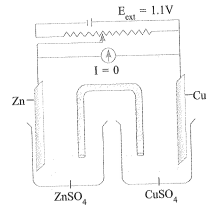
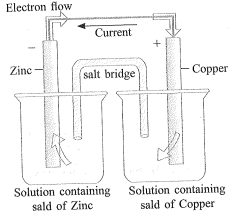
Explain Daniell cell with diagram and explain different condition when external potential is applied in opposite direction.

Answer

→ Daniell cell is a voltaic cell in which chemical energy convert into electrical energy.
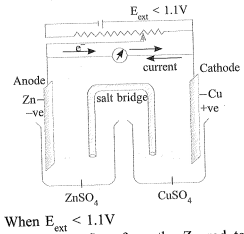
→ In Daniell cell Zn metal rod act as anode and Cu metal rod act as cathode.
Image
→ In Daniell cell the following reaction occurs.
$
Zn ( s )+ Cu ^{+2}( aq ) \rightarrow Zn ^{+2}( aq )+ Cu ( s )
$
→ When concentration for $Cu ^{+2}$ and $Zn ^{+2}$ ion is unit $(1 M )$ then cell potential of this cell is 1.1 V
→ such a device is called galvanic or a voltaic cell.
(1) Condition - a $\left( E _{\text {ext }}<1.1 V\right)$
→ If an external opposite potential is applied and increased slowly, we find that the reaction continues to take place till the opposing voltage reaches the value 1.1V
Image
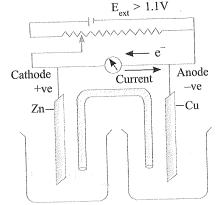
When $E _{ ext }<1.1 V$
(i) Electrons flow from the Zn rod to the Cu rod hence current flows from the Cu to Zn.
(ii) Zinc dissolves at anode and copper deposits at cathode.
(2) Condition - b $($ Eext $=1.1 V)$
→ The reaction stops altogether and no current flows through the cell.
Image
When $E _{\text {ext }}=1.1 V$
(i) No flow of electrons or current
(ii) No chemical reaction observed.
(3) Condition - c (Eext > 1.1V)
→ Any further increase in the external potential again starts the reaction but in the opposite direction.
→The cell now functions as an electrolytic cell, a device for using electrical energy to carry non- spontaneous chemical reactions.
Image
When $E _{ ext }>1.1 V$
(i) Electrons flow from Cu to Zn, and current flows from Zn to Cu.
(ii) Zinc is deposited at the zinc electrode and copper dissolves at copper electrode.

Need a full question paper?

Generate a complete, print-ready paper with questions like this in minutes — across 16+ boards, with answer keys.
Start Generating Free

Similar questions

Vapour pressure of a liquid or a solution is the pressure exerted by the vapour in equilibrium with the liquid or solution at a particular temperature. It depends upon the nature of the liquid and temperature. The non-volatile solute in solution reduces the escaping tendency of the solvent molecules in the vapour phase because some of the solute particles occupy the positions of the solvent molecules on the liquid surface. The relative lowering of the vapour pressure of a solution containing a non$-$volatile solute is equal to the mole fraction of the solute in the solution. This is also known as Raoult's law. However, for solutions of volatile solutes, the vapour pressure of a component in a solution at a given temperature is equal to the mole fraction of that component in the solution multiplied by the vapour pressure of that pure component. The solutions in which each component obeys Raoult's law is called an ideal solution. For ideal solutions $\Delta H_{\text {mixing }}$ and $\Delta V_{\text {mixing }}$ are also zero. Practically no solution is ideal. A non$-$ideal solution is that solution in which solute and solvent molecules interact with one another with a different force than the forces of interaction between the molecules of the pure components. There are two types of non-ideal solutions, showing positive deviations and negative deviations from ideal behaviour. If for the two components$ A$ and $B$ , the forces of interaction between $A$ and $B$ molecules are less than the $A-A$ and $B-B$ interactions, the non-ideal solutions have positive deviations. On the other hand, if the forces of interaction between $A$ and $B$ molecules are more than the $A-A$ and $B-B$ interactions, the non-ideal solutions have negative deviations.
$i.$ What is the mole fraction of A in solution obeying result's low if the vapour pressure of a pure liquid A is $40 \ mm$ of $Hg$ at $300 \ K$ . The vapour pressure of this liquid in solution with liquid $B$ is $32$ mm of $Hg ?$
$ii.$ Vapour pressure of a solution of heptane $\&$ octane is given by the equation: $(1) P ( sol ).( mm Hg )=35+65 x$, where x is the mole fraction of heptane. Calculate the vapour pressure of pure octane.
$iii.$ What is the value of $\Delta V _{\text {mixing }}$ and $\Delta H _{\text {mixing }}$ for non$-$ideal solution showing negative deviation?
OR
$iii.$ Acetic acid $+$ pyridine, the mixture is an example of which type of solution?
Crystal structure of oxides of transition metals often show defects. Given reason. (2)
Explain with chemical equations, various methods for the preparation of benzaldehyde by oxidation of methylbenzene.
Explain stereochemistry of $SN^1$ and $SN^2$ reaction.
The mole fraction of helium in a saturated solution at $20^\circ C$ is $1.2 g 10-6.$ Find the pressure of helium above the solution. Given Henry's constant at $20^\circ C$ is $144.97\ k\ bar. (2)$
Derive integrated rate equation for first order reaction and also explain how than rate constant can be determine with help of graph.
What is rate of a chemical reaction? Explain average and instantaneous rate of reaction with help of graph and also give unit of rate of reaction.
Read the following text carefully and answer the questions that follow:
A raw mango placed in concentrated salt solution loses water via osmosis and shrivel into pickle. Wilted flowers revive when placed in fresh water. A carrot that has become limp because of water loss into the atmosphere can be placed into the water making it firm once again. Water will move into its cells through osmosis. When placed in water containing less than 0.9% (mass/volume) salt, blood cells swell due to flow of water in them by osmosis.
i. People taking a lot of salt or salty food suffer from puffiness or edema. What is the reason behind this?
ii. The preservation of meat by salting and of fruits by adding sugar protects against bacterial action. How?
iii. Why the direction of osmosis gets reversed if a pressure larger than the osmotic pressure is applied to the solution side? Write its one application.
OR
iii.What care is generally taken during intravenous injections and why?
Explain the effect of substituents on the acidity of carboxylic acids.