Question
Explain colour in coordination compounds.

Answer

→ One of the most distinctive properties of transition metal complexes is their wide range of colours.
→ This means that some of the visible spectrum is being removed from white light as it passes through the sample, so the light that emerges is no longer white.
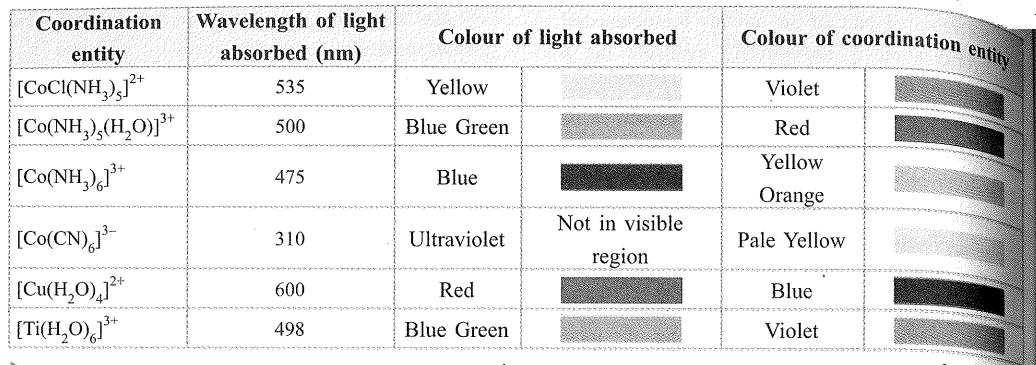
→ The colour of the complex is complementary to that which is absorbed.
→ The complementary colour is the colour generated from the wavelength left over; if green light is absorbed by the complex, it appears red.
Relationship between the Wavelength of Light absorbed and the Colour observed in some Coordination Entities
Image
→ The colour in the coordination compounds can be readily explained in terms of the crystal field theory.
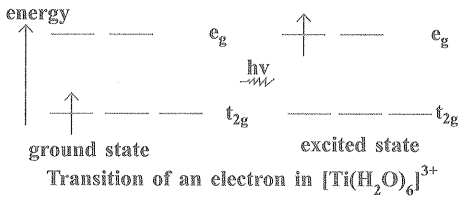
→ Consider, for example, the complex $\left[ Ti \left( H _2 O \right)_6\right]^{3+}$, which is violet in colour.
→ This is an octahedral complex where the single electron $\left( Ti ^{3+}\right.$ is a $3 d^1$ system $)$ in the metal d orbital is in the $t_{2 g}$ level in the ground state of the complex.
→ The next higher state available for the electron is the empty $e _{ g }$ level. If light corresponding to the energy of blue green region is absorbed by the complex, it would excite the electron from $t_{2 g}$ level to the e $e _{ g }$ level $\left( t _{2 g}^1 e _{ g }^{\circ} \rightarrow i _{2g}^{\circ} e _g^1\right)$
→ Consequently, the complex appears violet in colour
Image
→ The crystal field theory attributes the colour of the coordination compounds to d-d transition of the electron.
→ It is important to note that in the absence of ligand, crystal field splitting does not occur and hence, the substance is colourless.
→ For example, removal of water from $\left[ Ti \left( H _2 O \right)_6\right] Cl _3$ on heating renders it colourless.
→ Similarly, anhydrous $CuSO _4$ is white, but $CuSO _4 \cdot 5 H _2 O$ is blue in colour.
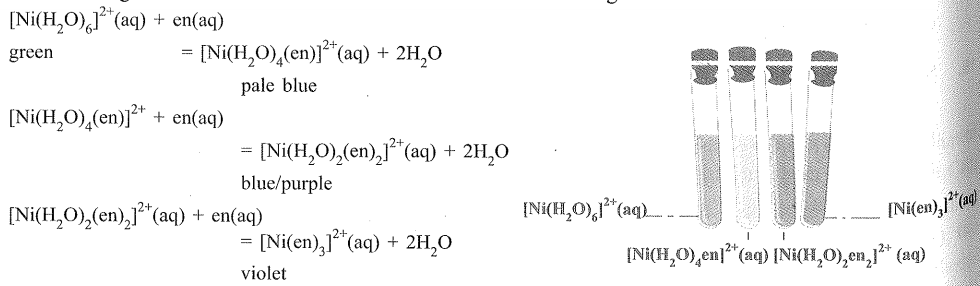
→ The influence of the ligand on the colour of a complex may be illustrated by considering the $\left[ Ni \left( H _2 O \right)_6\right]^{+2}$ complex, which forms when nickel(II) chloride is dissolved in water.
→ If the didentate ligand, ethane-1,2-diamine(en) is progressively added in the molar ratios en:Ni, 1:1, 2:1, 3:1, the following series of reactions and their associated colour changes occur :
Image

Need a full question paper?

Generate a complete, print-ready paper with questions like this in minutes — across 16+ boards, with answer keys.
Start Generating Free

Similar questions

Write the cell reaction and calculate the emf of the following cell at 298 K
$S n _{( s )}\left| S n ^{2+}( 0 . 0 0 4 ~ M ) \| H ^{+}( 0 . 0 2 0 ~ M )\right| H _2( g ) \overline{( 1 )} \mid P t s$ (Given : $ES _{ n }{ }^{2+} / Sn =- 0 . 1 4 V$ )
Give equations for the following reactions :
(i) Oxidation of propan-1-ol with alkaline $KMnO _4$ solution.
(ii) Bromine in presence of $C S _{ 2 }$ with phenol.
(iii) Dilute nitric acid with phenol.
Write the mechanism of hydration of ethene to yield ethanol.
Explain magnetic property of coordination compound.
The colligative properties of electrolytes require a slightly different approach than the one used for the colligative properties of non$-$electrolytes. The electrolytes dissociate into ions in solution. It is the number of solute particles that determines the colligative properties of a solution. The electron solutions, therefore, show abnormal colligative properties. To account for this effect we define a quantity called the van't Hoft factor, given
by
$i=\frac{\text { Actual number of particles in solution a fter dissociation }}{\text { Number of formula units initially dissolved in solution }}$
$i=1 ($for non$-$electrolytes$);$
$i>1 ($for electrolytes, undergoing dissociation$)$
$i<1 ($ for solutes, undergoing association$).$
$i. 0.1 M K _4\left[ Fe ( CN )_6\right]$ is $60 \%$ ionized. What will be its van't Hoff factor?
$ii.$ When a solution of benzoic acid dissolved in benzene such that it undergoes in molecular association and its molar mass approaches $244.$ In which form Benzoic molecules will exist?
$iii.$ How does van't Hoff factor $i$ and degree of association a are related if benzoic acid undergoes dimerisation in benzene solution? $\left( i =1 \frac{-\alpha}{2}\right.$ or $\left.i =1+\alpha\right)(2)$
OR
$iii.$ What do you mean by colligative properties of solutions?
Read the following text carefully and answer the questions that follow$:$
Aariv Sharma is very fond of a special drink made by his grandmother using different fruits available in their hometown. It has an outstanding taste and also provide great health benefits of natural fruits. He thought of utilizing his grandmother recipe to create a new product in the beverage market that provide health benefits and also contain fizziness of various soft drinks available in the market.
i. How he can add fizz to the special drink made by his grandmother? $(1)$
ii. What is the law stated in the chapter that can help Aariv to make his drink fizzy? $(1)$
iii. What precautions he should take while bottling so that his product does not lose fizz during storage and handling across long distances? $(2)$
What is ligand? Explain classification of ligand.
Which mechanisms helps in the transportation of water in a plant?
A solution of glucose in water is labelled as 10% w/w, what would be the molality and mole fraction of each component in the solution? If the density of solution is 1.2 g mL-1, then what shall be the molarity of the solution?
Explain with equations, the nucleophilic addition reaction of aldehydes and ketones with Grignard's reagent (R'-Mg-X).