Discuss the nature of bonding in $\left.[CoF _6\right]^{3-}$ coordination entities on the basis of valence bond theory.
Answer
$\rightarrow$ In $\left[ CoF _6\right]^{3-}$ oxidation state of cobalt is $+3$
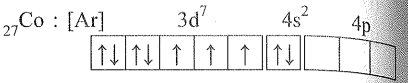
$\rightarrow$ Electronic configuration of cobalt in ground state.
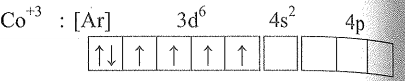
$\rightarrow$ Electronic configuration of cobalt in $+3$ oxidation state.
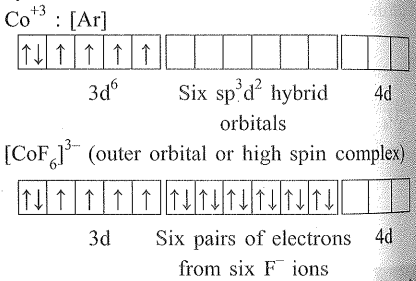
$\rightarrow F^-$^ is weak ligand so $3d$ orbital does not take place in hybridization
$\rightarrow $In this complex $4d$ orbital hybridize. So $sp^3d^2$ hybridization occurs.
$\rightarrow $The paramagnetic octahedral complex, $\left[ CoF _6\right]^{3-}$ uses outer orbital $(4d)$ in hybridization $(sp^3 d^2),$ It is thus called outer orbital or high spin of spin free complex.
Discuss the nature of bonding in $[Co(NH_3)_6]^{3+}$ coordination entities on the basis of valence
bond theory
Answer
$\rightarrow In [Co(NH_3)_6]^{3+}$ ion oxidation number of cobalt is $+3.$
$\rightarrow$ Electronic configuration of cobalt in ground state.
$\rightarrow$ Electronic configuration of cobalt in $+3$ oxidation state.
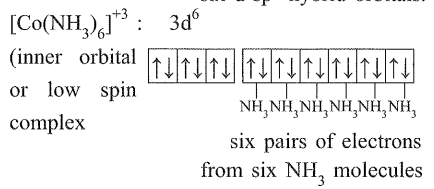
$\rightarrow NH_3$ is strong ligand so electrons get paired in d-orbital and $d^2sp^3$ hybridization occurs.
six $d^2sp^3$ hybrid orbitals
$\rightarrow$ Six pairs of electrons, one from each $NH_3$ molecule, occupy the six hybrid orbitals.
$\rightarrow$ Thus, the complex has octahedral geometry and is diamagnetic because of the absence of unpaired electron.
$\rightarrow$ In the formation of this complex, since the inner d orbital $(3d)$ is used in hybridization, the complex, $\left[ Co \left( NH _3\right)_6\right]^{3+}$ is called an inner orbite or low spin or spin paired complex.
Explain geometrical isomerism in octahedral Complex.
Answer
$\rightarrow$ This type of isomerism arises in heteroleptic complexes due to different possible geometric arrangements of the ligands.
$\rightarrow$ Important examples of these behaviour are found with coordination numbers $4$ and $6.$
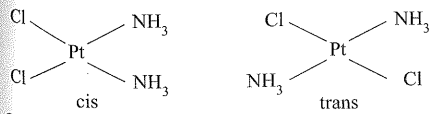
$\rightarrow$ In a square planar complex of formula $\ce{[MX_2L_2]} (X$ and $L$ are unidentate$),$ the two ligands $X$ may be arranged adjacent to each other in a cis isomer, or opposite to each other in a trans isomer.
Geometrical isomers $($cis and trans$)$ of $\ce{Pt[(NH_3)_2Cl_2]}$
$\rightarrow$ Other square planar complex of the type $\text{MABXL} ($where $\text{A, B, X, L}$ are unidentates$)$ shows three isomers$-$two cis and one trans.
$\rightarrow$ Such isomerism is not possible for a tetrahedral geometry.
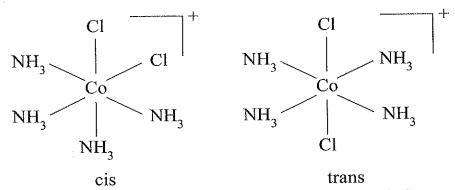
$\rightarrow$ In octahedral complexes of formula $\ce{[MX_2L_4]}$ in which the two ligands $X$ may be oriented cis or trans to each other
Geometrical isomers $($cis and trans$)$ of $\ce{[Co(NH_3)_4Cl_2]^+}$
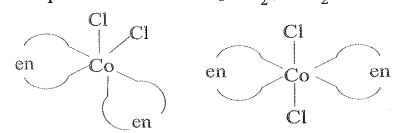
$\rightarrow$ This type of isomerism also arises when didentate ligands $L-L [e.g., en ]$ are present in complexes of formula $\ce{[MX_2(L-L)_2]}$
Geometrical isomers $($cis and trans$)$ of $\ce{[CoCl_2(en)_2]}$
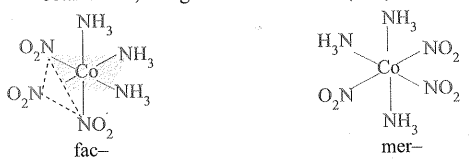
$\rightarrow$ Another type of geometrical isomerism occurs in octahedral coordination entities of the type $\ce{[Co(NH_3)_3(NO_2)_3].}$
$\rightarrow$ If three donor atoms of the same ligands occupy adjacent positions at the corners of an octahedral face, it forms the facial $($fac$)$ isomer.
$\rightarrow$ When the positions are around the meridian of the octahedron, we get the meridional $($mer$)$ isomer.
The facial $($fac$)$ and meridional $($mer$)$ isomers of $\ce{[Co(NH_3)_3(NO_2)_3]}$
$\rightarrow$ "Ligands are atom or ions which donates electron pairs to the central metal ion."
$(OR)$
$\rightarrow $ "The ions or molecules bound to the central atom/ion in the coordination entity are called ligands."
$\rightarrow$ These may be simple ions such as $Cl,$ small molecules such as $H_2O$ or $NH3,$ larger molecules such as $\ce{H_2NCH_2CH_2NH_2or N(CH_2CH_2NH_2)_3}$ or even macromolecules, such as proteins.
Classification of Ligands:
$(1)$ Unidentate ligands:
$\rightarrow$ "When a ligand is bound to a metal ion through a single donor atom, the ligand is said to be unidentate."
Example :
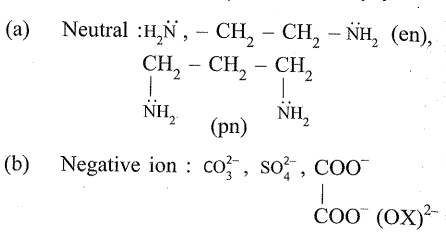
(a) Neutral: $\ce{H _2 \ddot{ O }$, : $NH _3,: CO ,: NO , CH _3 \ddot{N}H_2, C _5 H _5\ddot{N}} \ ($py$)$
(b) Negative ion: $\ce{{-} OH , F ^{-}, Cl ^{-}, Br ^{-}, I^{-} ,{ }^{-} CN , {}^{-}NH_2,}$
$\ce{NO _3^{-}, NO _2^{-}, NCH _3 COO ^{-}\left( AcO ^{-}\right), O ^{2-}, S ^2, N^{3-}}$
$(2)$ Didentate ligands:
$\rightarrow$ "When a ligand is bound to a metal ion through a two donor atom, the ligand is said to be didentate ".
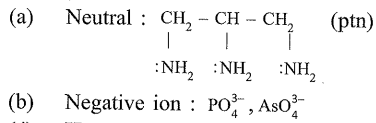
$(3)$ Tridentate ligands:
$\rightarrow$ "When a ligand is bound to a metal ion through a three donor atom, the ligand is said to be Tridentate,"
Example:
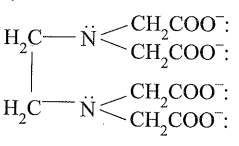
$(4)$ Hexadentate ligands:
$\rightarrow$ When a ligand is bound to a metal ion through a six donor atom, the ligand is said to be hexadendate
Example: Ethylenediaminetetraacetate ion $\left(\text{EDTA} ^{4-}\right)$
Explain magnetic property of coordination compound.
Answer
$\rightarrow$ Metal ions with upto three electrons in the $d$ orbitals, like $\ce{Ti ^{3+}\left( d ^1\right) ; V ^{3+}\left( d ^2\right) ; Cr ^{3+}\left( d ^3\right) ;}$ tuo vacant $d$ orbitals are available for octahed $d^3$ hybridization with $4 s$ and $4 p$ orbitals.
$\rightarrow$ The magnetic behaviour of these free jons and their coordination entities is similar.
$\rightarrow$ When more than three $3d$ electrons are present, the required pair of $3d$ orbitals for octahedral hybridization is not directly available $($as a consequence of Hund's rule$).$
$\rightarrow$ Thus, for $\ce{d ^4\left( Cr ^{2+}, Mn ^{3+}\right), d ^5\left( Mn ^{2+}, Fe ^{3+}\right), d ^6}$
$\ce{\left ( Fe ^{2+}, Co ^{3+}\right)}$ cases, a vacant pair of $d$ orbitals results only by pairing of $3 d$ electrons which leaves two, one and zero unpaired electrons, respectively.
$\rightarrow$ The magnetic data agree with maximum spin pairing in many cases, especially with coordination compounds containing $d^6$ ions.
However, with species containing $d^4$ and $d^5$ ions there are complications.
$\rightarrow \ce{\left[ Mn ( CN )_6\right]^{3-}}$ has magnetic moment of two unpaired electrons while $\ce{\left[ MnCl _6\right]^{3-}}$ has a paramagnetic moment of four unpaired electrons.
$\rightarrow \ce{\left[ Fe ( CN )_6\right]^{3-}}$ has magnetic moment of a single unpaired electron while $\ce{\left[ FeF _6\right]^{3-}}$ has a paramagnetic moment of five unpaired electrons.
$\rightarrow \ce{\left[ CoF _6\right]^{3-}}$ is paramagnetic with four unpaired electrons while $\ce{\left[ Co \left( C _2 O _4\right)_3\right]^{3-}}$ is diamagnetic.
$\rightarrow$ This apparent anomaly is explained by valence bond theory in terms of formation of inner orbital and outer orbital coordination entities.
$\rightarrow \ce{\left[ Mn ( CN )_6\right]^{3-},\left[ Fe ( CN )_6\right]^{3-}}$ and $\ce{\left[ Co \left( C _2 O _4\right)_3\right]^{3-}}$ are inner orbital complexes involving $\ce{d ^2 sp ^3}$ hybridisation, the former two complexes are paramagnetic and the latter diamagnetic.
$\rightarrow$ On the other hand, $\ce{\left[ MnCl _6\right]^{3-},\left[ FeF _6\right]^{3-}}$ and $\ce{\left[ CoF _6\right]^{3-}}$ are outer orbital complexes involving $\ce{sp ^3 d^2}$ hybridisation and are paramagnetic corresponding to four, five and four unpaired electrons.
Explain different types of Structural isomerism with example.
Answer
$(1)$ Linkage Isomerism:
$\rightarrow$ Linkage isomerism arises in a coordination compound containing ambidentate ligand.
$\rightarrow$ A simple example is provided by complexes containing the thiocyanate ligand, $\ce{NCS}^-,$ which may bind through the nitrogen to give $\ce{M-NCS}$ or through sulphur to give $\ce{M-SCN}.$
$\rightarrow$ Jorgenson discovered such behaviour in the complex $\ce{[ Co(NH_3)_5( NO_2)] Cl _2}$, which is obtained as the red form, in which the nitrite ligand is bound through oxygen $\ce{(- ONO)},$ and as the yellow form, in which the nitrite ligand is bound through nitrogen $\ce{(- NO _2)}$.
$\text { e.g. : }\ce{[ Co(ONO)(NH_3)_5]^{2+}}$ and $\ce{[ Co(NO_2)(NH_3)_5]^{2+}}$
$ \text{Red} \quad\text{Yellow}$
$(2)$ Coordination Isomerism:
$rightarrow$ This type of isomerism arises from the interchange of ligands between cationic and anionic entities of different metal ions present in a complex.
e.g. : $\ce{[ Co(NH_3)_6][ Cr( CN )_6]}$, and $\ce{[ Cr( NH_3)_6][Co(CN )_6]}$
$(3)$ Ionisation Isomerism:
$\rightarrow$ This form of isomerism arises when the counter ion in a complex salt is itself a potential ligand and can displace a ligand which can then become the counter ion.
e.g. : $ .. \ce{[Co(NH_3)_5]( SO_4)] Br}$ and $[Cr( NH_3)_5 Br ] SO_4$
$ \ce{{[Pt (NH_3)_4 Cl _2] Br_2}}$ and $\ce{[Pt (NH_3)_4 Br _2] Cl_2 }$
$ \ce{{[Cr(NH_3)_4 Cl _2] NO_2}}$ and $\ce{[Cr( NH_3)_4 Cl.NO_2]Cl }$
$(4)$ Solvate Isomerism $OR$ Hydrate isomerism:
$\rightarrow$ This form of isomerism is known as 'hydrate isomerism' in case where water is involved as a solvent.
$\rightarrow$ This is similar to ionization isomerism.
$\rightarrow$ Three isomeric forms of $\ce{CrCl_3 . 6 H_2O}$ are known
$(1) \ce{[ Cr(H_2O)_6]Cl_3} ($violet$).$
$(2) \ce{[ Cr(H_2O)_5Cl ] Cl_2 \cdot H_2O} ($grey green$).$
$(3) \ce{[ Cr(H_2O)_4Cl_2] Cl \cdot 2 H_2O} ($green$).$