Structure of Atom — Chemistry STD 11 Science — Question
Maharashtra BoardEnglish MediumSTD 11 ScienceChemistryStructure of Atom6 Marks
Question
Explain condensed orbital notation of electronic configuration of an atom.
✓
Answer
The orbital notation of electronic configuration of an element with high atomic number comprises a long train of symbols of orbitals with an increasing order of energy.
It can be condensed by dividing it into two parts: Inner or core part of electronic configuration and outer electronic configuration.
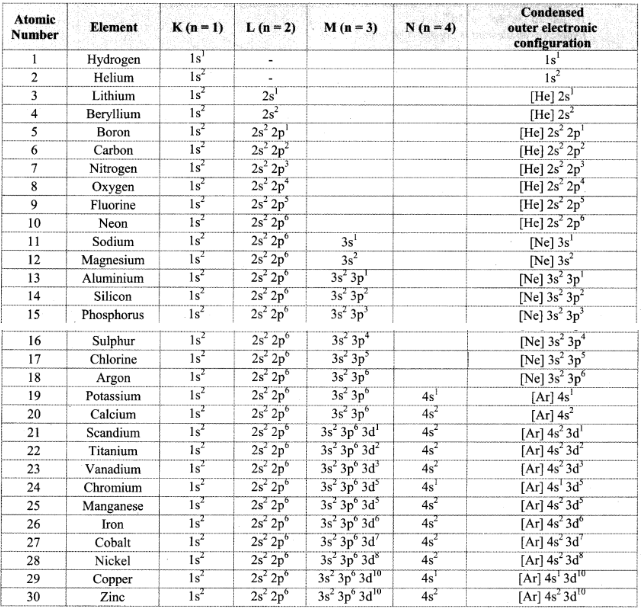
Electronic configuration of the preceding inert gas is a part of the electronic configuration of any element. In the condensed orbital notation, it is implied by writing symbol of that inert gas in a square bracket. It is core part of the electronic configuration of that element. The outer electronic configuration is specific to a particular element and written immediately after the bracket.
For example, the orbital notation of potassium $‘K (Z = 19) \ is \ 1s^2 2s^2 2p^6 3s^2 4s^2$ Its core part is the electronic configuration of the preceding inert gas argon $‘Ar: 1s^2 2s^2 2p^6 3s^2 3p^6, \ while \ ‘4s^1.’$ is an outer part. Therefore, the condensed orbital notation of electronic configuration of potassium is $‘K: [Ar] 4s^2.’$
Note: Electronic configuration of the elements with atomic numbers $1 \ to \ 30$ is as follows:
Need a full question paper?
Generate a complete, print-ready paper with questions like this in minutes — across 16+ boards, with answer keys.