Question
Explain construction and working of a nuclear reactor. State its utility also.

Answer

Nuclear Reactor : It is an example of application of nuclear energy produced during nuclear fission for constructive purposes. A nuclear reactor is a device in which a self sustaining controlled chain reaction is produced in a fissionable material. It is thus a source of controlled enormous energy which is utilised for many useful purposes. It is also called atomic pile.
Construction : The main parts of a nuclear reactor are as follows :
(1) Fuel : The fissionable material used in a reactor is called its fuel. The place in the reactor where it is kept is known as active core of the reactor. The common fuels used are - (a) Natural uranium containing 99% of ${ }^{238} U$ and 0.72% of ${ }^{235} U$, (b) Uranium-235, (c) Plutonium-239, (d) Uranium-233.
The form in which fuel is used in a reactor depends upon various circumstances. In many reactors fuel is used in the form of rods of uranium.
(2) Moderator : Any substance which is used to slow down the fast moving neutrons is called moderator. The commonly used moderators are (a) ordinary water, (b) heavy water, (c) graphite (carbon), and (d) beryllium oxide. Heavy water is the best moderator. It has excellent slowing down property.
(3) Control Rods : These rods are used to control fission process in the reactor. Cadmium and boron are good absorbers of slow neutrons, hence the rods made of these materials are used to control the fission rate. When these rods are pushed into the reactor the fission rate decreases and when they are pulled out the fission rate increases.
(4) Coolant : In the reactor energy is released in the form of heat. This heat has to be removed as fast as it is released by means of some cooling agent which is known as coolant. The various coolants used are air, CO2 gas, He, water, liquid radium etc. Out of these CO2 gas is a good coolant. The coolant is circulated through the interior of the nuclear reactor by a pumping system.
(5) Safety Device : It is a special set of control rods known as shut off rods which drop in automatically in emergency if nuclear reactor runs too fast.
(6) Shield : It is a device used to protect the persons near reactor from various types of harmful radiations emitted during nuclear fission. A 2 m thick wall of cement and concrete constructed around the reactor acts as a shield. In high power reactors another shield close to the interior core is used which is made of iron or steel.
Working : Nuclear reactors are of following two types :
(1) Breeder Reactor : The process in which the absorption of a nucleus by non-fissionable nucleus like ${ }^{238} U$ and the compound nucleus thus formed decaying into a fusible nucleus such as plutonium is called breeding. A device in which such breeding is arranged to take place is called a breeder reactor. In such a device it is so designed that for every fission produced in it at least one neutron is captured by a${ }^{238} U$ nucleus. As a result plutonium 239 is formed as described below. Thus, for every atom of fission material that is burnt atleast one fissionable atom viz., plutonium is formed. Thus, all the natural uranium that we start with in the reactor can be used up as nuclear fuel.
The series of reactions involved is
${ }_{92}^{238} U +n \rightarrow{ }_{92}^{238} U \rightarrow{ }_{93}^{239} Np+\bar{e}+\bar{v}$
${ }_{93}^{239} Np \rightarrow{ }_{93}^{239} Pu +\bar{e}+\bar{v}$
Image
Thus, in this reactor power is produced due to fis-sion by fast neutrons and at the same time it regener-ates more fissionable material than it consumes. Hence the purpose of this type of reactor is to convert a fertile material ${ }^{238} U$ into fissionable material ${ }^{239} Pu$ for use as a fuel in other reactors.
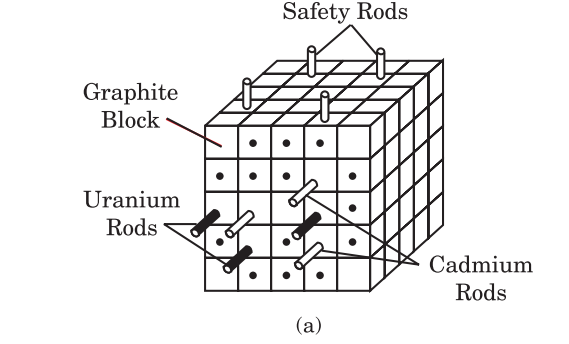
The working of a breeder reactor can be understood by reference to Fig. (a). Rods of uranium are inserted at various places in a block of graphite. To control the neutron density, a number of steel rods coated with boron are inserted into the pile at different points. Boron has a high absorption cross-section for neutrons and hence boron nuclei easily absorb neutrons.
A further safety measure is sometimes employed to avoid any undue increase in neutron density. If the neutron density exceeds a predetermined value a boron trifluoride counter and relay releases a safety rod of boron steel or cadmium which drops under gravity into the pile.
No special supply of neutrons is necessary to start the action in such a graphite moderated reactor.
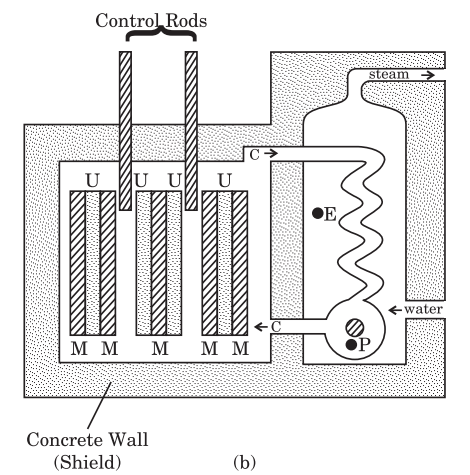
(2) Power Reactor : The primary purpose of a power reactor is the utilisation of the fission energy in useful power. A labelled diagram of this type of reactor is shown in figure (b).
U = Uranium Rods
M = Moderator Rods (Graphite)
P = Coolant (CO2) pump
E = Heat exchanger
C = Coolant (CO2)
Enriched uranium or plutonium in the form of rods is inserted in calculated manner in a huge pile of graphite blocks, so that fast neutrons are slowed down and their speed becomes critical. Control rods of silver alloy with cadmium or boron incorporated in stainless steel are arranged between uranium rods so that they can be raised or lowered. The reactor is provided with a thick concerete wall. Nuclear fission is started by raising the control rods up. The nuclear reaction of fission once started can be controlled by adjusting the position of the rods. Heat produced during fission is carried away by a coolant C pumped rapidly by pump P through the reactor. The coolant, in turn, passing through a heat exchanger E boils water producing steam.
Image
This steam is used to run through steam turbines which are coupled to the electrical generators to produce electricity. The steam after running through the turbine is condensed back to water by cooling in condenser and re-circulated in the heat exchanger for continuous running of the generator.
Applications of Nuclear Reactors : Nuclear reactors are used generally for the following purposes:
(1) Production of 239Pu : Plutonium 239Pu is produced by these reactors. Fast neutrons produced in fission of ${ }^{235} U$ are absorbed by ${ }^{238} U$ and changed it into heavy isotope ${ }_{92}^{239} U$.
${ }_{92}^{238} U +{ }_0^1 n \rightarrow{ }_{92}^{239} U +\gamma$-Energy
${ }^{239} U$ is unstable nuclide and emits $\beta$-particle and changes into heavy element Neptunium
${ }_{92}^{239} U \rightarrow{ }_{93}^{239} Np+{ }_{-1}^0 \beta+\bar{v}$ (Anti-neutrino)
Neptunium emits one $\beta$-particle and changes into plutonium binomial $\left({ }_{93}^{239} Pu \right)$ which is fissionable.
${ }_{93}^{239} Np \rightarrow{ }_{91}^{239} Pu +{ }_{-1}^0 \beta+\bar{\gamma}$
${ }_{94}^{239} Pu$ undergoes fission even with fast neutrons so that there is no need of a moderator in such a reactor.
${ }_{94}^{239} Pu$ is a fissionable material and is used as a fuel in making new reactors. The left over part of the used fuel is highly radioactive and dangerous. To avoid its spreading in atmosphere and water sources it is embedded deep under the earth.
(2) Production of Radio Isotopes : The used fuel of a reactor is highly radioactive because a large number of radio isotopes including ${ }_{94}^{239} Pu$ of radio isotopes including ${ }_{94}^{239} Pu$ are produced in it. India has developed its own facility to treat this used fuel and extract from it ${ }_{94}^{239} Pu$ and other radio isotopes which find wide application in agriculture, medicine, industry and research.
The reactors which are used primarily to supply neutrons for research and radio isotops production are called research reactors.
(3) Production of Neutron Beams : In the fission of ${ }^{235} U$ in reactor fast moving electrons are emitted which can be converted into a fine beam and with the help of the beam artificial disintegration of other elements is studied.
(4) Generation of Energy : The energy released in nuclear reactors is converted into electric energy on large scale at power stations, which is used in industries. Nuclear energy can be used as a fuel on place of coal and petrol for driving the engines and for navigation of ships, submarines and aircrafts.

Need a full question paper?

Generate a complete, print-ready paper with questions like this in minutes — across 16+ boards, with answer keys.
Start Generating Free

Similar questions

A pendulum clock gives correct time at $20^\circ C$ at a place where $g = 9.800\ m s^{-2}$. The pendulum consists of a light steel rod connected to a heavy ball. It is taken to a different place where $g = 9.788\ m s^{-2}$. At what temperature will it give correct time ? Coefficient of linear expansion of steel $= 12 \times 10^{-6^\circ} C^{-1}$.
Two moving coil meters, M1 and M2 have the following particulars:$\begin{array}{l} R _1=10 \Omega, N_1=30 \\
A_1=3.6 \times 10^{-3} m^2, B_1=0.25 T\end{array}$
$\begin{array}{l} R _2=14 \Omega, N_2=42 \\
A_2=1.8 \times 10^{-3} m^2, B_2=0.50 T\end{array}$
(The spring constants are identical for the two meters).
Determine the ratio of (a) current sensitivity and (b) voltage sensitivity of M2 and M1.
A screen is placed 90 cm from an object. The image of the object on the screen is formed by a convex lens at two different locations separated by 20 cm. Determine the focal length of the lens.
What is meant by forward bias and reverse bias of p-n junction diode? Draw experimental electrical circuit diagram to study V-I characteristic in forward bias and reverse bias of p-n junction diode. Draw forward bias and reverse bias V-I characteristic curves of p-n junction diode and briefly explain the following :
(i) Threshold or cut-in voltage
(ii) Breakdown voltage.
Write the definition of electric flux.Obtain the expression for the electric field intensity at any point due to a uniformly charged straight wire of infinite extension using Gauss'law. Draw the necessary diagram.
Seema's uncle was advised by his doctor to have an $\ce{MRI}$ $($Magnetic Resonance Imaging$)$ scan of his brain. Her uncle felt it to be expensive and wanted to postpone it. When Seema learnt about this, she took the help of her family and also approached the doctor, who also offered a substantial discount. She then convinced her uncle to undergo the test to enable the doctor to know the condition of his brain. The information thus obtained greatly helped the doctor to treat him properly.
Based on the above paragraph, answer the following questions:
  1. What according to you are the values displayed by Seema, her family and the doctor?
  2. What could be the possible reason for $\ce{MRI}$ test to be so expensive?
  3. Assuming that $\ce{MRI}$ test was performed using a magnetic field of $0.1 T.$, find the minimum and maximum values of the force that the magnetic field could exert on a proton $($charge $= 1.6 x 10^{-19} C)$ moving with a speed of $10^4 m/s.$
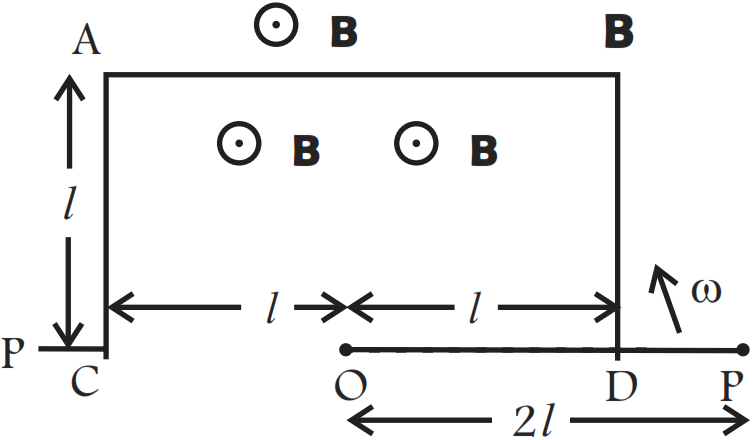
ODBAC is a fixed rectangular conductor of negilible resistance (CO is not connnected) and OP is a conductor which rotates clockwise with an angular velocity $\omega$ (Fig). The entire system is in a uniform magnetic field B whose direction is along the normal to the surface of the rectangular conductor ABDC. The conductor OP is in electric contact with ABDC. The rotating conductor has a resistance of $\lambda$ per unit length. Find the current in the rotating conductor, as it rotates by 180º.
The short-wavelength limit shifts by 26pm when the operating voltage in an X-ray tube is increased to 1.5 times the original value. What was the original value of the operating voltage?
Consider the situation of the previous problem:
  1. Find the tension in the string in equilibrium.
  2. Suppose the ball is slightly pushed aside and released. Find the time period of the small oscillations.
Draw a ray diagram of image formation by a concave mirror and establish the relation between object distance $(u)$, image distance ($v$) and focal length $(f)$.