Questions

5 Marks Questions

Take a timed test

9 questions · self-marked practice — reveal the answer and mark yourself.

Question 15 Marks
Write the nature, properties and difference among $\alpha$-, $\beta$- and $\gamma$-rays.
Answer
Comparative Vision of Properties of $\alpha-, \beta$ - and $\gamma-$ rays
Properties $\alpha$-rays $\beta$-rays $\gamma$-rays
1. Nature Helium
nucleus $\left({ }_2^4 He \right)$
electron $\left({ }_1^0 \beta\right)$
Fast moving Electro-magnetic wave or proton
2. Charge $+3.2 \times 10^{-19}$ coulomb $1.6 \times 10^{-19}$ coulomb Zero
3. Mass $6.62 \times 10^{-27} kg$ $9.1 \times 10^{-31} kg$ Rest mass is zero
4. Velocity (Between $1.4 \times 10^7$ m/sec and $\left.2.2 \times 10^7 m / sec \right)$ $1 \%$ to $99 \%$ of velocity of light $3 \times 10^8 m / sec$ i.e.,elocity of light
5. Ionising power 100 times of $\beta$-rays 100 times of $\gamma$-rays minimum
6. Penetrating power Minimum 100 times of $\alpha$-rays 100 times of $\beta$-rays
7. Effect of electric and magnatic fields Direction of deflection shows the positive charge on these parti-cles (rays). Direction of deflection shows the negative charge on these parti-cles (rays). There is no deflection of these rays.
View full question & answer
Question 25 Marks
Write four properties of $\gamma$-rays. What will be the difference between velocity of $\gamma$-ray of wavelength 0.01 Å and X-ray of wave-length 3 Å.
Answer
Properties of $\gamma$-rays:
(1) $\gamma$-rays are not deflected by electric field and magnetic field which indicates that these are electrically neutral i.e. have no electric charge.
These rays are electromagnetic waves (or photons) like X-rays. The energy of $\gamma$-photons is much higher (in the order of million electron volt). Therefore, their wavelength is very short. For example, the wavelength of $\gamma$-photon of 1 MeV (= 106 eV) energy is :
$\lambda=\frac{12375}{10^6} Å \approx 0.01 Å$
which is $\left(\frac{1}{100}\right)$ of the wavelength of X-rays.
(2) Their velocity is equal to that of light i.e., $3 \times 10^8$ m/sec.
(3) They produce ionisation through gases but their ionisation power is very small in comparison to that of $\alpha-$ and $\beta$-particles.
(4) They produce fluorescence in barium platinocyanide etc.
(5) They are most penetrating. They can pass through 30 cm thickness of iron sheet.
(6) They are diffracted by crystals in the same way as X-rays.
(7) They affect photographic plate more than $\alpha$ - and $\beta$-particles.
(8) Though there is much similarlity between X-rays and $\gamma$-rays , yet their sources of origin are different. X-rays are produced by the transition of electrons in an atom from one energy level to another energy level, that is, it is an atomic property; whereas $\gamma$-rays are produced from the nucleus, and are emitted only after the nucleus ejects either an $\alpha$ - or $\beta$-particles , that is, it is a nuclear property.
(9) $\gamma$-rays exhibit the phenomenon of pair production in which $\gamma$-rays photon striking the nucleus of some atom is completely absorbed by the nucleus and its energy is converted into one electron and one positron. This phenomenon is represented by the following reaction :
$\underset{\text { (Photon) }}{\gamma} \longrightarrow \underset{\text { (Electron) }}{e^{-}}+\quad \underset{\text { (Positron) }}{e^{+}}$
(10) $\gamma$-rays destroy living tissues. This property is used in the treatment of cancer where $\gamma$-rays emitted only from radium are used.
Since $\gamma$-rays and X-rays both are electromagnetic waves having velocity 3 × 10⁸ m/s. Hence there is no difference between velocities of these radiations.

View full question & answer
Question 35 Marks
Explain construction and working of a nuclear reactor. State its utility also.
Answer
Nuclear Reactor : It is an example of application of nuclear energy produced during nuclear fission for constructive purposes. A nuclear reactor is a device in which a self sustaining controlled chain reaction is produced in a fissionable material. It is thus a source of controlled enormous energy which is utilised for many useful purposes. It is also called atomic pile.
Construction : The main parts of a nuclear reactor are as follows :
(1) Fuel : The fissionable material used in a reactor is called its fuel. The place in the reactor where it is kept is known as active core of the reactor. The common fuels used are - (a) Natural uranium containing 99% of ${ }^{238} U$ and 0.72% of ${ }^{235} U$, (b) Uranium-235, (c) Plutonium-239, (d) Uranium-233.
The form in which fuel is used in a reactor depends upon various circumstances. In many reactors fuel is used in the form of rods of uranium.
(2) Moderator : Any substance which is used to slow down the fast moving neutrons is called moderator. The commonly used moderators are (a) ordinary water, (b) heavy water, (c) graphite (carbon), and (d) beryllium oxide. Heavy water is the best moderator. It has excellent slowing down property.
(3) Control Rods : These rods are used to control fission process in the reactor. Cadmium and boron are good absorbers of slow neutrons, hence the rods made of these materials are used to control the fission rate. When these rods are pushed into the reactor the fission rate decreases and when they are pulled out the fission rate increases.
(4) Coolant : In the reactor energy is released in the form of heat. This heat has to be removed as fast as it is released by means of some cooling agent which is known as coolant. The various coolants used are air, CO2 gas, He, water, liquid radium etc. Out of these CO2 gas is a good coolant. The coolant is circulated through the interior of the nuclear reactor by a pumping system.
(5) Safety Device : It is a special set of control rods known as shut off rods which drop in automatically in emergency if nuclear reactor runs too fast.
(6) Shield : It is a device used to protect the persons near reactor from various types of harmful radiations emitted during nuclear fission. A 2 m thick wall of cement and concrete constructed around the reactor acts as a shield. In high power reactors another shield close to the interior core is used which is made of iron or steel.
Working : Nuclear reactors are of following two types :
(1) Breeder Reactor : The process in which the absorption of a nucleus by non-fissionable nucleus like ${ }^{238} U$ and the compound nucleus thus formed decaying into a fusible nucleus such as plutonium is called breeding. A device in which such breeding is arranged to take place is called a breeder reactor. In such a device it is so designed that for every fission produced in it at least one neutron is captured by a${ }^{238} U$ nucleus. As a result plutonium 239 is formed as described below. Thus, for every atom of fission material that is burnt atleast one fissionable atom viz., plutonium is formed. Thus, all the natural uranium that we start with in the reactor can be used up as nuclear fuel.
The series of reactions involved is
${ }_{92}^{238} U +n \rightarrow{ }_{92}^{238} U \rightarrow{ }_{93}^{239} Np+\bar{e}+\bar{v}$
${ }_{93}^{239} Np \rightarrow{ }_{93}^{239} Pu +\bar{e}+\bar{v}$
Image
Thus, in this reactor power is produced due to fis-sion by fast neutrons and at the same time it regener-ates more fissionable material than it consumes. Hence the purpose of this type of reactor is to convert a fertile material ${ }^{238} U$ into fissionable material ${ }^{239} Pu$ for use as a fuel in other reactors.
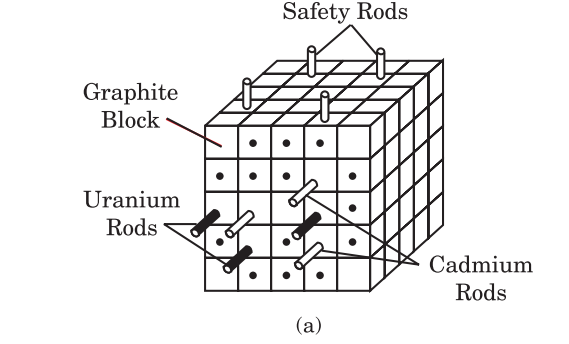
The working of a breeder reactor can be understood by reference to Fig. (a). Rods of uranium are inserted at various places in a block of graphite. To control the neutron density, a number of steel rods coated with boron are inserted into the pile at different points. Boron has a high absorption cross-section for neutrons and hence boron nuclei easily absorb neutrons.
A further safety measure is sometimes employed to avoid any undue increase in neutron density. If the neutron density exceeds a predetermined value a boron trifluoride counter and relay releases a safety rod of boron steel or cadmium which drops under gravity into the pile.
No special supply of neutrons is necessary to start the action in such a graphite moderated reactor.
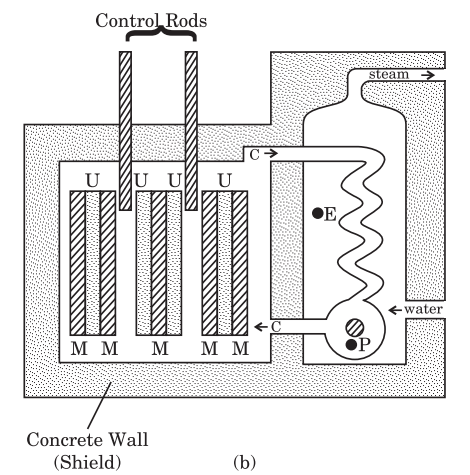
(2) Power Reactor : The primary purpose of a power reactor is the utilisation of the fission energy in useful power. A labelled diagram of this type of reactor is shown in figure (b).
U = Uranium Rods
M = Moderator Rods (Graphite)
P = Coolant (CO2) pump
E = Heat exchanger
C = Coolant (CO2)
Enriched uranium or plutonium in the form of rods is inserted in calculated manner in a huge pile of graphite blocks, so that fast neutrons are slowed down and their speed becomes critical. Control rods of silver alloy with cadmium or boron incorporated in stainless steel are arranged between uranium rods so that they can be raised or lowered. The reactor is provided with a thick concerete wall. Nuclear fission is started by raising the control rods up. The nuclear reaction of fission once started can be controlled by adjusting the position of the rods. Heat produced during fission is carried away by a coolant C pumped rapidly by pump P through the reactor. The coolant, in turn, passing through a heat exchanger E boils water producing steam.
Image
This steam is used to run through steam turbines which are coupled to the electrical generators to produce electricity. The steam after running through the turbine is condensed back to water by cooling in condenser and re-circulated in the heat exchanger for continuous running of the generator.
Applications of Nuclear Reactors : Nuclear reactors are used generally for the following purposes:
(1) Production of 239Pu : Plutonium 239Pu is produced by these reactors. Fast neutrons produced in fission of ${ }^{235} U$ are absorbed by ${ }^{238} U$ and changed it into heavy isotope ${ }_{92}^{239} U$.
${ }_{92}^{238} U +{ }_0^1 n \rightarrow{ }_{92}^{239} U +\gamma$-Energy
${ }^{239} U$ is unstable nuclide and emits $\beta$-particle and changes into heavy element Neptunium
${ }_{92}^{239} U \rightarrow{ }_{93}^{239} Np+{ }_{-1}^0 \beta+\bar{v}$ (Anti-neutrino)
Neptunium emits one $\beta$-particle and changes into plutonium binomial $\left({ }_{93}^{239} Pu \right)$ which is fissionable.
${ }_{93}^{239} Np \rightarrow{ }_{91}^{239} Pu +{ }_{-1}^0 \beta+\bar{\gamma}$
${ }_{94}^{239} Pu$ undergoes fission even with fast neutrons so that there is no need of a moderator in such a reactor.
${ }_{94}^{239} Pu$ is a fissionable material and is used as a fuel in making new reactors. The left over part of the used fuel is highly radioactive and dangerous. To avoid its spreading in atmosphere and water sources it is embedded deep under the earth.
(2) Production of Radio Isotopes : The used fuel of a reactor is highly radioactive because a large number of radio isotopes including ${ }_{94}^{239} Pu$ of radio isotopes including ${ }_{94}^{239} Pu$ are produced in it. India has developed its own facility to treat this used fuel and extract from it ${ }_{94}^{239} Pu$ and other radio isotopes which find wide application in agriculture, medicine, industry and research.
The reactors which are used primarily to supply neutrons for research and radio isotops production are called research reactors.
(3) Production of Neutron Beams : In the fission of ${ }^{235} U$ in reactor fast moving electrons are emitted which can be converted into a fine beam and with the help of the beam artificial disintegration of other elements is studied.
(4) Generation of Energy : The energy released in nuclear reactors is converted into electric energy on large scale at power stations, which is used in industries. Nuclear energy can be used as a fuel on place of coal and petrol for driving the engines and for navigation of ships, submarines and aircrafts.

View full question & answer
Question 45 Marks
What do you mean by chain reaction? What difficulties arise to obtain chain reactions and how are they removed? Explain critical mass in this reference.
Answer
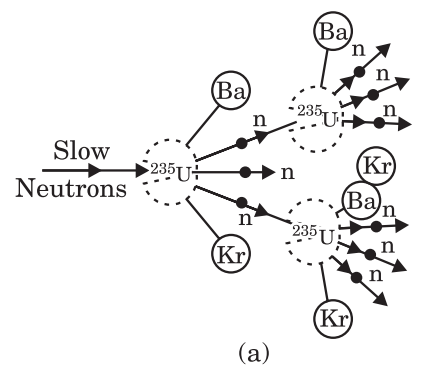
Chain Reaction in Nuclear Fission : When uranium $\left({ }_{92}^{235} U \right)$ is bombarded by slow neutrons nuclear fission takes place in which two fission fragments Barium and Krypton of comparable mass with the emission of energy and three new neutrons are formed. These emitted neutrons in turn break up other nearby $\left({ }_{92}^{235} U \right)$ nuclei under favourable conditions in the same manner causing further emission of energy and more neutrons.
Image
[Fig. (a)] In this way a chain of nuclear fission is sustained until the entire ${ }^{235} U$ is finished.
This self-sustained process is known as Nuclear chain reaction. Nuclear chain reactions are of two types as given ahead :
(i) Uncontrolled Chain Reaction: If more than one of the neutrons emitted in a particular fission cause further fission, then the number of fissions increases rapidly with time. Since a large amount of energy is liberated in each fission, within a very short time the energy takes a tremendous magnitude and is released as a violent explosion. This is what happens in a nuclear bomb. Such a chain reaction is called an "uncontrolled" reaction.
(ii) Controlled Chain Reaction : If, by some means, the reaction is controlled in such a way that only one of the neutrons emitted in a fission causes another fission, then the fission rate remains constant and the energy is released steadily. Such a chain reaction is called controlled chain reaction.
Difficulties in sustaining the nuclear chain reaction and their remedy : There are two main difficulties in sustaining a nuclear chain reaction in natural uranium. The major part in natural uranium is isotope ${ }^{238} U$ while isotope ${ }^{235} U$ has much less percentage in it (0.7%).
The first difficulty is that every neutron entering a uranium nucleus does not produce fission. ${ }^{238} U$ fissioned by only fast neutrons. For this, neutrons of at least one MeV energy are required. Neutrons with energy less than this are absorbed by ${ }^{238} U$ Though these slow neutrons can produce nuclear fission of ${ }^{238} U$ but the probability of their absorption by ${ }^{238} U$ is much more. Therefore, the fresh neutrons emitted in fission of natural uranium being absorbed by ${ }^{238} U$ are not able to sustain chain reaction.
The second difficulty is that if the uranium block to be fissioned is of small size, then most of the emitted neutrons will go out of the block before they can produce nuclear fission in any nucleus. Thus, the nuclear chain reaction cannot be sustained.
Therefore, in order to sustain the nuclear chain reaction the two conditions should be fulfilled: (i) the neutrons emitted during nuclear fission should not be absorbed by ${ }^{238} U$ and (ii) they should not go out of the uranium block to be fissioned.
There are two methods for the remedy of first difficulty as given below :
(i) Separation of ${ }^{235} U$ from Natural Uranium :
In order to prevent the absorption of neutrons by ${ }^{238} U$, the lighter isotope ${ }^{235} U$ is separated from natural uranium by diffusion method. Then the fission of ${ }^{235} U$ is possible by slow and fast neutrons both i.e., by neutrons of any energy. Thus, chain reaction is sustained. But this method is difficult to carry.
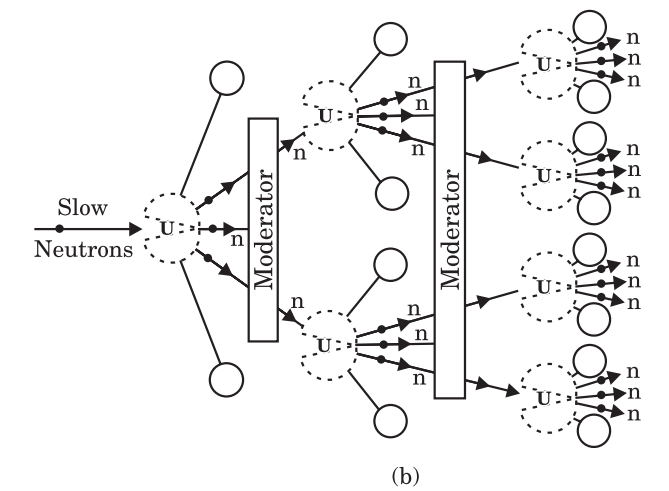
(ii) Use of Moderators: In order to prevent the absorption of neutrons of ${ }^{238} U$ isotope another way is to slow down the emitted neutrons to energy about 0.03 eV. Then the probability of their absorption by ${ }^{238} U$ becomes very low while the probability of producing nuclear fission in ${ }^{235} U$ by them becomes very high. This is done by the use of some material in the path of emitted neutrons which can slow down the speed of neutrons rapidly when they pass through them. Such substances are called moderators. Graphite and heavy water are very good moderators. The working principle of moderator is based on the principle of elastic collision, i.e., when two particles of nearly equal mass collide elastically then their velocity is interchanged. Thus, when a neutron collides with nucleus of hydrogenic substancce like graphite, heavy water etc. then, after the collision, it suffix maximum loss in its kinetic energy i.e. it slow down.
In this way by introducing moderators in the path of emitted neutrons, there nuclear chain reaction can be sustained in natural uranium also [Fig. (b)].
Image
Critical Mass: The secondary neutrons emitted during the fission procces are lost (i) due to leakage from the surface of the system, and (ii) due to absorption by the non-fissionable material present in the system. The leakage of neutrons is found to be considerably reduced, when the fissionable material is of suitable size and shape (spherical). It is found that the average distance, a secondary neutron must travel through the material before it gets slowed down to the point, where it can cause a fission reaction is about 10 cm. Thus, if the size of the given material is less than 10 cm, most of the secondary neutrons will cross the surface of the material and fly away before they get a chance to cause another fission and produce more secondary neutrons. Thus, the chain reaction is not possible, if the size of the fissionable material is too small. The mass of active material capable of sustaining a chain reaction is determined by what is called the reproduction factor. If the rate of neutron production is equal to the rate at which neutrons disappear, the reproduction factor is one and the mass is said to be critical. If we take fissionable material of larger size, then more and more of the secondary neutrons produced in the interior of the material will get a chance to produce another fission by hitting a nucleus before they escape through the surface. The minimum size of a given fissionable material for which the percentage of neutrons giving rise to subsequent fission is high enough to secure a progressive chain reaction is known as the critical size and the corresponding mass is called critical mass.

View full question & answer
Question 55 Marks
Explain principle of Rutherford and Soddy in relation with redioactive decay.
Answer
When a radioactive element emits $\alpha-$ or $\beta-$ particle the original atom of the element called the parent atom changes into a new atom of another element called the daughter atom and the parent atom is said to be disintegrated. Now, if the daughter atom is also radioactive, the process of disintegration continues till a stable element usually lead is obtained. This phenomenon is known as radioactive disintegration and this gives rise to a series of radioactive elements. There are three main series namely uranium, thorium and actinium series.
In 1903 Rutherford and Soddy together made an exhaustive study of radioactive disintegration and summed up their conclusions in the form of two laws as follows:
(1) Soddy's group displacement law : It may be stated in the following two parts :
(i) When an element is disintegrated by the emission of an $\alpha$ - particle $\left({ }_2^4 He \right)$, the daughter element obtained has an atomic mass number less by 4 and atomic number less by 2 and it falls in a group of periodic table two coloumns to the left of the parent element.
In this way if a parent element X of mass number A and atomic number Z emits an $\alpha$ - particle to form a daughter element Y then the disintegration process can be expressed as follows :
${}_{Z}^{A}X \rightarrow {}_{Z-2}^{A-4}Y + {}_{2}^{4}He$ ($\alpha$ - particle)
Image
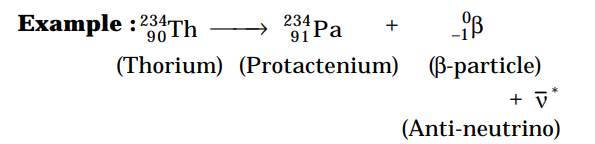
(ii) When an element is disintegrated by the emission of a $\beta$-particle $\left({ }_{-1}^0 \beta\right)$ , the daughter element obtained has an atomic mass number same as that of parent element and atomic number increased by 1 and it falls in a group of periodic table one coloumn to the right.
In this way if a parent element X with mass number A and atomic number Z emits a $\beta$-particle to form a daughter element Y then this disintegration process is expressed as follows :
${}_{Z}^{A}X \rightarrow {}_{Z+1}^{A}Y + {}_{-1}^{0}\beta + \bar{v}$
Image
Although $\gamma$-rays are emitted with the emission of a-particle and $\beta$-particle both, but if only $\gamma$-rays are emitted from some nucleus there is no change in mass number and atomic number of the parent nucleus but it falls in its excited state.
(2) Law of Decay : When a radioactive element disintegrates by emitting $\alpha-$ or β-particles, the number of atoms of the parent element goes on decreasing with passage of time because disintegration occurs spontaneously i.e. it is a continuous process. The continuous decrease in number of atoms of parent element is called radioactive decay. All the atoms of a radioactive element do not disintegrate simultaneously. Which atom will disintegrate first is simply a matter of chance. Thus, the radioactive disintegration process is statistical in nature.
The law of radioactive decay established by Rutherford and Soddy experimentally is stated as follows :
"The rate of disintegration of a radioactive element (i.e., number of atoms disintegrating per second) at any instant is directly proportional to the number of atoms present in the element at that instant."
This law is known as Rutherford-Soddy's law of radioactive decay.
Since radioactive disintegration is a continuous process hence the number of atoms present decreases with time. Therefore, the rate of disintegration decreases with time. According to this law
$\frac{ d N }{ d t }=-\lambda . N$ ...(1)
If N be the number of atoms of a radioactive element present at any given instant $t$ and $d N$, be the number of atoms that disintegrate during the time interval $d t$ (from $t$ to $t+d t)$, and $\lambda$ is called decay constant of radioactive element. The above relation (1) can also be expressed as follows :
$N = N _0 \cdot e^{-\lambda t}$ ...(2)
Or $N = N _0(1 / 2)^n$ ...(3)
where $n$ = number of half-life in time '$t$'.
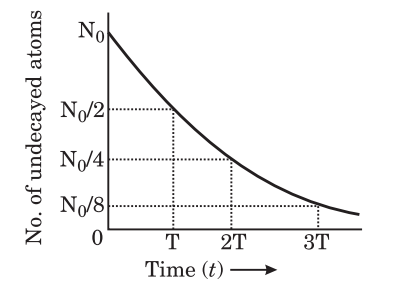
A graph between undecayed atoms and time is shown in the figure given here. The radioactive substance decreases exponentially with time i.e. more rapidly first and slowly afterwards.
Image

View full question & answer
Question 65 Marks
What is radioactivity? State the laws of $\alpha$-rays and $\beta$-rays.
Answer
Radioactivity : In 1896 a French physicist Henri Becquerel while investigating the relationship between X-rays and fluorescence, accidently found that photographic plate wrapped in thick black paper was blackened when a uranium compound was placed near it. Careful investigations showed that this property had no relation with fluorescence of X-rays, but was a property of the element uranium. The photographic plate was affected by some type of radiations emitted by uranium. The emission of these radiations was spontaneous not affected by external agencies like temperature pressure, electric field and magnetic field. These radiations were named Becquerel rays and the phenomenon was named as radioactivity. Hence :
"The phenomenon of spontaneous disinte-gration of heavy nuclei with the emission of certain radiations is called radioactivity and the radiations are called radioactive rays.
The radioactivity found in naturally occurring elements is called natural radioactivity.
Properties of $\alpha$-rays :
(a) $\alpha$-rays Consist of doubly ionised helium atoms.
(b) $\alpha$-rays are deflected by the electric field and magnetic field.
(c) $\alpha$-rays Carry positive charge of $3.2\times10^{-19}C$.
(d) The Velocity of $\alpha$-rays of about 10% the velocity of light speed.
(e) $\alpha$-rays affect the photographic plate.
(f) $\alpha$-rays are absorbed by thin foils. For example, an aluminium foil 0.01 cm thick is sufficient to absorb them. In air at normal pressure they may penetrate up to 3 to 4 cm.
(g) $\alpha$-rays ionise the gas through which they pass. A single $\alpha$-particle can ionise even up to 20000 gas atoms.
(h) $\alpha$-rays fluorescence in zinc sulphide, barium platinocyanide etc.
(i) $\alpha$-rays get scattered by the thin foils.
Properties of $\beta$-rays :
(a) $\beta$-rays consist of electrons.
(b) $\beta$-rays are deflected by the electric field and the magnetic field.
(c) $\beta$-rays Carry negative charge of $1.6\times10^{-19}C$.
(d) $\beta$-rays velocity is upto 90% the velocity of light.
(e) $\beta$-rays affect the photographic plate.
(f) Penetrating power of $\beta$-rays is about 1000 times more than the $\alpha$-particles.
(g) $\beta$-rays can cause ionisation of the gases. But their ionisation power is about 1/100th of the $\alpha$-particles.
(h) $\beta$-rays cause fluorescence in zinc sulphide and other materials.
(i) $\beta$-rays are scattered by the metallic sheet more than the $\alpha$-particles.
(j) Mass of $\beta$-particles depends upon their velocity. If rest mass of $\beta$-particle is $m_0$, and its mass is '$m$' when it is in state of motion with velocity in then according to Einstein theory of relativity :
$m=\frac{m_0}{\sqrt{1-\left(\frac{v^2}{c^2}\right)}}$, where $c=$ velocity of light.

View full question & answer
Question 75 Marks
What is nuclear fusion? How is energy produced in the sun by this process? Explain with necessary equations.
Answer
Nuclear fusion : "The process in which two or more very light nuclei moving at very high speed i.e. possessing very high energy $(\approx 0.1$ MeV) are fused together to form a single nucleus is called nuclear fusion."
In this process mass of the product nucleus is less than the total mass of the nuclei to be fused and the lost mass is converted into energy. The fusion process is, however, not easy to carry out. Since the nuclei to be fused are positively charged, they would repel one another strongly. Hence, they must be brought very close together not only by high pressure but also with high kinetic energy. For this, a temperature of the order of 108 K is required. Such high temperature is available in the Sun and stars. On earth they may be produced by exploding a nuclear fission bomb. Since very high temperature is needed for the fusion of nuclei, the process is called a 'thermonuclear reaction', and the energy released is called 'thermonuclear energy'.
Nuclear fusion of light nuclie as source of Sun's energy : The sun mainly consists of about 90% of hydrogen and helium gases and rest 10% other elements. Hence the fusion of these light nuclei into heavier nuclei is responsible for the energy of the sun i.e., solar energy and that of stars.
The temperature of the interior of the sun is estimated to be about 2 x 10⁷ K. At such a high temperature the molecules dissociate into atoms, and atoms are completely ionised to form a hot plasma. Fusion of hydrogen nuclei into helium nuclei is continuously taking place in this plasma, with continuous liberation of energy.
It is unlikely in the solar conditions that four hydrogen nuclei would fuse together directly to form a helium nucleus. This may take place through a cycle of thermo-nuclear reactions.
Two sets of thermonuclear reactions have been proposed as sources of energy in the sun and other stars. One is called proton-proton chain reaction and the other is carbon cycle. In both reactions enormous energy is liberated.
Carbon cycle : This was proposed by Bethe in 1939. In this cycle of thermonuclear reactions carbon acts as a catalyst and four hydrogen nuclei are fused to form helium nucleus through a series of nuclear reactions as gives below:
${}_{6}^{12}C+{}_{1}^{1}H \rightarrow {}_{7}^{13}N+\gamma$ (energy)...(1)
${}_{7}^{13}N \rightarrow {}_{6}^{13}C + {}_{+1}^{0}\beta + v$ (neutrino)...(2)
${}_{6}^{13}C+{}_{1}^{1}H \rightarrow {}_{7}^{14}N+\gamma$ ...(3)
${}_{7}^{14}N+{}_{1}^{1}H \rightarrow {}_{8}^{15}O+\gamma$ ...(4)
${}_{8}^{15}O \rightarrow {}_{7}^{15}N + {}_{+1}^{0}\beta + v$ ...(5)
${}_{7}^{15}N+{}_{1}^{1}H \rightarrow {}_{6}^{12}C+{}_{2}^{4}He$ ...(6)
On adding all the above reactions the resultant reaction can be represented as follows :
$4 _1^1 H \rightarrow{ }_2^1 H e + 2 \left( + _1^{ 0 } \beta\right)+ 2 v+\gamma$ (energy)
This proposes that in this cycle four hydrogen nuclei are fused into one helium nucleus with the emission of 2 positrons $\left({ }_1^0 \beta\right)$ and 24.7 MeV of energy (in the form of neutrino and $\gamma$-rays). The carbon nucleus ${ }_6^{12} C$ which starts the cycle reappears in the final reaction (6). Here it acts as a catalyst. The emitted positrons combine with two electrons and are annihilated, producing about 2 MeV of energy. Thus, about 26.7 MeV of energy is released for every helium nucleus formed. Enormously large number of such fusions can simultaneously take place in the sun.
Proton-Proton cycle : This cycle is completed in a series of thermonuclear reaction given as below :
${}_{1}^{1}H + {}_{1}^{1}H \rightarrow {}_{1}^{2}H + {}_{+1}^{0}\beta + v$ ...(1)
${}_{1}^{2}H + {}_{1}^{1}H \rightarrow {}_{2}^{3}He + \gamma$ ...(2)
${}_{2}^{3}He + {}_{2}^{3}He \rightarrow {}_{2}^{4}He + 2{}_{1}^{1}H$ ...(3)
On multiplying the above equations (1) and (2) by two and adding the resulting equations with above equation (3), we get
$4{ }_1^1 H \rightarrow{ }_2^4 He +2\left({ }_{+1}^0 \beta\right)+2 \nu+\gamma$ (energy) ...(4)
In this way the first two reactions (1) and (2) must take place twice to complete reaction (3) and it is obvious that the resultant equation of this cycle is the same as that of carbon cycle and approxi-mately the same energy is released per cycle as in carbon cycle.
Generally, the carbon cycle is more efficient at high temperatures, whereas the proton-proton cycle is more efficient at low temperatures. Therefore, probability of occurrence of proton-proton cycle is greater in the sun because its interior temperature is estimated to be 2 x 10⁷ K. The stars hotter than the sun emit their energy known as stellar energy largely through the carbon cycle whereas those cooler than the sun emit major part of their energy through proton-proton cycle.

View full question & answer
Question 85 Marks
(a) What do you mean by mean life time? Establish its relation with half-life time.
(b) One gram of uranium $({}_{92}^{238}U)$ emits $1.24 \times 10^{4}$ $\alpha$-particle per second. Calculate the half-life time of ${}_{92}^{238}U$ (Avogadro's Number $N_{A}=6\times10^{23}$ per gm mole)
(c) What do you mean by activity of radioactive substance?
Answer
(a) Mean life time : Radioactive disintegration is a statistical phenomenon.
Thus, in radioactive disintegration of radioactive element the atom which disintegration in the beginning has a very short life and those which disintegrate at the end have the longest life. "Thus, average life time or mean life time of a radioactive element is defined as the average time for which the atoms of a radioactive element exist."
In this way the average life time of a radioactive element is equal to the average of the lives of all atoms of the radioactive element i.e., it is equal to the sum of the life times of all the atoms divided by the total number of atoms.
Average life time of a radioactive element is denoted by Tau $(\tau)$.
$\therefore \tau=\frac{\begin{array}{c}\text { Sum of ages of all the nuclie } \\ \text { in a radioactive substance }\end{array}}{\text { Total number of nuclie in the substance }}$
Relation between mean life time and half-life time : Let us consider a sample containing N0 radioactive nuclei at time t = 0. The number left Nuclie at time $t$ is $N = N _0 e^{-\lambda t}$. Between the time $t$ and $(t+d t)$, nuclei further decay, where
$d N=\lambda N$.
The life of these $d N$ nuclei is approximately $t$ each.
The sum of the lives of these $d N$ nuclei is $t . d N=t . \lambda N$.
$\therefore \quad$ The sum of all the lives of all the $N _0$ nuclei that were present at $t=0$, will be
$S =\int_0^{\infty} t \lambda N=\int_0^{\infty} t \lambda N_0 e^{-\lambda t}$
$=\lambda N _0 \int_0^{\infty} t e^{-\lambda t}$
$=\lambda N _0\left[t \cdot \frac{e^{-\lambda t}}{(-\lambda)}-\int \frac{e^{-\lambda t}}{(-\lambda)} d t\right]_0^{\infty}$
$=\lambda N _0\left[-\frac{t \cdot e^{-\lambda t}}{\lambda}-\frac{e^{-\lambda t}}{\lambda^2}\right]_0^{\infty}=\frac{ N _0}{\lambda}$
∴ The mean life period of the given radio nuclide
$\tau=\frac{ S }{ N _0}=\frac{ N _0 / \lambda}{ N _0}=\frac{1}{\lambda}$
Thus, mean life period of a radioactive sample is numerically given by reciprocal of its decay constant.
but $\lambda=\frac{0.6931}{T}$, where $T =$ half-life time.
$\therefore \quad \tau=\frac{1}{0.6931 / T }=\left(\frac{1}{0.6931}\right) T \Rightarrow \tau=1.443 T$
(b) According to Avogadro's hypothesis number of atoms in 1 gm mole of ${ }_{92}^{238} U$ i.e., in $238 gm =$ Avogadro's number ' $N _{ A }$ '
∴ Number of atoms in 1 gm of ${ }_{92}^{238} U$ :
$N =\left(\frac{ N _{ A }}{238}\right)=\left(\frac{6 \times 10^{23}}{238}\right)=2.52 \times 10^{21}$
Here rate of disintegration, $R=1.24 \times 10^4$ per second
$\therefore R =\lambda N \Rightarrow$ Decay constant for uranium ${ }_{92}^{238} U$ :
$\lambda=\frac{ R }{ N }=\frac{1.24 \times 10^4 / s }{2.52 \times 10^{21}}=0.492 \times 10^{-17} sec ^{-1}$
Half-life time $: ~ T=\frac{0.6931}{\lambda}$
$=\frac{0.6931}{0.492 \times 10^{-17} s^{-1}}$
$=1.4 \times 10^{17}$ second
Since 1 year $=365 \times 24 \times 60 \times 60$ second
$=3.1536 \times 10^7$ second
$\therefore \quad T =\left(\frac{1.4 \times 10^{17}}{3.1536 \times 10^7}\right)$ years
$=4.439 \times 10^9$ years
(c) Activity of Radioactive Substance : "The activity of a radioactive substance is defined as the rate of disintegration or decay of that substance." It is denoted by R.
Thus, if $d N$ be the number of atoms in a sample of a radioactive substance which disintegrates during a time interval $d t$, then the activity of the sample is given by
$R =-\left(\frac{d N}{d t}\right)$ ...(1)
Here the negative sign indicates that the number of atoms in the sample is decreasing with time.
But according to Rutherford-Soddy law at any instant the rate of disintegration is directly proportional to the number of atoms present in the sample at that instant.
i.e. $-\left(\frac{d N}{d t}\right) \propto N \Rightarrow-\left(\frac{d N}{d t}\right)=\lambda . N$ ...(2)
where N is the number of atoms present in the sample at any instant $t$ and $\lambda$ is the decay constant of the radioactive substance.
∴ From equations (1) and (2), we have
$R =\lambda N$ ...(3)
Thus, the activity of the sample depends upon the number of atoms in the sample i.e. upon the mass of the sample. Activity is different for different radioactive elements.
The formula (3) for the activity of radioactive substance may be expressed in another form as follows:
From Rutherford-Soddy law we know that : $N = N _0 e^{-}$$\lambda t$, where $N _0$ is the number of atoms in the radioactive sample in the beginning i.e., at time $t=0$.
Substituting this value of N in equation (3), we get
$R =\lambda\left( N _0 e^{-\lambda t}\right) \Rightarrow R =\lambda N _0 \cdot e^{-\lambda t}$
But on the basis of the formula (3) we have $\lambda N _0$ as the initial activity of the substance at time $t=0$, which is represented by $R_0$. Therefore we have
$R = R _0 \cdot e^{-\lambda t}$ ...(4)

View full question & answer
Question 95 Marks
(a) Write the uses of isotopes.
(b) How many electrons, protons and neutrons are there in 14 gm of pure ${}_{6}^{14}C$? (Avogadro's Number $N=6.02 \times 10^{23}$ atoms per g mole)
Answer
(a) Uses of isotopes : Radioactive isotope find a variety of applications in nuclear research, biology, medicine, agriculture, archeology and industry as discussed below :
(i) Nuclear Research : In pure nuclear research it provides a sensitive method for the study of nuclear disintegration and the phenomena such as photosynthesis. For instance radioactive carbon finds use in the study of photosynthesis.
(ii) Biology and Medicine : Radioactive isotopes find wide applications as tracers in biological researches and medicine. For the first time RaD used was an isotope of lead as a tracer of lead movements in plants. The circulation of a medicine in human body has been investigated by mixing the medicine with radioactive lead. With the aid of radioactive isotope tracers the rate, place and sequence of formation of the organic constituents of a living body, the permeability of cell walls, the metabolism of phosphorus in human, animal and plant systems, etc., have been investigated.
(iii) Treatment of Diseases : Some radioactive isotopes are found very useful in the treatment of diseases. For example, radioactive iodine is used in the treatment of thyroid gland. Radioactive phosphorus is used in the treatment of skin diseases. Radioactive cobalt and radioactive gold are used in the treatment of cancer.
(iv) Agriculture : Radio isotopes are used in agriculture for studying the function of fertilizers in plants.
(v) In Archeology : All organic matter contains some proportion of ${}^{12}C$ and isotope ${}^{14}C$. In dead organic matter ${}^{14}C$ decays steadily. Hence by studying the carbon $\beta$ activity of the dead organic matter such as wooden implements we can determine the age of the implements (if it lies between 1000 to 300000 years).
(b) Solution of numerical : For carbon atom $({}_{6}^{14}C)$: atomic number $Z=6$ and atomic mass number $A=14.$
Thus in one atom of ${}_{6}^{14}C$ number of electron = number of protons $=Z=6$ and number of neutrons $=A-Z=(14-6)=8.$
But 14 gm is the mass of one gm mole of carbon and in one gm mole number of atoms = Avogadro Number N.
Hence number of electrons and protons in 14 g of pure
${}^{14}C = 6 \times N = 6 \times 6.02 \times 10^{23} = 36.12 \times 10^{23}.$Number of neutrons
$= 8 \times N = 8 \times 6.02 \times 10^{23} = 48.16 \times 10^{23}.$
View full question & answer