Question
Explain construction of the galvanic cell according to Daniell cell and explain electrode potential.
Answer

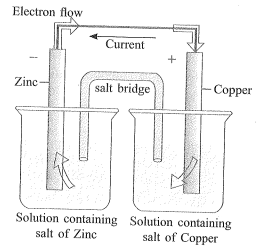
→ We can construct innumerable number of galvanic cells based on the pattern of Daniell cell by taking combination of different half-cells
→ Each half-cell consists of a metallic electrode dipped into an electrolyte. The two half-cells are connected by a mettalic wire through a voltmeter and a switch externally.
→ The electrolytes of the two half-cells are connected internally through a salt bridge as shown in Fig.
Image
→Sometimes, both the electrodes dip in the same elecrtolyte solution and in such cases we don't require a salt bridge.
→At the interface of each electrode and electrolyte, metal ions from the solution tend to deposit on the metal electrode, to make it positively charged.
→ At the same time, metal atoms of the electrode have a tendency to go into the solution as ions leaving behind electrons at the electrode, there by trying to make it negatively charged.
→ At equilibrium, there is a separation of charges occurs, and depending on the tendencies of the two opposing reactions, the electrode may become positively or negatively charged with respect to the solution.
→ A potential difference develops between the electrode and the electrolyte is called as electrode potential.
→ When the concentrations of all the species involved in a half-cell in unity then the electrode potential is known as standard electrode potential.
→ In a galvanic cell, the half-cell in which oxidation takes place is called anode and it hasti a negative potential with respect to the solution.
→ The other half-cell in which reduction takes place is called cathode and it has positive potential with respect to the solution.
→ Thus, there exists a potential difference between the two electrodes and as soon as the switch is in the on position the electrons flow from negative electrode to positive electrode. The direction of current flow is opposite to that of electron flow.

Need a full question paper?

Generate a complete, print-ready paper with questions like this in minutes — across 16+ boards, with answer keys.

Start Generating Free

Similar questions

Explain the nucleophilic substitution reaction of aldehydes and ketones with Grignard reagent (R'-Mg-X) with chemical equations ### Write only chemical reactions to obtain 1º, 2º and 3º alcohols from aldehyde andketone compounds.
A solution Ni(NO3)2 is electrolysed between platinum electrodes a current of 5 amperes for 20 minutes. What mass of Ni is deposited at the cathode?
Consider a certain reaction $A \rightarrow$ Products with $k = 2.0 \times 10^{-2} s^{-1}$. Calculate the concentration of $A$ remaining after $100 s$ if the initial concentration of $A$ is $1.0\ mol\ L^{-1}.$
  1. Write the electronic configuration of the element with atomic number $102$.
  2. What is lanthanoid contraction? What is its effect on the chemistry of the elements which follow the lanthanoids?
Why Haloarenes undergo electrophilic substitution reactions at o and p - position? Why it is less reactive than benzene ?

Match the example given in Column I with the name of the reaction in Column II.
  Column I (Example)   Column II (Reaction)
(i) $\ \ \ \ \ \ \ \ \ \ \ \ \ \text{O}\ \ \ \ \ \ \ \ \ \ \ \ \ \ \ \ \ \ \ \ \ \ \ \ \ \ \ \ \ \ \ \ \ \ \ \ \ \ \ \ \ \ \ \ \ \ \ \ \ \ \ \text{O}\\ \ \ \ \ \ \ \ \ \ \ \ \ \ || \ \ \ \ \ \ \ \ \ \ \ \ \ \ \ \ \ \ \ \ \ \ \ \ \ \ \ \ \ \ \ \ \ \ \ \ \ \ \ \ \ \ \ \ \ \ \ \ \ \ \ \ ||\\\text{CH}_3-\text{C}-\text{Cl}+\text{H}_2\xrightarrow{\text{Pd-C/BaSO}_4}\text{CH}_3-\text{C}-\text{H}$ (a) Friedel Crafts acylation
(ii) (b) HVZ reaction
(iii) (c) Aldol condensation
(iv) $\text{R}-\text{CH}_2-\text{COOH}\xrightarrow{\text{Br}_2/\text{Red}\ \text{P}}\text{R}-\text{CH}-\text{COOH}\\ \ \ \ \ \ \ \ \ \ \ \ \ \ \ \ \ \ \ \ \ \ \ \ \ \ \ \ \ \ \ \ \ \ \ \ \ \ \ \ \ \ \ \ \ \ \ \ \ \ \ \ \ \ \ \ \ \ \ \ \ \ \ \ \ \ \ \ |\\\ \ \ \ \ \ \ \ \ \ \ \ \ \ \ \ \ \ \ \ \ \ \ \ \ \ \ \ \ \ \ \ \ \ \ \ \ \ \ \ \ \ \ \ \ \ \ \ \ \ \ \ \ \ \ \ \ \ \ \ \ \ \ \ \ \ ^\text{Br}$ (d) Cannizaro’s reaction
(v) $\text{CH}_3-\text{CN}\xrightarrow[\text{(ii)}\ \text{H}_2\text{O}/\text{H}^+]{\text{(i)}\ \text{SnCl}_2/\ \text{HCl}}\text{CH}_3\text{CHO}$ (e) Rosenmund’s reduction
(vi) $2\text{CH}_3\text{CHO}\xrightarrow{\text{NaOH}}\text{CH}_3-\text{CH}=\text{CH}=\text{CHCHO}$ (f) Stephen’s reaction
Write the Nernst equation and emf of the following cells at $298\ K:$
$Mg(s) | Mg^{2+}(0.001M) || Cu^{2+}(0.0001 M) | Cu(s)$
Give the required equation for following conversions:
(i) Acetophenone to Benzoic acid
(ii) Propionic acid to Acetic acid.
Observe the graph in diagram and answer the following questions.
  1. If slope is equal to $-2.0 \times 10^{-6} \sec^{-1} ,$ what will be the value of rate constant?
  2. How does the half$-$life of zero order reaction relate to its rate constant?
Give the mechanism for the formation of ethanol from ethene.