Question 13 Marks
Short Note on dry cell ### Explain Leclanche cell.
Answer
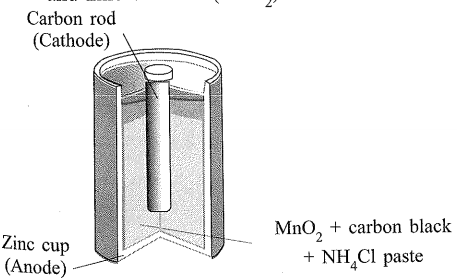
View full question & answer→→ The cell consists of a zinc container that also acts as anode, while the cathode is a carbon (graphite) rod surrounded by powered manganese dioxide and carbon.
→ The space between the electrodes is filled with a moist of paste of ammonium chloride $\left( NH _4 Cl \right)$ and zinc chloride $\left( ZnCl _2\right)$
→ Dry cells are often used in devices like transistors, toys and clocks.
→ The electrode reactions are complex, by they can be written approximately as follows :
Anode $: Zn ( s ) \rightarrow Zn ^{2+}+2 e ^{-}$
Cathode : $MnO _2+ NH _4^{+}+ e ^{-} \rightarrow MnO ( OH )+ NH _3$
→ In the reaction at cathode, manganese is reduced from the +4 oxidation state to the +3 state.
→ Ammonia produced in the reaction forms a complex with $Zn ^{+2}$ to give $\left[ Zn \left( NH _3\right)_4\right]^{+2}$. The cell has a potential of nearly 1.5 V .
→ The space between the electrodes is filled with a moist of paste of ammonium chloride $\left( NH _4 Cl \right)$ and zinc chloride $\left( ZnCl _2\right)$
→ Dry cells are often used in devices like transistors, toys and clocks.
→ The electrode reactions are complex, by they can be written approximately as follows :
Anode $: Zn ( s ) \rightarrow Zn ^{2+}+2 e ^{-}$
Cathode : $MnO _2+ NH _4^{+}+ e ^{-} \rightarrow MnO ( OH )+ NH _3$
→ In the reaction at cathode, manganese is reduced from the +4 oxidation state to the +3 state.
→ Ammonia produced in the reaction forms a complex with $Zn ^{+2}$ to give $\left[ Zn \left( NH _3\right)_4\right]^{+2}$. The cell has a potential of nearly 1.5 V .