Question
Explain convergent and divergent evolution with the help of one example of each.

Answer

Convergent - Different structures evolving in the same direction in different organisms eg. wings of butterfly and of birds/eye of octopus and of mammals/the flippers of penguins and dolphins/sweet potato and potato.
Divergent - Same structure evolving in different directions in different organisms eg. forelimbs of whales, bats, cheetah and humans/vertebrate hearts or brains/thorns of Bougainvillea and tendrils of cucurbita.

Need a full question paper?

Generate a complete, print-ready paper with questions like this in minutes — across 16+ boards, with answer keys.
Start Generating Free

Similar questions

Explain the process of pollination in Vallisneria. How is it different in water-lily, which is also an aquatic plant?
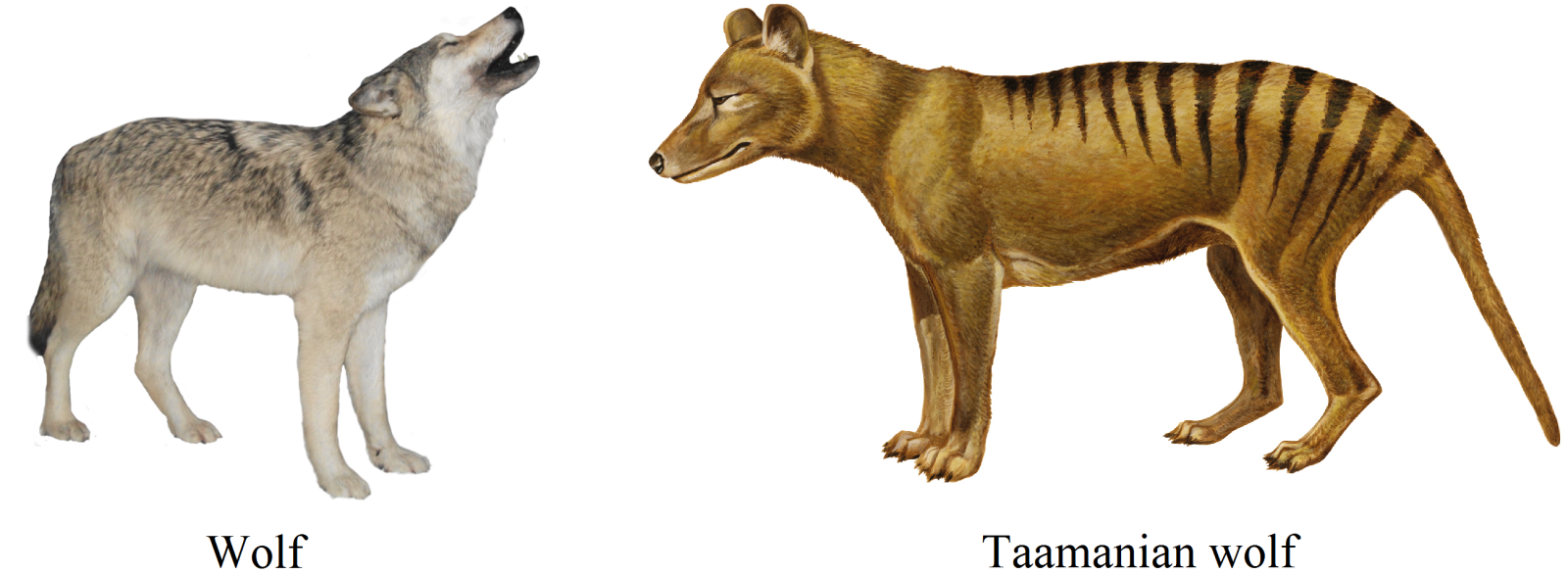
Refer to the figure given below and answer the questions that follow:
  1. Recognize and explain the process by which Tasmanian wolf evolved.
  2. Give one example of an animal that has evolved along with Tasmanian wolf.
  3. Compare and contrast the two animals shown?
What is global warming? List four strategies for reducing global warming.
How has RNAi technique helped to prevent the infestation of roots in tobacco plants by a nematode Meloidogyne incognita?
What is meant by gestation period?
Why is molecular diagnosis preferred over conventional methods? Name any two techniques giving one use of each.
Classify the following as examples of homology and analogy:
  1. Mouth parts of cockroach and butterfly.
  2. Hearts of rabbits and human beings.
  3. Eyes of octopus and mammals.
  4. Sweet potato and potato.
  5. Stings of honeybee and scorpion.
  6. Tendrils of Lathyrus and tendrils of Gloriosa.
  1. Draw a diagram of a sectional view of a monocot seed (grain).
  2. Label and write the function of: Coleoptile, Coleorrhiza, Endosperm.
Draw a diagram of E.coli cloning vector pBR322.
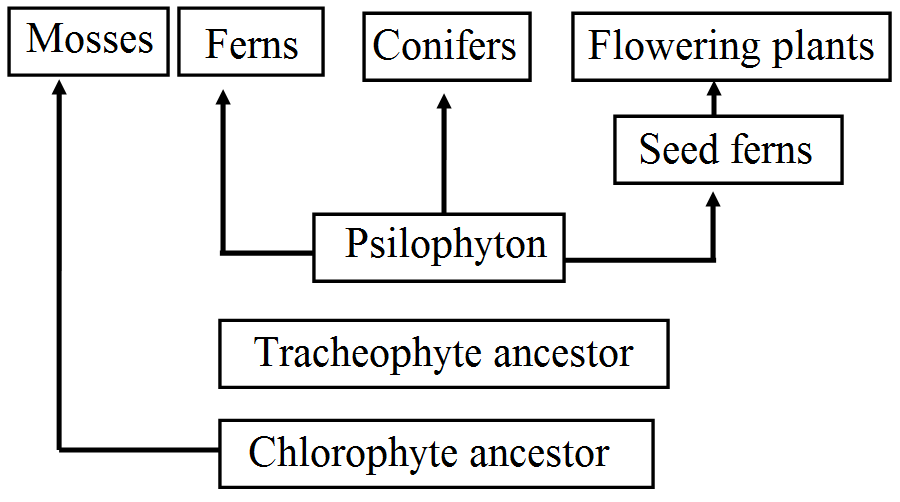
Study the schematic representation of evolutionary history of plant forms given below and mention:
  1. The plant form Ferns and Conifers are most related to.
  2. The nearest ancestors of flowering plants.
  3. The most primitive group of plants
  4. Common ancestry Psilophyton provides to.
  5. The common ancestors of Psilophyton and seed ferns.
  6. The common ancestors of mosses and tracheophytes.