Question
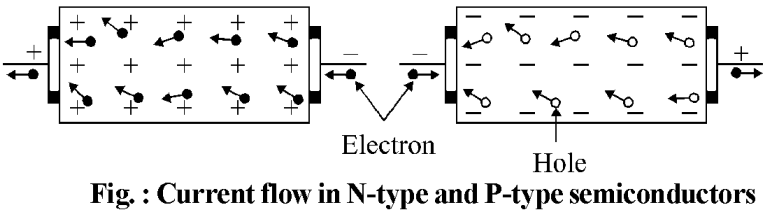
Explain current flow in N- and P-type semiconductors.

Need a full question paper?

Generate a complete, print-ready paper with questions like this in minutes — across 16+ boards, with answer keys.
Start Generating Free

Similar questions

What is paramagnetic substance?
If the solenoid in question 5.3 is free to turn about the vertical direction and a uniform horizontal magnetic field of 0.25 T is applied, then what is the magnitude of torque on the solenoid when its axis makes an angle of$30^{\circ}$ with the direction of applied field?
Define the term magnetic moment.
Unpolarised light is passed through a polaroid $P_1.$ When this polarised beam passes through another polaroid $P_2$ and if the pass axis of $P_2$ makes angle $\theta$ with the pass axis of $P_1,$ then write the expression for the polarised beam passing through $P_2.$ Draw a plot showing the variation of intensity when $\theta$ varies from $0$ to $2\pi.$
Write two points of difference between $n-$type and $p-$type semiconductors.
Derive an expression for drift velocity of free electrons in a conductor in terms of relaxation time.
When a boron nucleus $\big(\text{ }^{10}_5\text{B}\big)$ is bombarded by a neutron, an $\alpha$-particle is emitted. Which nucleus will be formed as a result?
A tightly closed metal lid of a glass bottle can be opened more easily if it is put in hot water for some time. Explain.
A boy puts a heavy box of mass M on his head and jumps down from the top of a multistoried building to the ground. How much is the force exerted by the box on his head during his free fall? Does the force greatly increase during the period he balances himself after striking the ground?
The circuit arrangement given below shows that when an a.c. passes through the coil A, the current starts flowing in the coil B.
  1. State the underlying principle involved.
  2. Mention two factors on which the current produced in the coil B depends.