Question
Explain Debit and Credit note in five sentences.

Answer

Debit Note:
This is referred to a note that is issued by the business to the other concerned parties. It represents the details and reasons for debiting the concerned party's account.
Example: Goods worth ₹ 2,000 returned by the business to Mr. Ramesh (a supplier).
In this case, Ramesh's Account will be debited with ₹ 2,000 as the goods purchased from him were returned to him. A issue of Debit Note in this case explains that Ramesh A/c has been debited with ₹ 2,000 with explanation, i.e. due to the goods returned by the business.
Credit Note:
Similar to the Debit Note, a Credit Note is also issued by the business to the other concerned parties. It represents the details and reasons for crediting the concerned party's account.
Example: Goods worth ₹ 2,000 were returned by Mr. Ramesh (a customer) to the business.
In this case, Ramesh's Account will be credited with ₹ 2,000 as the goods sold to him were returned back to the business. A issue of Credit Note in this case explains that Ramesh's A/c has been credited with ₹ 2,000 with explanation, i.e. due to the goods returned by him.
Both Debit Note as well as Credit Note also contains other important information such as, quantity of the goods (in units), amount of the transaction, Challan Number, Date, Names and Addresses of both the parties involved in the transaction.

Need a full question paper?

Generate a complete, print-ready paper with questions like this in minutes — across 16+ boards, with answer keys.

Start Generating Free

Similar questions

On July 01, 2011 Ashwani purchased a machine for ₹ 2,00,000 on credit. Installation expenses ₹ 25,000 are paid by cheque. The estimated life is 5 years and its scrap value after 5 years will be ₹ 20,000. Depreciation is to be charged on straight line basis. Show the journal entry for the year 2011 and prepare necessary ledger accounts for first three years.
Give Journal Entries to rectify the following errors:-
  1. Goods purchased from Ajay for ₹ 2,600 were recorded in Sales Book by mistake.
  2. Goods for ₹ 4,400 sold to Surendra was passed through Purchase Book.
  3. A customer returned goods worth ₹ 1,000. It was recorded in 'Purchase Return Book'.
  4. A credit sale of ₹ 126 to Rajesh was entered in the books as ₹ 162.
  5. Sale of old chairs and Table for ₹ 700 was treated as sale of goods.
  6. Rent of proprietor's residence, ₹ 800, debited to Rent A/c.
From the following transactions, state the nature of account and state which account will be debited and which account credited:
S.No
 
i
Manu started business with cash
1,00,000
ii
He purchased furniture for business
20,000
iii
Purchase goods on credit from Anshul
6,000
iv
Paid to his creditor, Anshul
2,000
v
Paid salary to his clerk
1,000
vi
Paid rent
500
vii
Received interest
200
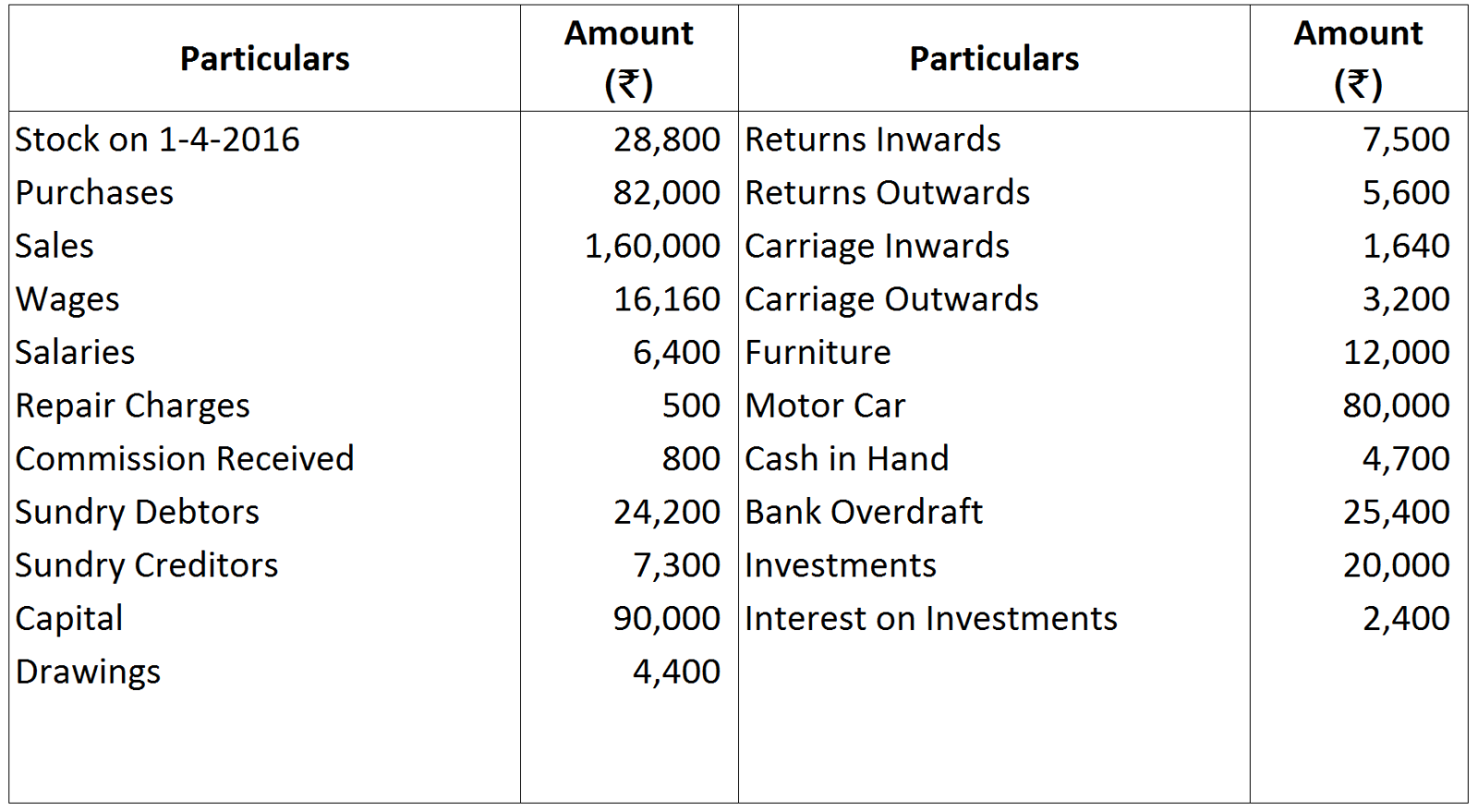
Prepare a Trial Balance from the following balances as at 31st March 2017:−
Rectify the following errors assuming:-
That no suspense account has been opened with difference in the trial balance.
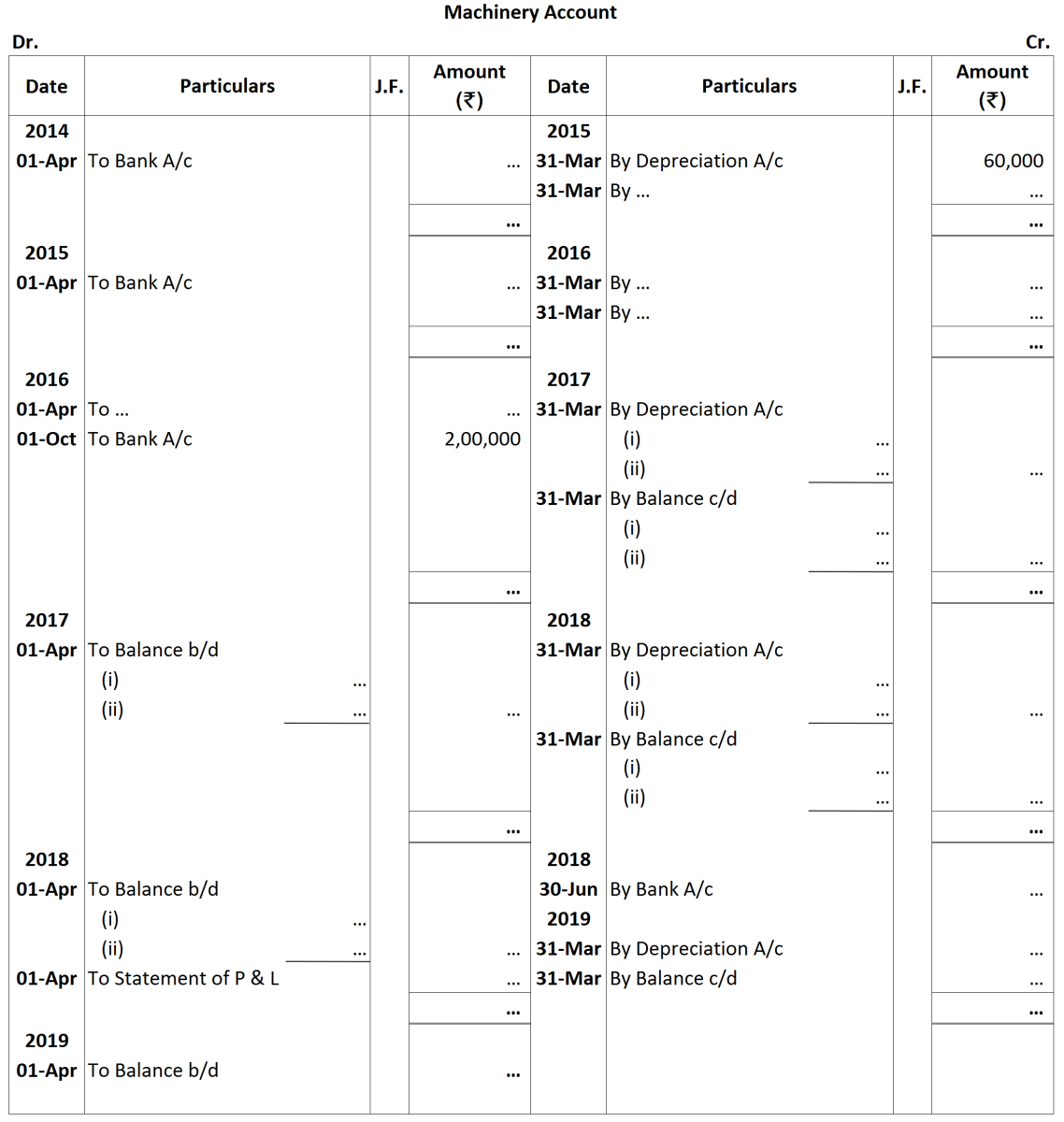
Fill up the missing information in the Machinery Account below. You are informed that the Machine purchased on $1^{\text {st }}$ October,$ 2016$ was sold on $1^{\text {st }}$ April, $2018$ for ₹ $2,30,000$. The depreciation is provided at the rate of $10 \%$ p.a. on diminishing blance method by the company.
Write short note on ‘Original Cost Method of providing depreciation with a suitable example.
Journalise the following transactions, post to the ledger:
2017
 
Nov. 01
Business started with
(i) Cash
1,50,000
 
 
(ii) Goods
50,000
Nov. 03
Purchased goods from Harish
30,000
Nov. 05
Sold goods for cash
12,000
Nov. 08
Purchase furniture for cash
5,000
Nov. 10
Cash paid to Harish on account
15,000
Nov. 13
Paid sundry expenses
200
Nov. 15
Cash sales
15,000
Nov. 18
Deposited into bank
5,000
Nov. 20
Drew cash for personal use
1,000
Nov. 22
Cash paid to Harish in full settlement of account
14,700
Nov. 25
Good sold to Nitesh
7,000
Nov. 26
Cartage paid
200
Nov. 27
Rent paid
1,500
Nov. 29
Received cash from Nitesh
6,800
 
Discount allowed
200
Nov. 30
Salary paid
3,000
On Jan 01, 2016 Neha sold goods for ₹ 20,000 to Muskan and drew upon her a bill of exchange payable after two months. One month before the maturity of the bill Muskan approached Neha to accept the payment against the bill at a rebate @ 12% p.a. Neha agreed to the request of Muskan and Muskan retired the bill under the agreed rate of rebate. Journalise the above transaction in the books of Neha and Muskan.
Shri S. K. Gupta, Chandigarh commenced business on 1st April, 2019 with a capital of ₹ 1,20,000 of which ₹ 60,000 was paid into his Bank Account and balance retained as cash. His other transactions during the month were as follows:
2019
 
April 2
Bought office furniture
20,000
April 5
Purchased goods
16,000
April 8
Purchased goods from Ramesh, Chandigarh
11,000
April 12
Sold goods to Sameer, Delhi
21,000
April 13
Purchased stationery for cash
1,800
April 13
Paid to Ramesh in cash on account*
10,000
 
Discount allowed by him*1,000
April 17
Withdrawn cash for office use*
4,000
April 18
Sen of Chandigarh sold goods to S.K. Gupta
30,000
April 19
Cash received from Sameer on account*
20,000
 
Allowed him discount*
1,000
April 20
Sold to Raj Banwari, Delhi
40,000
April 28
Cash sales
1,400
April 30
Paid salary by cheque*
8,000
April 30
Paid rent by cheque
5,000
April 30
Paid telephone expenses by cheque
2,000
April 30
Paid cash into bank*
2,000
Inter-state transactions are subject to levy of IGST @ 12% and Intra-state transactions are subject to levy of CGST and SGST @ 6% each. GST is not levied on transactions marked with (*).
Journalise the above transactions and post them to the Ledger.