Question
Explain destructive interference using proper $($appropriate$)$ example.

Answer

Image
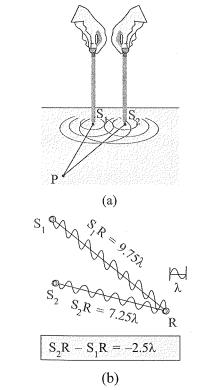
$\rightarrow $ As shown in fig.$(c),$ consider two needles $S _1$ and $S _2$ moving periodically up and down in an identical fashion in a trough of water.
$\rightarrow $ Here, they produce two water waves, and at a particular point, the phase difference between the displacements produced by each of the waves does not change with time.
$\rightarrow $ When this happens, the two sources $($here $S_1$ and $S _2 )$ are said to be coherent sources,
$\rightarrow $ As shown in fig. $(a),$ consider a point $R$ for which,
$S _2 R - S _1 R =-2.5 \lambda$
$\rightarrow $ The waves emanating from $S _1$ will arrive exactly two and a half cycles later than the waves from $S _2$.
Hence the wave coming from $S _2$ will be ahead in phase by $5 \pi \text{ rad}$.
$\rightarrow $ Hence, displacement produced by $S_1$ is given by
$_1=a \cos \omega t$
$\rightarrow $ then the displacement produced by $S _2$ will be given by,
$y_2=a \cos (\omega t+5 \pi)$
$y_2=-a \cos \omega t$
$\rightarrow $ Resultant $($ Net$)$ displacement at $R$ ,
$ y =y_1+y_2$
$\therefore y =a \cos \omega t+(-a \cos \omega t)$
$\therefore y =0$
$\rightarrow $ As the net displacement at point $R$ is zero, the resultant intensity at $R$ will also be zero.
$($That is because, here, the two displacement are now out of phase and they will cancel out to give zero intensity.$)$
$\rightarrow $ This is referred to as Destructive interference.

Need a full question paper?

Generate a complete, print-ready paper with questions like this in minutes — across 16+ boards, with answer keys.
Start Generating Free

Similar questions

Verify that the units weber and volt-second are the same.
Is it possible to add two vectors of unequal magnitudes and get zero? Is it possible to add three vectors of equal magnitudes and get zero?
A small pin fixed on a table top is viewed from above from a distance of 50cm. By what distance would the pin appear to be raised if it is viewed from the same point through a 15 cm thick glass slab held parallel to the table? Refractive index of glass = 1.5. Does the answer depend on the location of the slab?
State the right hand thumb rule for finding the direction of the magnetic field due to a current carrying circular loop.
If the distance of the observation point from the central point of the small electric dipole is halved, then how many times will the intensity of the electric field increase?
An electron beam projected along the positive X-axis deflects along the positive Y-axis. If this deflection is caused by a magnetic field, what is the direction of the field? Can we conclude that the field is parallel to the Z-axis?
Suppose you are told that the linear size of everything in the universe has been doubled overnight. Can you test this statement by measuring sizes with a metre stick? Can you test it by using the fact that the speed of light is a universal constant and has not changed? What will happen if all the clocks in the universe also start running at half the speed?
A person wears glasses of power -2.5D. Is the person farsighted or nearsighted? What is the far point of the person without the glasses?
What is the importance of radial magnetic field in a moving coil galvanometer?
A tightly-wound, long solenoid has n turns per unit length, a radius r and carries a current i. A particle having charge q and mass m is projected from a point on the axis in a direction perpendicular to the axis. What can be the maximum speed for which the particle does not strike the solenoid ?