Question
Verify that the units weber and volt-second are the same.

Answer

$\text{v}=\frac{\text{d}\phi}{\text{dt}}$
$\Rightarrow\text{d}\phi=\text{dt}$
Charge in flux has unit weber and potential difference as volt.

Need a full question paper?

Generate a complete, print-ready paper with questions like this in minutes — across 16+ boards, with answer keys.
Start Generating Free

Similar questions

Write the name of optical instruments.
12J of work has to be done against an existing electric field to take a charge of 0.01C from A to B. How much is the potential difference $V_B- V_A$?
Write and explain the law of conservation of electric charge.
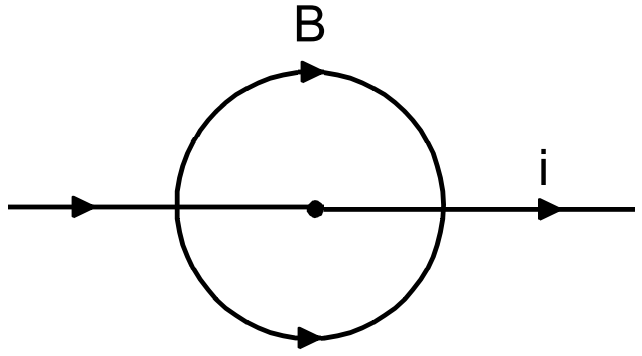
A conducting circular loop of radius a is connected to two Iong, straight wires. The straight wires carry current I as shown in figure. Find the magnetic field B at the centre of the loop.
The average kinetic energy of molecules in a gas at temperature T is 1.5kT. Find the temperature at which the average kinetic energy of the molecules of hydrogen equals the binding energy of its atoms. Will hydrogen remain in molecular from at this temperature? Take $k = 8.62 \times 10^{-5}eVK^{-1}.$
A magnetic needle free to rotate in a vertical plane parallel to the magnetic meridian has its north tip down at 60° with the horizontal. The horizontal component of the earth's magnetic field at the place is known to be 0.4 G. Determine the magnitude of the earth's magnetic field at the place.
A gas thermometer measures the temperature from the variation of pressure of a sample of gas. If the pressure measured at the melting point of lead is 2.20 times the pressure measured at the triple point of water, find the melting point of lead.
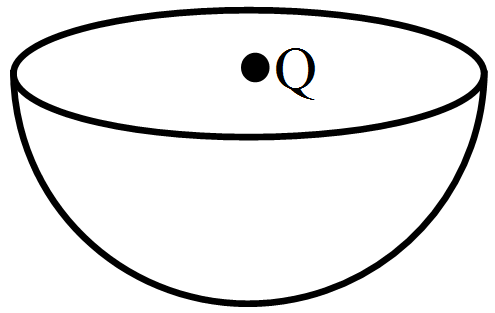
A charge Q is placed at the centre of an imaginary hemispherical surface. Using symmetry arguments and the Gauss's law, find the flux of the electric field due to this charge through the surface of the hemisphere (figure).
The outer surface of a cylinder containing a gas is rubbed vigorously by a polishing machine. The cylinder and its gas become warm. Is the energy transferred to the gas heat or work?
The radius of a planet is $R_1$ and a satellite revolves round it in a circle of radius $R_2$. The time period of revolution is $T$. Find the acceleration due to the gravitation of the planet at its surface.