Question
Explain destructive interference using proper $($appropriate$)$ example.

Answer

Image
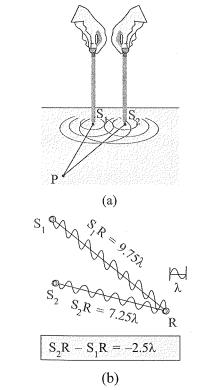
$\rightarrow $ As shown in fig.$(c)$, consider two needles $S _1$ and $S _2$ moving periodically up and down in an identical fashion in a trough of water.
$\rightarrow $Here, they produce two water waves, and at a particular point, the phase difference between the displacements produced by each of the waves does not change with time.
$\rightarrow $When this happens, the two sources $($here $S_1$ and $S _2 )$ are said to be coherent sources,
$\rightarrow $As shown in fig. $(a),$ consider a point R for which,
$S _2 R - S _1 R =-2.5 \lambda$
$\rightarrow $The waves emanating from $S _1$ will arrive exactly two and a half cycles later than the waves from $S _2$. Hence the wave coming from $S _2$ will be ahead in phase by $5 \pi rad$.
$\rightarrow $Hence, displacement produced by $S_1$ is given by
$_1=a \cos \omega t$
$\rightarrow $then the displacement produced by $S _2$ will be given by,
$y_2=a \cos (\omega t+5 \pi)$
$y_2=-a \cos \omega t$
$\rightarrow $Resultant (/ Net) displacement at $R ,$
$\begin{aligned} y & =y_1+y_2 \\ \therefore y & =a \cos \omega t+(-a \cos \omega t) \\ \therefore y & =0\end{aligned}$
$\rightarrow $As the net displacement at point $R$ is zero, the resultant intensity at R will also be zero. $($That is because, here, the two displacement are now out of phase and they will cancel out to give zero intensity.$)$
$\rightarrow $This is referred to as Destructive interference.

Need a full question paper?

Generate a complete, print-ready paper with questions like this in minutes — across 16+ boards, with answer keys.
Start Generating Free

Similar questions

Can fringes of white light be formed in interference or not? If yes, under what circumstances?
A force F = a + bx acts on a particle in the x-direction, where a and b are constants. Find the work done by this force during a displacement from x = 0 to x = d.
Draw the transfer characteristic curve of a base biased transistor in $CE$ configuration. Explain clearly how the active region of the $V_0$ versus $V_i$ curve in a transistor is used as an amplifier.
A galvanometer has a resistance of $8 \Omega$ . It gives a full scale deflection for a current of $10 mA$. It is to be converted into an ammeter of range $5 A$. The only shunt resistance available is of $0.02 \Omega$ , which is not suitable for this conversion. Find the value of resistance $R$ that must be connected in series with the galvanometer $($Fig.$)$ to get ammeter of desired range.
Image
i. Define the terms: impact parameter and distance of closest approach for an -particle in the GeigerMarsden scattering experiment.
ii. What will be the value of the impact parameter for scattering angle (I) $\theta=0^{\circ}$ and (II) $\theta=180^{\circ}$ ?
A radioactive nucleus $A$ undergoes a series of decay according to following scheme:
$\text{A}\ \xrightarrow{\ \alpha\ }\ \text{A}_1\ \xrightarrow{\ \beta\ }\ \text{A}_2\ \xrightarrow{\ \alpha\ }\ \text{A}_3\ \xrightarrow{\ \text{g}\ }\ \text{A}_4$
The mass number and atomic number of $A$ are $180$ and $72$ respectively. What are these numbers for $A_4$?
At a certain location in Africa, a compass points $12^\circ$ west of the geographic north. The north tip of the magnetic needle of a dip circle placed in the plane of magnetic meridian points $60^\circ$ above the horizontal. The horizontal component of the earth’s field is measured to be $0.16 G.$ Specify the direction and magnitude of the earth’s field at the location.
A Galilean telescope is $27\ cm$ long when focused to form an image at infinity. If the objective has a focal length of $30\ cm,$ what is the focal length of the eyepiece?
If the bar magnet in Q. 58 is turned around by 180°, where will the new null points be located?
An electroplating unit plates $3.0g$ of silver on a brass plate in $3.0$ minutes. Find the current used by the unit. The electrochemical equivalent of silver is $1.12 \times 10^{-6}\ kg\ C^{-1.}$