Questions

2 Marks Questions

Take a timed test

23 questions · self-marked practice — reveal the answer and mark yourself.

Question 12 Marks
Write down Huygen's principle and explain how a new plane wavefront is formed at the end of a very small time interval.
Answer
• Huygen's principle :
"Every point or particle of a wavefront behaves as an independent secondary source, emits by itself secondary spherical waves. After a very small time interval the surface tangential to all such secondary spherical wavelets gives the position and shape of the new wavefront."
Image
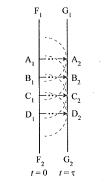
A plane wavefront $F _1 F_2$ is shown in the fig. at time $t=0$.
To determine the shape of the wavefront at time $t=\tau$, we draw spheres of radius $v \tau$, from each point (points $A _1, B_1, C _1 \ldots$ etc.) on the wavefront. (Where $v$ is the speed of waves in the medium.)
A tangent common to all such points is drawn, which gives the position and shape of the new wavefront at time $t=\tau$.
View full question & answer
Question 22 Marks
Explain the reflection of a plane wave using Huygen's principle.
Answer

Image
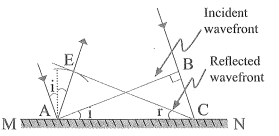
Consider a plane wave AB incident at an angle $i$ on a reflecting surface MN .
If $v$ is the speed of wave in the given medium, $\tau$ represents the time taken by the wavefront to advance from point B to C , then the distance $BC =v \tau$.
In order to construct the reflected wavefront we draw a sphere of radius $v \tau$ from the point A as shown in fig.
Let $C E$ represent the tangent plane drawn from the point C to this sphere.
Obviously,
$AE = BC =v \tau$
From fig., incident and reflected wave fronts make angle $i$ and $r$ with reflecting surface, MN respectively.
From fig.,
AC is the common side between $\triangle AEC$ and $\triangle ABC$.
Also, $\angle AEC =\angle ABC =\frac{\pi}{2}$.
$\text { and } AE = BC =v \tau$
So $\triangle AEC$ and $\triangle ABC$ are congruent.
And therfore, $\angle i=\angle r$,
which is law of reflection.
View full question & answer
Question 32 Marks
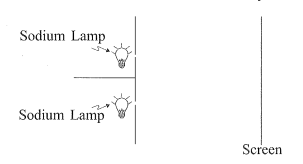
Explain that in day to day life we can't get coherent sources using two sodium lamps.
Answer
Image

As shown in fig. if we use two sodium lamps illuminating two pin holes, we will not observe any interference fringes.
This is because of the fact that light wave emitted from ordinary source undergoes abrupt phase changes in times of the order of $10^{-10}$ seconds.
Thus, the light waves coming out from two independent sources of light will not have any fixed phase relationship and would be incoherent.
When this happens, their intensities on the screen will add up.
View full question & answer
Question 42 Marks
Derive the equation of intensity of resultant wave generated due to super postion (or interference) of waves generated from two coherent sources.
Answer
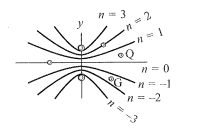
As shown in the fig., two waves emanated from two coherent sources.
$S _1$ and $S _2$ are superimposed on each other at a point G in the medium.
Let, the phase difference between the two displacements be $\phi$.
Image
Thus, if the displacement produced by $S _1$ is given by,
$y_1=a \cos \omega t$
then the displacement produced by $S _2$ will be,
$y_2=a \cos (\omega t+\phi)$
where, $(a$ - Amplitude, $\omega$ - Angular frequency)
As per super position principle, the resultant displacement will be given by :
$\begin{aligned}
y & =y_1+y_2 \\
y & =a \cos \omega t+a \cos (\omega t+\phi) \\
\therefore \quad y & =2 a \cos \left(\frac{\omega t-\omega t-\phi}{2}\right) \cos \left(\frac{\omega t+\omega t+\phi}{2}\right)
\end{aligned}$
View full question & answer
Question 52 Marks
Write down the expression (equation) to find the distance of $n^{\text {th }}$ bright fringe and $n^{\text {th }}$ dark fringe from the central maximum.
Answer
→In Young's experiment, constructive interference is formed when path difference
$\frac{x d}{ D }=n \lambda$
→From this eq., the distance of $n ^{\text {th }}$ bright fringe
$x_n=\frac{n \lambda D }{d} \quad(n=0, \pm 1, \pm 2, \ldots)$.......(1)
→On the other hand in the region where destructive interference is formed path difference,
$\frac{x d}{ D }=\left(n+\frac{1}{2}\right) \lambda$
→From this eq., the distance of $n ^{\text {th }}$ dark fringe
$x_n=\left(n+\frac{1}{2}\right) \frac{\lambda D }{d}$
(Where, $n=0, \pm 1, \pm 2, \ldots$ )
Image
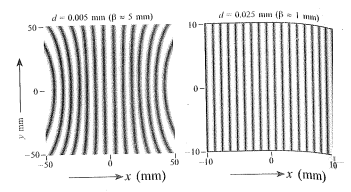
→As shown in the fig. dark and bright bands are seen on screen. These bands are known as fringes.
→From equations (1) and (2) it can be said that the disance between two consecutive dark and bright fringes is same.
View full question & answer
Question 62 Marks
Derive the condition of Constructive and destructive interference in terms of the phase difference.
Answer
The formula to find out the intensity of resultant wave generated due to super position of waves emanated from two coherent sources is, $I =4 I _0 \cos ^2\left(\frac{\phi}{2}\right)$ (where, $\phi$ - phase difference)
• Constructive Interference :
If the phase difference at the point of super position is
$\phi=0, \pm 2 \pi, \pm 4 \pi \ldots$ we will have constructive interference leading to maximum intensity.
→Condition : phase difference $= \pm 2 n \pi$
$(n=0,1,2,3 \ldots)$
• Destructive Interference :
If the phase difference at the point of super position is
$\phi= \pm \pi, \pm 3 \pi, \pm 5 \pi \ldots$ we will have destructive interference leading to zero intensity.
→Condition : phase difference $= \pm(2 n+1) \pi$
$(n=0,1,2,3 \ldots .)$
View full question & answer
Question 72 Marks
Describe/Explain single slit diffraction using a simple day to day life example.
###
Describe a simple experiment (/activity) to see single slit diffraction.
Answer
Image

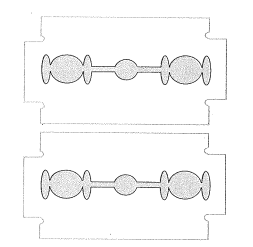
It is very easy to see the single-slit diffraction pattern for oneself.
The equipment needed can be found in most homes-two razor blades and one clear glass electric bulb preferably with a straight filament.
One has to hold two blades so that the edges are parallel and have a narrow slit in between. This is easily done using the thumb and forefingers (fig.)
Keep the slit parallel to the filament, right in front of the eye. Use the spectacles if you normally do. With slight adjustment of the width of the slit and the parallelism of the edges, the pattern should be seen with its bright and dark bands.
Since the position of all the bands (except the central one) depends on wavelength, they will show some colours.
Using a filter for red or blue will make the fringes clearer. With both filters available, the wider fringes for red compared to blue can be seen.
→Another example :
In case of a dark room, where there is some light entering from outside, if the door is kept slightly open, the diffraction pattern can be seen on the tiles.
View full question & answer
Question 82 Marks
What is interference ? Write the types of interference.
Answer
→ "The effect produced by superposition of two or more waves is called interference."
There are two types of interference :
(i) Constructive interference
(ii) Destructive interference
View full question & answer
Question 92 Marks
Explain destructive interference using proper $($appropriate$)$ example.
Answer
Image
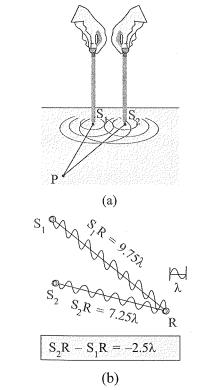
$\rightarrow $ As shown in fig.$(c)$, consider two needles $S _1$ and $S _2$ moving periodically up and down in an identical fashion in a trough of water.
$\rightarrow $Here, they produce two water waves, and at a particular point, the phase difference between the displacements produced by each of the waves does not change with time.
$\rightarrow $When this happens, the two sources $($here $S_1$ and $S _2 )$ are said to be coherent sources,
$\rightarrow $As shown in fig. $(a),$ consider a point R for which,
$S _2 R - S _1 R =-2.5 \lambda$
$\rightarrow $The waves emanating from $S _1$ will arrive exactly two and a half cycles later than the waves from $S _2$. Hence the wave coming from $S _2$ will be ahead in phase by $5 \pi rad$.
$\rightarrow $Hence, displacement produced by $S_1$ is given by
$_1=a \cos \omega t$
$\rightarrow $then the displacement produced by $S _2$ will be given by,
$y_2=a \cos (\omega t+5 \pi)$
$y_2=-a \cos \omega t$
$\rightarrow $Resultant (/ Net) displacement at $R ,$
$\begin{aligned} y & =y_1+y_2 \\ \therefore y & =a \cos \omega t+(-a \cos \omega t) \\ \therefore y & =0\end{aligned}$
$\rightarrow $As the net displacement at point $R$ is zero, the resultant intensity at R will also be zero. $($That is because, here, the two displacement are now out of phase and they will cancel out to give zero intensity.$)$
$\rightarrow $This is referred to as Destructive interference.
View full question & answer
Question 102 Marks
What are coherent sources ? Explain Constructive interference using proper example.
Answer

Image
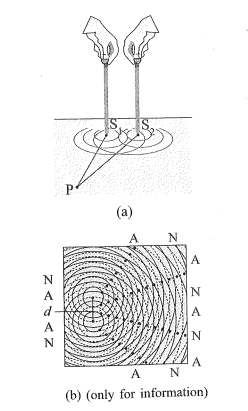
Consider two needles $S _1$ and $S _2$ moving periodically up and down in an identical fashion in a trough of water. (fig. (a))
Consequently two ripples (/water waves) are created in water. When the two waves superimpose at a particular point, the phase difference between the displacements produced by each of the waves does not change with time.
When this happens, the two sources are said to be coherent sources.
Consider a point P for which,
$S _1 P = S _2 P$
Since distances are equal, waves from $S _1$ and $S _2$ will take the same time to travel to point $P$ and waves that emanate from $S_1$ and $S_2$ in phase will also arrive, at point $P$ in phase.
Displacement produced by the source $S_1$ at point P is given by,
$y_1=a \cos \omega t$
Displacement produced by the source $S _2$ at point P is given by,
$y_2=a \cos \omega t$
As per superposition principle,
$\begin{aligned}
y & =y_1+y_2 \\
\therefore y & =a \cos \omega t+a \cos \omega t \\
\therefore y & =2 a \cos \omega t
\end{aligned}$
The intensity of a wave is proportional to the square of the amplitude.
So, the resultant intensity is given by :
$I=4 I_0$
where $I _0$ represents the intensity produced by each one of the individual sources.
Here, the intensity at point P is maximum, which is known as the constructive interference.
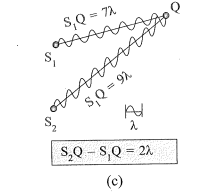
Now, as shown in fig. (c), consider a point $Q$ for which,
$S _2 Q - S _1 Q =2 \lambda$
Image
The waves emanating from $S_1$ will arrive exactly two cycles earlier, than the waves from $S _2$ and will be in phase. Path difference of $2 \lambda$ corresponds to a phase difference of $4 \pi rad$. Hence, the wave coming from $S _2$ will be late in phase by $4 \pi$ radian.
If the displacement produced by $S _1$ is
$y_1=a \cos \omega t$
Then the displacement produced by $S _2$ will be,
$\begin{aligned}
y_2 & =a \cos (\omega t-4 \pi) \\
\therefore \quad y_2 & =a \cos \omega t
\end{aligned}$
Net displacement at point Q ,
$\begin{aligned}
y & =y_1+y_2 \\
\therefore y & =a \cos \omega t+a \cos \omega t \\
\therefore y & =2 a \cos \omega t
\end{aligned}$
The two displacements are in phase once again, and the intensity once again will be $4 I _0$ giving rise to the Constructive interference.
View full question & answer
Question 112 Marks
Write down difference between the Interference pattera and the diffraction pattern.
Answer
 Interference patternDiffraction pattern
(1)In an interference pattern, there are many bright and dark bands at equal distance from each other.In a diffraction pattern, the central maximum has width double the width of other secondary maxima.
(2)Intensity of all the bright fringes is same.Intensity of the central maximum is the highest and intensity gradually keeps reducing for successive secondary maxima,
(3)An interference pattern is seen because of super position of two waves created from two narrow slits.A difference pattern is seen because of super position of continuous wave fronts created from each point of the single slit.
(4)♦ For constructive interference phase difference is  $\pm 2 n \pi$ (where $n=0,1,2, \ldots)$

♦ For destructive interference phase diff. is $\pm(2 n+1) \pi$
(where $n=0,1,2,3 \ldots)$
 ♦ For central maxima $\theta \approx 0$

 ♦ secondary maxima phase diff. is $\left(n+\frac{1}{2}\right) \frac{\lambda}{a}$
(where $n= \pm 1, \pm 2, \pm 3 \ldots$ )

 ♦ Secondary minima phase diff. is $\frac{n \lambda}{a}$
(where $n= \pm 1, \pm 2, \pm 3 \ldots$ )
View full question & answer
Question 122 Marks
Explain the refraction of light from a denser medium to a rarer medium, using Huygen's principle.
Answer
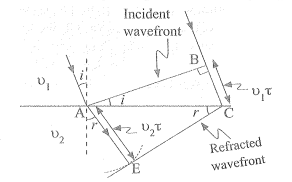
→As shown in the fig., a wavefront enters from a denser to rarer medium.
→Speed of light in the denser and rarer medium are $v_1$ and $v_2$ and the refractive indices of the medium 1 and 2 are $n_1$ and $n_2$, respectively. $\left(n_1>n_2\right)$
Image

→As shown in fig., a wavefront AB is incident at an angle $i$ on a surface separating medium 1 and 2 .
(i) $i→Figure for this situation is shown above. Where CE is the refracted wavefront. Snell's law $n_1 \sin i=n_2 \sin r$ is followed in this condition.
→Here, since $n_1>n_2$ the angle of incidence $(r>i)$ is less then the angle of refrection.
If $i=i_c$ (Angle of incidence is equal to Critical angle), $ r=90^{\circ} \text {. } $
→$\therefore$ From Snell's law, $ \sin i_c=\frac{n_2}{n_1} $
(ii) $i>i_c$ (Angle of incidence is greater than critical angle)
→If the angle of incidence is greater than the critical angle, we will not have any refracted wave and the wave will undergo what is known as total internal reflection.
View full question & answer
Question 132 Marks
Explain the changes occuring in the wave length, speed and frequency when light enters from one mudium to the other medium.
Answer
As shown in the fig., a wavefront enters from a rarer to a denser medium.
For medium (1), the wave length is $\lambda_1$, speed is $v_1$ and frequency $v_1$.
Similary, for medium (2), the wavelength is $\lambda_2$, speed $v_2$ and frequency is $v_2$.
Suppose, distance BC is equal to $\lambda_1$, so the distance AE will be equal to $\lambda_2$.
Image

Because if the crest from B has reached C , in time $\tau$, then the crest from A should have also reached E in time $\tau$.
Thus, $\frac{ BC }{ AE }=\frac{\lambda_1}{\lambda_2}$
$\begin{aligned}
\quad BC & =v_1 \tau \\
AE & =v_2 \tau \\
\therefore \quad & \frac{v_1 \tau}{v_2 \tau}=\frac{\lambda_1}{\lambda_2} \\
\therefore \quad & \frac{\lambda_1}{\lambda_2}=\frac{v_1}{v_2}
\end{aligned}$
hence for $v_1>v_2$, so, $\lambda_1$ will be greater than $\lambda_2$.
$\text { (If } v_1>v_2, \lambda_1>\lambda_2 \text { ) }$
The above equation implies that when a wave gets refracted into a denser medium, $\left(v_1>v_2\right)$, the wavelength and the speed of propogation decrease, but the frequency $\left(v=\frac{\nu}{\lambda}\right)$ remains the same.
View full question & answer
Question 142 Marks
Describe Young's experiment performed to obtain coherent sources (More popularly known as Young's Double Slit Experiment) with proper figure.
Answer

Image
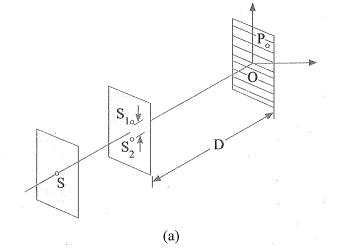
The British physicist Thomas Young used an ingenious technique to "lock" the phases of the waves emanating from $S _1$ and $S _2$.
 He made two pinholes $S _1$ and $S _2$ (very close to each other) on an opaque screen. (fig. (a))
These were illuminated by another pinholes that was in turn, lit by a bright source.
Image
Light waves spread out from S and fall on both $S _1$ and $S _2$.
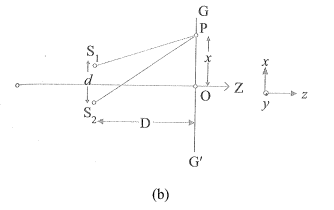
$S _1$ and $S _2$ then behave like two Coherent Sources because light waves coming out from $S_1$ and $S_2$ are derived out from same original source and any abrupt phase change in S will manifest in exactly similar phase changes in the light coming out from $S _1$ and $S _2$.
Thus, the two sources $S _1$ and $S _2$ will be locked in phase; i.e. they will be coherent
Thus spherical waves emanating from $S _1$ and $S _2$ will produce interference fringes on the screen $GG ^{\prime}$; as shown in fig. (b)
View full question & answer
Question 152 Marks
What was the difficulty with the wave theory ? How was this difficulty explained using Maxwell's Electro-magnetic wave theory ?
Answer
The only major difficulty with wave theory was that, since it was thought that a wave required a medium for its propagation, how could light waves propagate through vacuum.
This was explained when Maxwell put forward his famous electro magnetic theroy of light.
He had developed a set of equations describing the laws of electricity and magnetism, and using these equations he derived what is known as the wave equation, from which he predicted the existence of electro magnetic waves.
From the wave equation, he calculated the speed of Electro magnetic waves in free space and he found that the theoretical value was very close to the measured value of speed of light.
From this, he propounded that light must be an electro magnetic wave.
Thus, according to Maxwell, light waves are associated with changing electric and magnetic
fields. Changing electric field produces time and space varying magnetic field, and a changing magnetic field produces a time and space varying electric field.
The changing electric and magnetic fields result in the propogation of electromagnetic waves (or light waves) even in vacuum.
View full question & answer
Question 162 Marks
Give explanation of linearly pofarized, unpolarized and plane polarized wave.
Answer
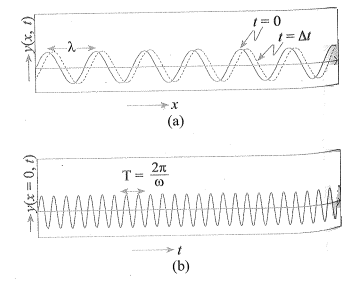
Consider holding a long string that is held horizontally, the other end of which is assumed to be fixed.
If the end of the string is moved in up and down in periodic manner, a wave propogating in the + X direction. (fig. (a)) is generated.
Such a wave can be described by the following equation :
$y(x, t)=a \sin (k x-\omega t)$
where, $a=$ amplitude and, $\omega=$ Angular freq. of the wave $(\omega=2 \pi \nu)$
$k=\left(\frac{2 \pi}{\lambda}\right)=\text { Wave vector (/Angular wave number) }$
Image
Here the displacement of the particle is if $y$-direction, where as the propogation of wave is in x-direction. Since the displacement of particle is perpendicular to the direction of propogation of the wave, this type of wave is known as transverse wave.
Also, since the displacement is in the $y$-direction, it is often referred to as a y-polarised wave.
Since each point on the string moves on a straight line, the wave is also referred to as linearly polarized wave.
Further, the string always remains confined to the X-Y plane and therefore it is also referred to as a plane polarised wave.
In a similar manner we can consider the vibration of the string in the $X - Z$ plane generating a Z-polarized wave whose displacement will be given by :
$Z (x, t)=a \sin (k x-\omega t)$
Linearly polarized waves [described by e.q. (1) and (3)] are all transverse waves, i.e. the displacement of each point of the string is always at right angles to the direction of propogation of the wave.
If the plane of vibration of the string is changed randomly in very short intervals of time, then the wave is known as an unpolarized wave.
Thus, for an unpolarized wave, the displacement will be randomly changing with time though it will always be perpendicular to the direction of propogation.
View full question & answer
Question 172 Marks
Briefly discuss different theories (or models) about light given by different scientists.
Answer
Many different theories are given by different scientists about the fundamental nature of light, which are as follows :
• Descartes :
In 1637, Descartes gave the corpuscular model of light and derived Snell's law. It explained the laws of reflection and refraction of light at an interface. The Corpuscular model predicted that if the ray of light (on refraction) bends towards the normal, then the speed of light would be greater in the second medium.
• Isaac Newton :
The Corpuscular model of light was further developed by Isaac Newton in his famous book entitled OPTICKS and because of tremendous popularity of this book, the Corpuscular model is often attributed to Newton.
The wave theory of Huygens was not readily accepted primarily because of Newton's authority and also because, light could travel through vacuum and it was felt (or believed) that a wave would always require a medium to propogate from one point to the other.
• Huygens :
In 1678, the Dutch physicist Christian Huygens put forward the wave theory of light.
This wave model could satisfactorily explain the phenomenon of reflection and refraction. The model predicted that on refraction, if the wave bends towards the normal, then the speed of light would be less in the second medium. This is in contradiction to the prediction made by using the Corpuscular theory (Corpuscular model of light.) It was later confirmed by experiments and it was shown that the speed of light in water is less than the speed in air.
• Foucault :
He carried out an experiment in 1850 and confirmed by experiment and showed that the speed of light in water is less than the speed in air as per prediction of the wave model.
• Thomas Young :
He performed his famous interference experiment in 1801 and it was firmly established that light is actually (indeed) a wave phenomenon. The wavelength of the visible light was measured and found to be extremely small. For example, the wave length of the yellow light is about $0.6 \mu m$. Because of the smallness of the wavelength of the visible light (in comparison to the dimensions of typical mirrors and lenses), light can be assumed to approximately travel in straight lines.
View full question & answer
Question 182 Marks
What is diffraction? Which are the factors on which diffraction depends ? Give some examples of day to day life where the diffraction phenomenon is observed.
Answer
• Diffraction :
Is the effect produced due to the limited part of the wave front.
It was first discovered by scientist Grimaldy
Extent of diffraction depends on the ratio $\frac{\lambda}{d}$ (where, $\lambda$ - wave length and $d$ - width of the slit)
As this ratio is larger diffraction is higher and as this ratio is smaller diffraction is lower.
If we look clearly at the shadow cast by an opaque object, close to the region of geometrical shadow, there are alternate dark and bright regions just like in interference.
This happens due to the phenomenon of diffraction.
Diffraction is a general characteristic exhibited by all types of waves, be it sound waves, light waves, water waves or matter waves.
Since the wave length of light is much smaller than the dimensions of most obstacles, we do not encounter diffraction effects of light in everyday observations.
However, the finite resolution of our eye or microscopes is limited due to the phenomenon of diffraction.
The colours that we see when a CD is viewed is due to diffraction effects.
It is due to the phenomenon of diffraction that the person standing behind the open door inside the room can hear the voice of the person standing on the other side of the door but they can not see each other.
 
View full question & answer
Question 192 Marks
Give explanation about polaroid and its passaxis, and give uses of the polaroid.
Answer
A device (/ plate/equipment) which can convert unpolarised light in to plane-polarised light, is called a polaroid.
It is a thin plastic like sheet.
A polaroid consists of long chain molecules aligned in a particular direction.
When an unpolarised light wave is incident on such a polaroid then the electric vectors (associated with the, propogating light wave) along the direction of the aligned molecules get absorbed, and the electric vectors oscillating along a direction perpendicular to the aligned molecules pass through it, and the light wave gets linearly polarised.
This direction is known as the pass-axis (or Crystalographic axìs) of the polaroid.
• Uses :
Polaroids can be used to control the intensity, in sunglasses, window panels, etc. Polaroids are also used in photographic cameras and 3D movie cameras.

View full question & answer
Question 202 Marks
Write down the conditions for constructive and destructive interference in terms of path difference.
Answer
• Constructive Interference :
$\rightarrow $ If we have two coherent sources $S _1$ and $S _2$ vibrating in phase, then for an arbitrary point $P$, whenever the path difference,
$S _1 P \sim S _2 P =n \lambda \quad(n=0,1,2,3, \ldots)$
we will have maximum intensity $\left( I =4 I _0\right.$ ) at the given point, which means we will have constructive interference.
$[$The sign $\sim$ between $S _1 P$ and $S _2 P$ represents the difference between $S _1 P$ and $S _2 P.]$
• Destructive interference :
$\rightarrow $ When two coherent sources $\left( S _1\right.$ and $\left.S _2\right)$ are vibrating in phase, and if the point $P$ is such that the path difference
$S _1 P \sim S _2 P =\left(n+\frac{1}{2}\right) \lambda$
$\left( OR S _1 P \sim S _2 P =(2 n+1) \frac{\lambda}{2}\right)$
 $($where, $n=0,1,2,3....)$
We will have destructive interference and the resultant intensity will be zero.
View full question & answer
Question 212 Marks
What is stationary interference? How can we get, the resultant intensity of super position of waves emanated from the incoherent sources?
Answer
$•$ Stationary interference :
$\rightarrow$ "For an interference pattern, if the intensity at a point does not change with time, the interference is known as stationary interference."
$• $ Incoherent Sources :
$\rightarrow$ "When the phase difference between the oscillating sources keeps changing rapidly, such sources are known as incoherent sources."
$\rightarrow$ If the two sources do not maintain a constant phase difference, then interference pattern $($and the positions of maxima and minima$)$ also varies rapidly will time. And a "time-averaged" average intensity distribution is seen at the given point.
$\rightarrow$ This average intensity is given by,
$< I >=\left\langle 4 I _0 \cos ^2 \frac{\phi}{2}\right\rangle$
$\therefore \quad < I >=4 I _0\left\langle\cos ^2 \frac{\phi}{2}\right\rangle$
$\text { but }\left\langle\cos ^2 \frac{\phi}{2}\right\rangle=\frac{1}{2} .$
$\therefore < I >=4 I _0\left(\frac{1}{2}\right)=2 I _0$
$\rightarrow$ Thus, when two sources are incoherent, the resultant intensity due to superposition of waves generated from the sources, is simply equal to the sum $($addition$)$ of independent intensity of the two waves.
View full question & answer
Question 222 Marks
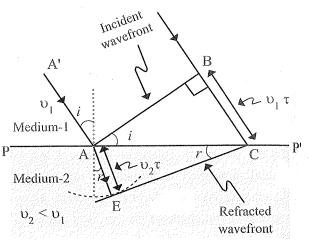
Explain the refraction of a plane wave from rarer medium to a denser medium, using Huygen's principle.
Answer
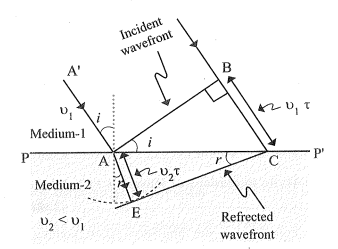
$\rightarrow$ As shown in fig. $PP\ ^{\prime}$ represents the surface separating medium $1$ and medium $2 .$
$\rightarrow$ Let $v_1$ and $v_2$ represent the speed of light in medium $1$ and medium $2,$ respectively.
Also, the refractive indices of medium $1$ and $2$ are $n_1$ and $n_2$ respectively.
$\rightarrow$ As shown in fig. a plane wave front $AB$ is incident on the interface at an angle $i$.
Image
$\rightarrow$ Let $\tau$ be the time taken by the wavefront to travel the distance $BC$.
Thus, $BC =v_1 \tau$
$\rightarrow$ In order to determine the shape of the refracted wavefront, we draw a sphere of radius $v_2 \tau$ from the point $A$ in the second medium.
A tangent $($tangent plane$) CE$ is drawn from the point $C$ on the sphere.
$\rightarrow$ Let $CE$ represent the refracted wavefront at the end of time $\tau$.
$AE = v _2 \tau$ and $r$ is the angle formed at point $C$ which is angle of refraction.
$\rightarrow$ From Fig., From $\triangle ABC$
$\sin i=\frac{ BC }{ AC }=\frac{v_1 \tau}{ AC }.......(1)$
$\rightarrow$ From, $\triangle AEC$
$\sin r=\frac{ AE }{ AC }=\frac{v_2 \tau}{ AC }.......(2)$
$\rightarrow$ Taking the ratio of eq. $(1)$ and $(2),$
$\frac{\sin i}{\sin r}=\frac{v_1 \tau}{ AC } \times \frac{ AC }{v_2 \tau}$
$\frac{\sin i}{\sin r}=\frac{v_1}{v_2}.......(3)$
$\rightarrow$ Refractive index of medium $1, n_1=\frac{c}{v_1}$
$\rightarrow$ Refractive index of medium $2, n_2=\frac{c}{v_2}$
$\therefore \frac{n_2}{n_1}=\frac{v_1}{v_2}........(4)$
$\rightarrow$ From eq. $(3)$ and $(4),$
$\frac{\sin i}{\sin r}=\frac{n_2}{n_1}$
$\therefore n_1 \sin i= n_2 \sin r$
$\rightarrow$ which is Snell's law of refraction.
$\rightarrow$ Thus, the refraction of given plane wave front can be explained using Huygen's principle.
View full question & answer
Question 232 Marks
Write limitations of Huygen's Principle.
Answer
Following is the limitation (short coming) of Huygen's principle:

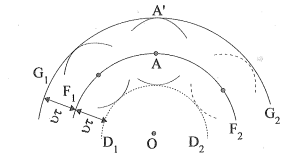
Image

As per Huygen's principle, we get two wavefronts : one, in the direction of propogation of the wavefront (forward) and second, in the backward direction of the wavefront. They are shown in the fig. with $G_1 G_2$ and $D_1 D_2$.
But we get wavefront only in the forward direction, and not in the backward direction. This is the limitation of Huygen's principle.
To explain this, Huygen argued that the amplitude of the secondary wavelets is maximum in the forward direction and zero in the backward direction.
By making this adhoc assumption, Huygens could explain the absense of the backwave.
However, this adhoc assumption is not satisfactory and the absence of the back wave is really justified from more rigorous wave theory.

View full question & answer
2 Marks Questions - Physics STD 12 Science Questions - Vidyadip