Question
Explain dihybrid cross.
Answer

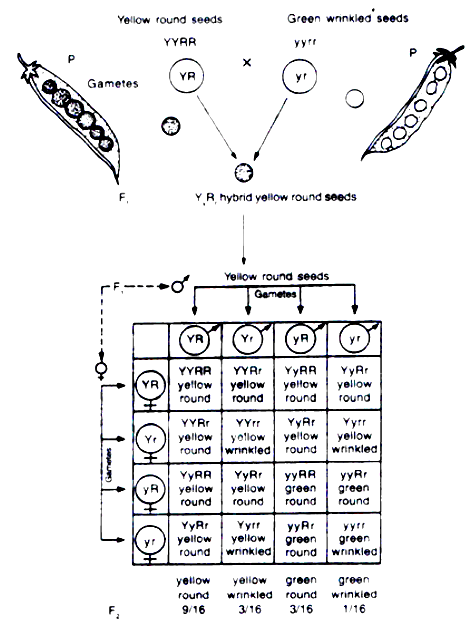
In a dihybrid cross , two pairs of alleles or contrasting characters are considered in parents.
For example, cotyledon colour and seed shape of pea are used as two pairs of alleles.
Suppose, among the two parents, one was true breeding dominant i.e. yellow coloured cotyledons and round seeds, YYRR and the other was a true breeding recessive i.e. green coloured cotyledons and wrinkled seeds, yyrr. On crossing the two parents, $F_1$​​​​​​​ generation so obtained had all yellow and round seeds.
On self pollinating, the hybrids - YyRr produced four types of seeds in $F_2​​​​​​​$​​​​​​​ generation:
(i) Yellow cotyledons and round seeds (YYRR)
(ii) Yellow cotyledons and wrinkled seeds (YYrr)
(iii) Green cotyledons and round seeds (yyRR)
(iv) Green cotyledons and wrinkled seeds (yyrr)
Thus the phenotypic ratio of a dihybrid cross is 9:3:3:1.

Need a full question paper?

Generate a complete, print-ready paper with questions like this in minutes — across 16+ boards, with answer keys.
Start Generating Free

Similar questions

Name the three types of transpiration.
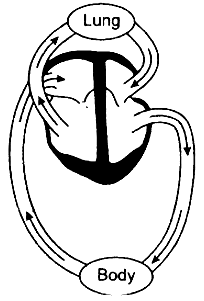
The diagram represents the ‘closed system’ or ‘double circulation’ of blood in mammals.

Justify the above statement.
State two structural and two functional differences between the arteries and veins.
State the changes in the composition of blood as it passes through the following organs:
(a) Lungs (b) Gut (c) Liver (d) Kidneys.
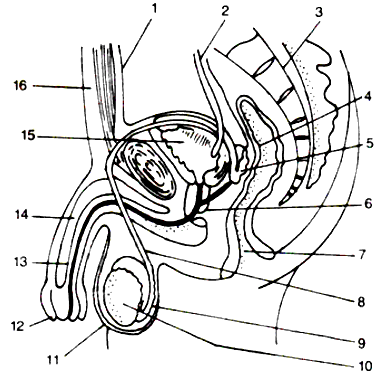
Given on the right is a diagram which represents the reproductive organs of a man:
(i) Write the names of the parts numbered 1 to 16.
(ii) Give two functions of the part 6.
(iii) Name three components of the fluid which may be found in the tube labeled 2.
(iv) What is the main function of the part labelled 3?
Draw labeled diagram of different steps of mitosis.
How is root hair adapted for the absorption of water from the soil?
Using the destarched plant describe step by step how would you proceed to prove that in the absence of light the leaf cannot manufacture starch?
Complete the following by filling in the blanks numbered 1 to 10 with the appropriate word/term:
Photosynthesis involves light reaction and dark reaction. During light reaction, the chlorophyll present in the (1) ______ gets activated by absorbing light energy. This energy splits (2) ______ molecules to (3) ______ and oxygen and releases two electrons. This process is called (4) ______. The (5) ______ ions are picked up by NADP to form (6) ______. The ADP is converted to (7) ______. This process is called (8) ______. During the dark phase, the compound produced at the end of the light reaction reacts with carbon dioxide to form (9) ______. This product is converted to starch. The process is called (10) ______.
Name and describe very briefly the stages in the development of human embryo.
Given below is a diagram of the female reproductive system of a human being

(i) Name the parts numbered 1 to 6.
(ii) Normally after how many days does an ovary release an egg?
(iii) Where are the sperms released during coitus?
(iv) What do the sperms do after being released?
(v) What is the function of the organ numbered 5?
(vi) How many days does it normally take from the fertilization of the egg up to the birth of the baby?
Match the terms given in column I with terms in Column II:
Column IColumn Il
(i) Left-auricle(a) Clotting
(ii) Right auricle(b) Thebasius valve
(iii) Left ventricle(c) Pulmonary vein
(iv) Right-ventricle(d) Aorta
(v) Fibrin(e) Pulmonary arch