Question
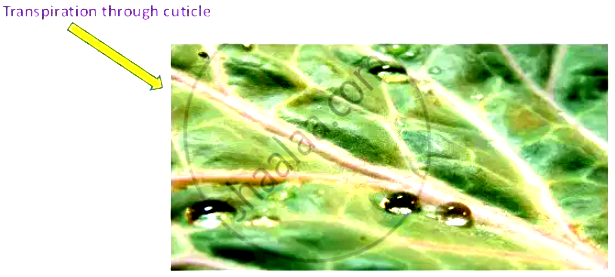
Name the three types of transpiration.
Answer

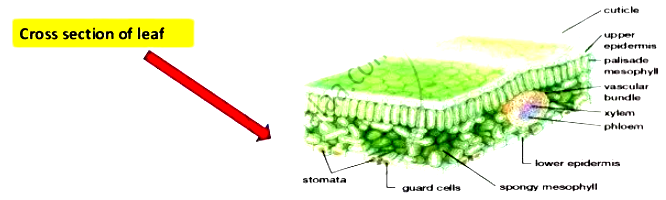
(i) Stomatal transpiration: Stomata are minute pores confined to the epidermis of green shoot and leaves. The opening and closing of stomata are controlled by guard cells. Maximum loss (80-90 percent of the total water loss) of water from the plant tissues takes place through the stomatal opening.

(ii) Lenticular transpiration: Loss of water in the form of water vapour taking place through the lenticels present in woody stem and fruits is called lenticular transpiration. it amounts 1-5 percent of the total water loss by the plant.

(iii) Cuticular transpiration: the loss of water in the form of water vapour through the cuticle is known as cuticular Transpiration.

Need a full question paper?

Generate a complete, print-ready paper with questions like this in minutes — across 16+ boards, with answer keys.
Start Generating Free

Similar questions

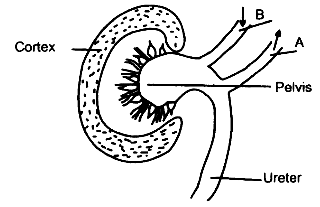
Given below is a simple diagram of the human kidney cut open longitudinally. Answer the following questions:
c
(v) Write two differences in the composition of the blood flowing through blood vessels A and B.
Column ‘II’ is a list of items related to ideas in Column ‘I’. Match the term in Column ‘II’ with a suitable idea given in Column ‘I’.
Column IColumn II
(i) Acrosome
(ii) Ovulation
(iii) Sperm
(iv) Menopause
(v) Implantation>
(vi) Fertilization
(vii) Contraception in males
(a) Male gamete
(b) Oviduct
(c) Uterus
(d) Spermatozoa
(e) Progesterone
(f) Stoppage of the menstrual cycle
(g) Sudden change in genes
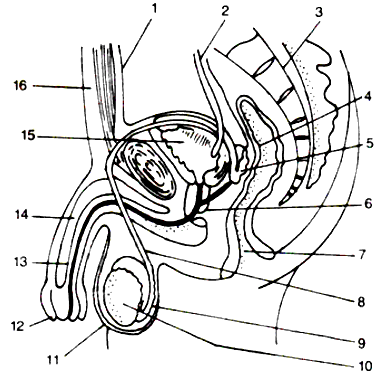
Given on the right is a diagram which represents the reproductive organs of a man:
(i) Write the names of the parts numbered 1 to 16.
(ii) Give two functions of the part 6.
(iii) Name three components of the fluid which may be found in the tube labeled 2.
(iv) What is the main function of the part labelled 3?
Does the sex of the child depend on the father or it is just a matter of chance? Discuss
Explain the terms ultrafiltration and selective absorption
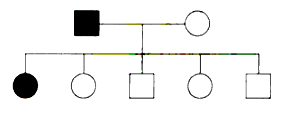
A family consists of two parents and their five children and the pedigree chart below shows the inheritance of the trait colour blindness .

(i) Who is colour blind in parents - Father or Mother?
(ii) How many daughters and sons have beeen born in the family?
(iii) What does the child 1 indicate about this trait?
(iv) Complete the depiction of all probabilities of the trait among the children 2-5 in the chart.
(v) On which chromosome is the gene of this trait located?
(vi) Name one other trait in humans which follows the similar mode of inheritance.
(i) Draw a neat labeled diagram to show the metaphase stage of mitosis in an animal cell having ‘6’ chromosome.
(ii) How many daughter cells are formed at the end of mitosis and at the end of meiosis?
(iii) With reference to cell division explain the following terms:
(Chromatid, Centromere, Haploid).
(iv) Name the type of cell division that occurs during:
1. Growth of shoot 2. Formation of pollen grains.
3. Repair of worn out tissues.
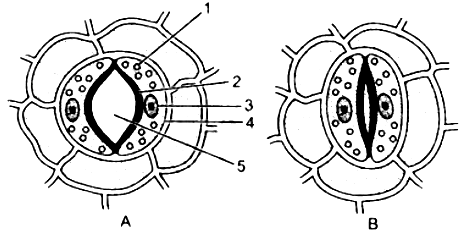
Given below are the diagrams of a certain structure in plants in two conditions.

(i) Name the structure shown.
(ii) Name the parts numbered 1-5.
(iii) What is the most apparent difference between A and B in the structure shown?
(iv) Describe the mechanism which brings about the change in the structure depicted in A and B.
Name the hormones secreted by the following glands:
(i) Anterior pituitary
(ii) Testes
(iii) Ovary
(iv) Adrenal cortex
(v) Pancreas
With well labelled diagrams explain meiosis.