Question
Explain direct current direct emf and draw their graphs. Define alternating current and explain in detail.
Answer

SELF

Need a full question paper?

Generate a complete, print-ready paper with questions like this in minutes — across 16+ boards, with answer keys.

Start Generating Free

Similar questions

A particle is observed from two frames $S_1$ and. $S_2.$ The frame $S_{2 }$ moves with respect to $S_{1 }$ with an acceleration $a$. Let $F_1$ and $F_2$ be the pseudo forces on the particle when seen from $S_1$ and $S_2$ respectively. Which of the following are not possible?
  1. An electron moves along a circle of radius 1m in a perpendicular magnetic field of strength 0.50T. What would be its speed? Is it reasonable?
  2. If a proton moves along a circle of the same radius in the same magnetic field, what would be its speed?
A rectangular conducting loop consists of two wires on two opposite sides of length $l$ joined together by rods of length $d.$ The wires are each of the same material but with cross$-$sections differing by a factor of $2.$ The thicker wire has a resistance $R$ and the rods are of low resistance, which in turn are connected to a constant voltage source $V_0.$ The loop is placed in uniform a magnetic field $B$ at $45^\circ$ to its plane. Find $\tau$, the torque exerted by the magnetic field on the loop about an axis through the centres of rods.
The coil of an electric bulb takes 40 watts to start glowing. If more than 40W is supplied, 60% of the extra power is converted into light and the remaining into heat. The bulb consumes 100W at 220V. Find the percentage drop in the light intensity at a point if the supply voltage changes from 220V to 200V.
A pendulum clock gives correct time at $20^\circ C$ at a place where $g = 9.800\ m s^{-2}$. The pendulum consists of a light steel rod connected to a heavy ball. It is taken to a different place where $g = 9.788\ m s^{-2}$. At what temperature will it give correct time ? Coefficient of linear expansion of steel $= 12 \times 10^{-6^\circ} C^{-1}$.
The conductivity of an intrinsic samiconductor depends on temperature as $\sigma=\sigma_0\text{ e}^{\frac{-\Delta\text{E}}{2\text{kT}}}$ where $\sigma_0$ is a constant. Find the temperature at which the conductivity pf an intrinsic germanium semiconductor will be double of its value at T = 300K. Assume that the gap for germanium is 0.650eV and remains constant as the temperature is increased.
A neutron star has a density equal to that of the nuclear matter. Assuming the star to be spherical, find the radius of a neutron star whose mass is $4.0 \times 10^{30}kg ($twice the mass of the sun$).$
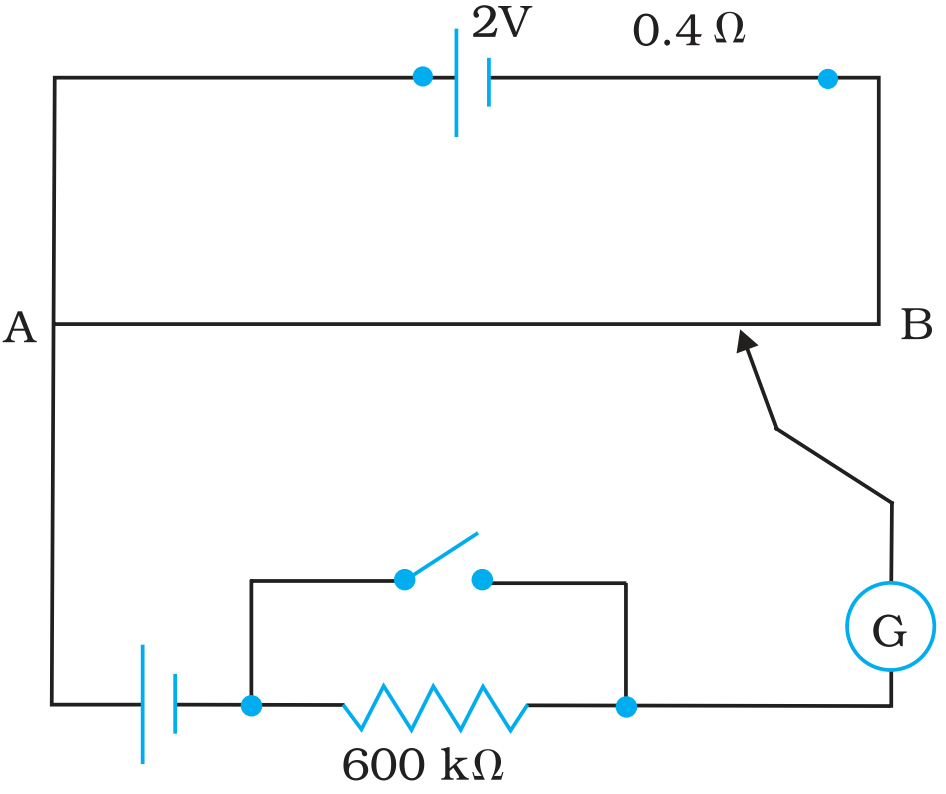
Figure shows a potentiometer with a cell of $2.0 V$ and internal resistance $0.04\ \Omega$ maintaining a potential drop across the resistor wire $AB$. A standard cell which maintains a constant emf of $1.02 V ($for very moderate currents upto a few $mA)$ gives a balance point at $67.3 \ cm$ length of the wire. To ensure very low currents drawn from the standard cell, a very high resistance of $600\ \text{k}\Omega$ is put in series with it, which is shorted close to the balance point. The standard cell is then replaced by a cell of unknown emf $\varepsilon$ and the balance point found similarly, turns out to be at $82.3 \ cm$ length of the wire.
  1. What is the value $\varepsilon?$
  2. What purpose does the high resistance of $600\ \text{k}\Omega$ have?
  3. Is the balance point affected by this high resistance?
  4. Is the balance point affected by the internal resistance of the driver cell?
  5. Would the method work in the above situation if the driver cell of the potentiometer had an emf of $1.0 V$ instead of $2.0 V$?
  6. Would the circuit work well for determining an extremely small emf, say of the order of a few $mV ($such as the typical emf of a thermo$-$couple$)$? If not, how will you modify the circuit?
  1. Two insulated charged copper spheres $A$ and $B$ have their centres separated by a distance of $50 \ cm$. What is the mutual force of electrostatic repulsion if the charge on each is $6.5 \times 10^{-7} C?$ The radii of A and B are negligible compared to the distance of separation.
  2. What is the force of repulsion if each sphere is charged double the above amount, and the distance between them is halved?
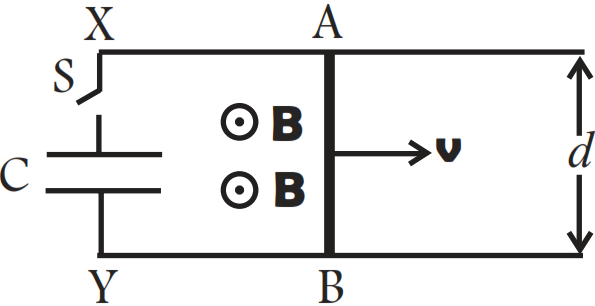
Find the current in the sliding rod AB (resistance = R) for the arrangement shown in Fig. B is constant and is out of the paper. Parallel wires have no resistance. v is constant. Switch S is closed at time t = 0.