Question 15 Marks
(a) Prove that the peak value ( $I_m$ ) of an alternating current is $\sqrt{2}$ times its root mean square ( rms ) value.(b) If alternating current $I=4 sin \omega t$ of and voltage $V =200 \sin (\omega t+\pi / 3)$, calculate the dissipated average power in the circuit.
Answer
View full question & answer→(a) The root mean square (r.m.s.) value of alternating current is equal to that value of direct current. Which exhibits the same heating effect as alternating current. We represent this by $I _{ mms }$ or $I _{ eff }$
As a mathematical definition, the square root of the mean square of the instantaneous alternating current for a complete cycle is called the root mean square of the alternating current (r.m.s.)
Equation of instantaneous alternating current $ I=I_0 \sin \omega t $
On squaring the instantaneous value of alternating current, $ I^2=I_0{ }^2 \sin ^2 \omega t $
Mean value of $I ^2$ will be for one periodic time.
$I ^2=$ Mean value of $I ^2$ will be for one periodic time/ Time period
$\overline{ I ^2}=\frac{\int_0^{ T } I ^2 d t}{\int_0^{ T } d t}=\frac{1}{T} \int_0^{ T } I ^2 \sin ^2 \omega t d t$
$\overline{ I ^2}=\frac{ I _0^2}{T} \int_0^{ T } \sin ^2 \omega t d t$
$=\frac{ I _0^2}{T} \int_0^{ T }\left[\frac{1-\cos 2 \omega t}{2}\right] d t$
$\because \quad \sin ^2 \omega t=\frac{1-\cos 2 \omega t}{2}$
$=\frac{ I _0^2}{2 T} \int_0^{ T }[1-\cos 2 \omega t] d t$
$=\frac{ I _0^2}{2 T}\left[\int_0^{ T } d t-\int_0^{ T } \cos 2 \omega t d t\right]$
$=\frac{ I _0^2}{2 T}\left[[t]_0^{ T }-\left(\frac{\sin 2 \omega t}{2 \omega}\right)_0^{ T }\right]$
$=\frac{I_0^2}{2 T}\left[(T-0)-\frac{1}{2 \omega}[\sin 2 \omega T-\sin 0]\right]$
$[\because \omega t=2 \pi]$
$=\frac{I_0^2}{2 T}\left[T-\frac{1}{2 \omega}\left(\frac{\sin 2 \omega \times 2 \omega}{\omega}-\sin 0\right)\right]$
$=\frac{I_0^2}{2 T}\left(T-\frac{1}{2 \omega}(\sin 4 \pi-\sin 0)\right)$
$=\frac{ I _0^2}{2 T}\left( T -\frac{1}{2 \omega}(0-0)\right)$
$\overline{ I ^2}=\frac{ I _0^2}{2 T} \times T =\frac{ I _0^2}{2}\left[\because \sin 4 \pi=\sin 0^{\circ}=0\right]$
Taking square root
$\overline{I^2}=\frac{I_0}{\sqrt{2}}$
$I _{ rms }=0.707 I _0$ $\left[\because \frac{1}{\sqrt{2}}=0.707\right]$
$I _{ rms }=70.7 \%$ of $I _0$
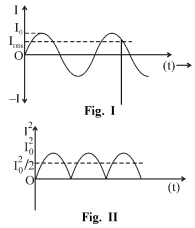
It is clear from equation (4) that the root mean square value of alternating current is $70.7 \%$ of the peak value ( $I _0$ ) of the current. This can be expressed through the following graph :
(b) $\quad V_{\text {rms }}=\frac{V_0}{\sqrt{2}}=0.707 E _0$
$=0.707 \times 200$
$=141.4$ volt
(Here $V _0=200$ , $I _0=4$)
$I_{ rms }=\frac{ I _0}{\sqrt{2}}=0.707 I _0$
$=0.707 \times 4$ $=2.878 A$
$\phi=\pi / 2=60^{\circ}$
$\cos \theta=\cos 60^{\circ}=0.5$
Average power
$\overline{ P }=\frac{ V _0}{\sqrt{2}} \times \frac{ I _0}{\sqrt{2}} \cos \phi$
$=\frac{V_0 I_0}{2} \cos \phi$
$=\frac{200 \times 4}{2} \times \frac{1}{2}$
$P =200 W$
As a mathematical definition, the square root of the mean square of the instantaneous alternating current for a complete cycle is called the root mean square of the alternating current (r.m.s.)
Equation of instantaneous alternating current $ I=I_0 \sin \omega t $
On squaring the instantaneous value of alternating current, $ I^2=I_0{ }^2 \sin ^2 \omega t $
Mean value of $I ^2$ will be for one periodic time.
$I ^2=$ Mean value of $I ^2$ will be for one periodic time/ Time period
$\overline{ I ^2}=\frac{\int_0^{ T } I ^2 d t}{\int_0^{ T } d t}=\frac{1}{T} \int_0^{ T } I ^2 \sin ^2 \omega t d t$
$\overline{ I ^2}=\frac{ I _0^2}{T} \int_0^{ T } \sin ^2 \omega t d t$
$=\frac{ I _0^2}{T} \int_0^{ T }\left[\frac{1-\cos 2 \omega t}{2}\right] d t$
$\because \quad \sin ^2 \omega t=\frac{1-\cos 2 \omega t}{2}$
$=\frac{ I _0^2}{2 T} \int_0^{ T }[1-\cos 2 \omega t] d t$
$=\frac{ I _0^2}{2 T}\left[\int_0^{ T } d t-\int_0^{ T } \cos 2 \omega t d t\right]$
$=\frac{ I _0^2}{2 T}\left[[t]_0^{ T }-\left(\frac{\sin 2 \omega t}{2 \omega}\right)_0^{ T }\right]$
$=\frac{I_0^2}{2 T}\left[(T-0)-\frac{1}{2 \omega}[\sin 2 \omega T-\sin 0]\right]$
$[\because \omega t=2 \pi]$
$=\frac{I_0^2}{2 T}\left[T-\frac{1}{2 \omega}\left(\frac{\sin 2 \omega \times 2 \omega}{\omega}-\sin 0\right)\right]$
$=\frac{I_0^2}{2 T}\left(T-\frac{1}{2 \omega}(\sin 4 \pi-\sin 0)\right)$
$=\frac{ I _0^2}{2 T}\left( T -\frac{1}{2 \omega}(0-0)\right)$
$\overline{ I ^2}=\frac{ I _0^2}{2 T} \times T =\frac{ I _0^2}{2}\left[\because \sin 4 \pi=\sin 0^{\circ}=0\right]$
Taking square root
$\overline{I^2}=\frac{I_0}{\sqrt{2}}$
$I _{ rms }=0.707 I _0$ $\left[\because \frac{1}{\sqrt{2}}=0.707\right]$
$I _{ rms }=70.7 \%$ of $I _0$
It is clear from equation (4) that the root mean square value of alternating current is $70.7 \%$ of the peak value ( $I _0$ ) of the current. This can be expressed through the following graph :
(b) $\quad V_{\text {rms }}=\frac{V_0}{\sqrt{2}}=0.707 E _0$
$=0.707 \times 200$
$=141.4$ volt
(Here $V _0=200$ , $I _0=4$)
$I_{ rms }=\frac{ I _0}{\sqrt{2}}=0.707 I _0$
$=0.707 \times 4$ $=2.878 A$
$\phi=\pi / 2=60^{\circ}$
$\cos \theta=\cos 60^{\circ}=0.5$
Average power
$\overline{ P }=\frac{ V _0}{\sqrt{2}} \times \frac{ I _0}{\sqrt{2}} \cos \phi$
$=\frac{V_0 I_0}{2} \cos \phi$
$=\frac{200 \times 4}{2} \times \frac{1}{2}$
$P =200 W$