Question
Explain double fertilisation and trace the post-fertilisation events in sequential order leading to seed formation in a typical dicotyledonous plant.

Answer

Double fertilisation:

  • On reaching synergid, pollen tube releases the two male gametes into cytoplasm of synergid.
  • One of the male gamete fuses with egg nucleus to form a diploid cell called zygote. This event is called syngamy.
  • Other male gamete fuses with polar nuclei at the centre to produce a triploid primary endosperm nucleus (PEN). This is termed as triple fusion. As syngamy and triple fusion take place simultaneously in the embryo sac, it is termed as double fertilisation.
  • The central cell after triple fusion forms primary endosperm cell (PEC) which later develops into endosperm.
  • The zygote later develops into an embryo.

Following are the post-fertilisation events:

  1. Development of embryo: Embryo develops in fertilised ovule, from the zygote. The early stages of embryo development from a zygote is known as embryogeny. The formation of embryo starts only after certain amount of endosperm formation to assure the nutrition supply, for development and growth of embryo.
  2. Development of seeds: Refer to Basic Concepts Point 10 (Embryogeny in Dicots). As a result of double fertilisation number of changes takes place in an ovule due to which ovule is converted into seeds.

Need a full question paper?

Generate a complete, print-ready paper with questions like this in minutes — across 16+ boards, with answer keys.
Start Generating Free

Similar questions

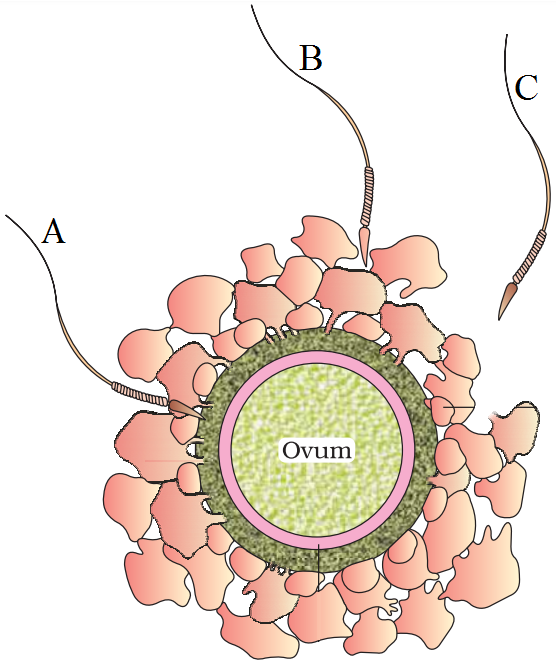
Given below is the diagram of a human ovum surrounded by a few sperms. Observe the diagram and answer the following questions:

Compare the fate of sperms shown in the diagram.

Recombinant DNA (rDNA) is a technology that uses enzymes to cut and paste together DNA sequences of interest. The recombined DNA sequences can be placed into vehicles called vectors that ferry the DNA into a suitable host cell where it can be copied or expressed.
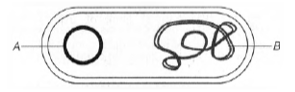
i. A bacterial cell is shown in the figure given below. Label the part 'A' and 'B'. Also, mention the use of part A in rDNA technology.
Image
ii. Suppose a linear DNA fragment and a plasmid has three restriction sites for EcoRI. How many fragments will be produced from linear DNA and plasmid, respectively?
Do you think microbes can also be used as source of energy? If yes, how?
Drugs like LSD, barbiturates, amphetamines, etc., are used as medicines to help patients with mental illness. However, excessive doses and abusive usage are harmful. Enumerate the major adverse effects of such drugs in humans.
  1. Compare, giving reasons, the J-shaped and S-shaped models of population growth of a species.
  2. Explain "fitness of a species" as mentioned by Darwin.
i. Why must a cell be made 'competent' in biotechnology experiments? How does calcium ion help in doing so?
ii. State the role of 'biolistic gun' in biotechnology experiments.
Describe the steps involved in the sequencing of genome of an organism.
State and explain any three factors affecting allele frequency in populations.
Draw a labelled diagram of the L.S. of embryo of grasses. How does it differ from that of bean?
What do you understand by conservation? Describe the methods how biological resources are conserved?