Question
Explain effect of technological changes on supply of a product.
Answer

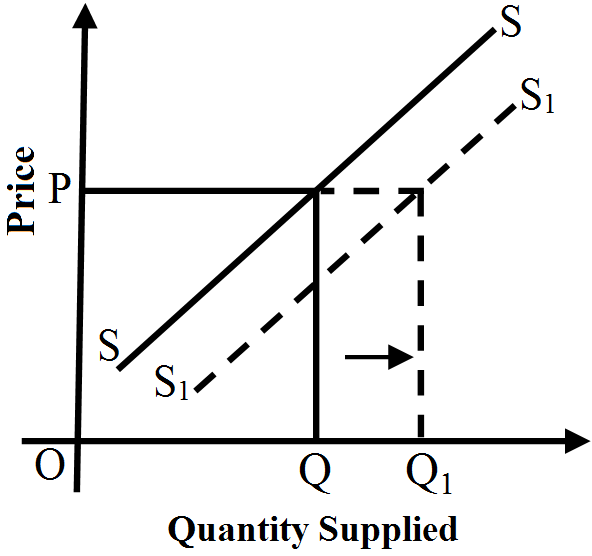
Case I: Technological Progress when there is technological progress in the firm, then cost of production will decrease, which leads to increase in the profit margin of the firm and thereby shifts the supply curve shifts rightward as shown below:

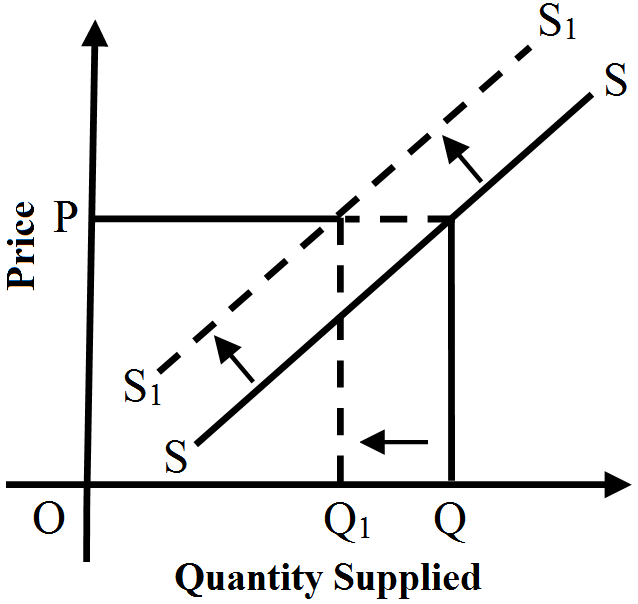
Case II: Outdated Technology Supply of those goods which are being produced with old and inferior technology causing increase in cost of production will decrease the total output and shift the supply curve to the left.

Need a full question paper?

Generate a complete, print-ready paper with questions like this in minutes — across 16+ boards, with answer keys.

Start Generating Free

Similar questions

Calculate (a) national income (b) net national disposable income:
    Rs. in crores
(i) Net factor income to abroad (–) 50
(ii) Net indirect taxes 800
(iii) Net current transfers from rest of the world 100
(iv) Net imports 200
(v) Private final consumption expenditure 5000
(vi) Government final consumption expenditure 3000
(vii) Gross domestic capital formation 1000
(ix) Change in stock (–) 50
(x) Mixed income 4000
(xi) Scholarship to students 80
What do you mean by excess demand? Explain with the help of a diagram as to what will be the effect of an excess demand on the price of the commodity.###At a given price of a commodity, there is excess demand. Is this price an equilibrium price? If not, how will the equilibrium price be reached? Use diagram.
Derive the multiplier when MPS is:
  1. 0.10
  2. 0.20
  3. 0.25
Using these multiplier values, find the change in the equilibrium level of income that results from ₹ 20 crore decrease in investment.
Market for a good is in equilibrium. The supply of good "decreases". Explain the chain of effects of this change.
State three characteristics of monopolistic competition. Which of the characteristics separates it from perfect competition and why?
Assuming that increase in investment is Rs. 1000 crore and marginal propensity to consume is 0.9, explain the working of multiplier.
Define price elasticity of demand. Explain its various degrees. Use diagrams.
Explain the implications of the following in a perfectly competitive market:
  1. Large number of buyers.
  2. Freedom of entry and exit to firms.
A consumer spends ₹ 80 on a commodity when price is ₹ 1 per unit. If the price increases by ₹ 1, what would be his expenditure. PED = -0.4?
Identify the three phases of the Law of Variable Proportions from the following and also give reason behind each phase:

Units of Variable Input

(Units)

Total Physical Product


1 10
2 22
3 30
4 35
5 30