Question
Define price elasticity of demand. Explain its various degrees. Use diagrams.
Answer

Price elasticity of demand is the degree of responsiveness of the quantity demanded of a good to a change in its price.
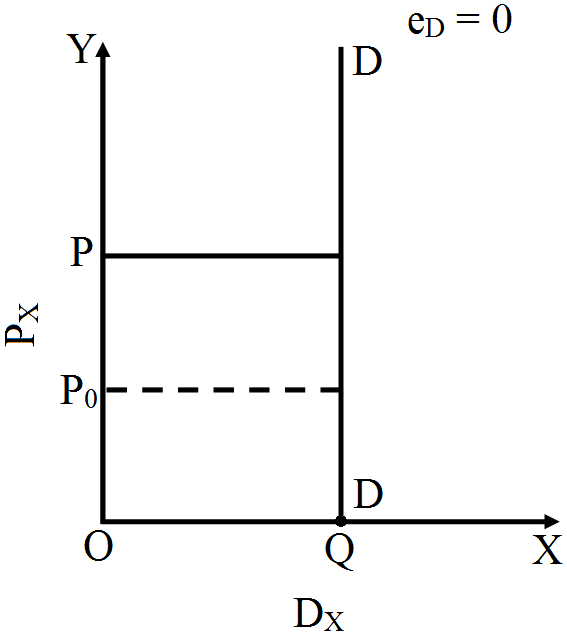
There are five degrees of price elasticity of demand which are given as:
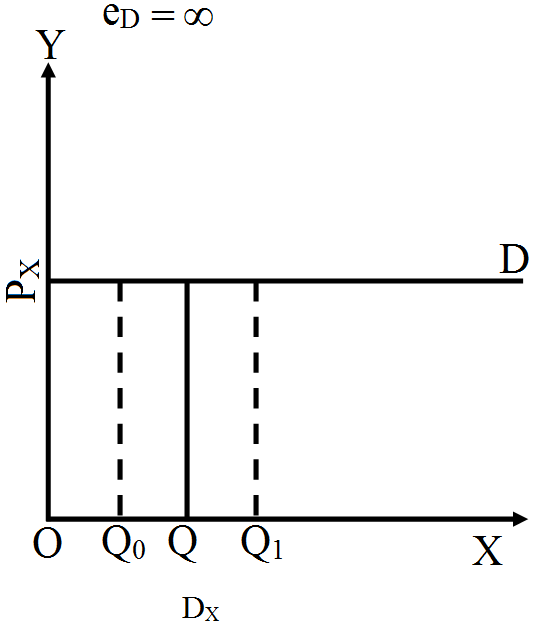
  1. Perfectly Elastic Demand $(\text{e}_\text{D}=\infty)$: When the demand of a commodity rises or falls to any extent at the prevailing price, it is said to be perfectly elastic demand. Here coefficient of elasticity of demand = ∞ (infinity). PD denotes perfectly elastic demand curve, parallel to the OX axis.

  1. Perfectly Inelastic Demand (eD = 0): When the demand of a commodity does not change at all irrespective of any change in its price, it is said to be perfectly inelastic demand. Here coefficient of elasticity of demand = 0 (zero).

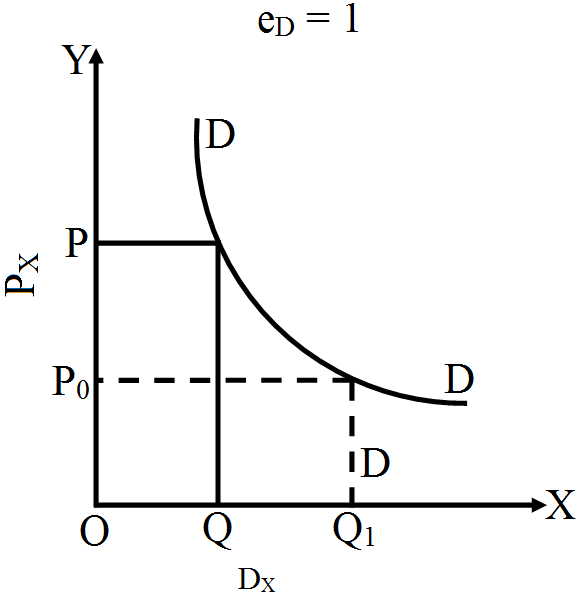
  1. Unit Elastic Demand (eD = 1): When percentage change in the demand of a commodity is equal to the percentage change in its price, it is said to be unit elastic demand. Here coefficient of elasticity of demand = 1.

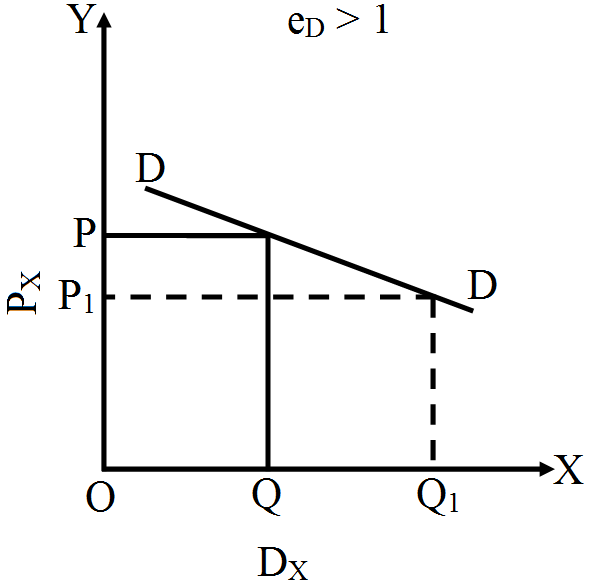
  1. More Elastic Demand (eD > 1): When percentage change in demand of a commodity is more than the percentage change in its price, it is called greater than unitary elastic demand. Here coefficient of elasticity of demand > 1.

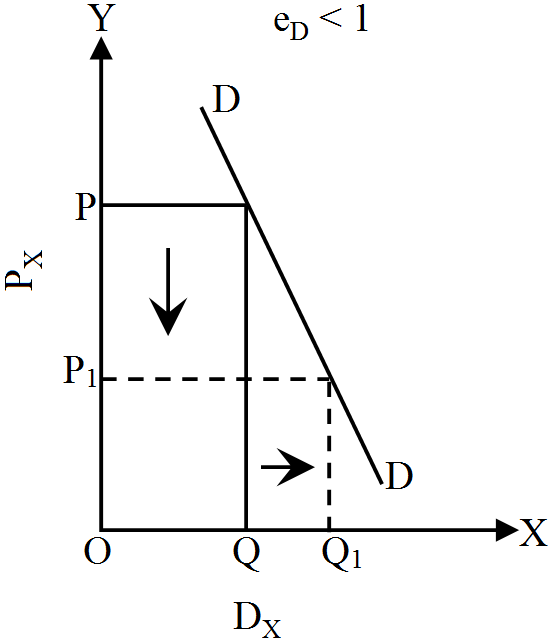
  1. Less than Unitary Elastic Demand (eD < 1): When percentage change in demand of a commodity is less than the percentage change in its price, it is called less than unitary elastic demand or less elastic demand. Here coefficient of elasticity of demand < 1.
​​​​​​​

Need a full question paper?

Generate a complete, print-ready paper with questions like this in minutes — across 16+ boards, with answer keys.

Start Generating Free

Similar questions

Market for a good is in equilibrium. Supply of the good 'increases'. Explain the chain of effects of this change.
Giving reason explain how should the following be treated in estimating gross domestic product at market price?
  1. Fees to a mechanic paid by a firm.
  2. Interest paid by an individual on a car loan taken from a bank.
  3. Expenditure on purchasing a car for use by a firm.
On the basis of the information given below, determine the level of output at which the producer will be in equilibrium. Use the marginal cost-marginal revenue approach. Give reasons for your answer.
Output (Units) Average Revenue(₹) Total Cost(₹)
1 7 7
2 7 15
3 7 22
4 7 28
5 7 33
6 7 40
7 7 48
Market for a good is in equilibrium. There is decrease in demand for this good. Explain the chain of effects of this change. Use diagram.### How will equilibrium price and quantity be affected when there is decrease in demand? Explain with diagram.###How will equilibrium price and quantity be affected when there is leftward shift of demand curve?### Explain the chain effects on demand, supply and price caused by leftward shift of demand curve.### Market for a good is in equilibrium. The demand for the good ‘decreases’. Explain the chain of effects of this change.###Good Y is a substitute of good X. The price of Y falls. Explain the chain of effects of this change in the market of X.
What is government budget? Explain the role of government budget in influencing allocation of resources in the economy.
From the following data find out the level of output that will give the producer maximum profit (use marginal cost and marginal revenue approach). Give reasons for your answer.
Output (units) 12345
Total Cost 917242936
Total Revenue1120273235
What type of changes take place in total product and marginal proudct when there are:
  1. Increasing returns to a factor?
  2. Diminishing returns to a factor? Why do these changes take place?
The demand for goods X and Y have equal price elasticity. The demand of good X rises from 100 units to 250 units due to a 20 percent fall in its price. Calculate the percentage rise in demand of Y if its price falls by 8 percent.
Explain the main steps involved in the expenditure method of estimating national income.