Laws of Motion — Physics STD 11 Science — Question
Maharashtra BoardEnglish MediumSTD 11 SciencePhysicsLaws of Motion4 Marks
Question
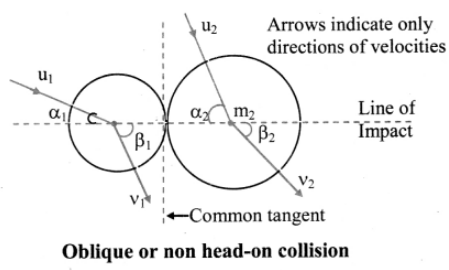
Explain elastic collision in two dimensions.
✓
Answer
$i.$ Suppose a particle of mass mi moving with initial velocity $\overrightarrow{ u _1}$, undergoes a non head$-$on collide with another particle of mass $m _2$ and initial velocity $\overrightarrow{ u _2}$.
$ii.$ Let us consider two mutually perpendicular directions; Common tangent at the point of impact, along which there is no force $($or no change of momentum$).$
Line of impact which is perpendicular to the common tangent through the point of impact, in the two$-$dimensional plane of initial and final velocities.
$iii.$ Applying the law of conservation of linear momentum along the line of impact, we have, $m_1u_1 \cos \alpha _1 + m_2u_2 \cos \alpha _2 = m_1v_1 \cos \beta_1 + m_2v_2 \cos \beta_2$
As there is no force along the common tangent,
$m_1u_1 \sin \alpha _1 = m_1u_1 \sin \beta_1$ and $m_2u_2 \sin \alpha _2 = m_2v_2 \sin \beta_2$
$iv.$ Coefficient of restitution $(e)$ along the line of impact is given as
$e=-\left(\frac{v_2 \cos \beta_2-v_1 \cos \beta_1}{u_2 \cos \alpha_2-u_1 \cos \alpha_1}\right)$
$\therefore e =\frac{ v _2 \cos \beta_2- v _1 \cos \beta_1}{ u _1 \cos \alpha_1- u _2 \cos \alpha_2}$
Need a full question paper?
Generate a complete, print-ready paper with questions like this in minutes — across 16+ boards, with answer keys.