Question
Define and explain the following terms:
i. Zero vector (Null vector)
ii. Resultant vector
iii. Negative vectors
iv. Equal vectors
v. Position vector
Answer

i. Zero vector (Null vector):
A vector having zero magnitude and arbitrary direction is called zero vector. It is denoted as $\overrightarrow{0}$.
Example: Velocity vector of stationary particle, acceleration vector of a body moving with uniform velocity.
ii. Resultant vector:
The resultant of two or more vectors is defined as that single vector, which produces the same effect as produced by all the vectors together.
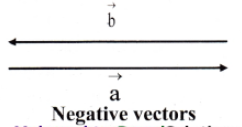
iii. Negative vectors:
A negative vector of a given vector is a vector of the same magnitude but opposite in direction to that of the given vector.
Negative vectors are antiparallel vectors.
In figure, $\vec{b}=-\vec{a}$
Image
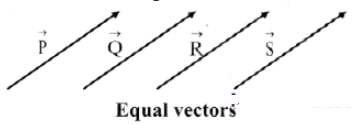
iv. Equal vectors: Two vectors A and B representing same physical quantity are said to be equal if and only if they have the same magnitude and direction.
Image
In the given figure$|\vec{P}|=|\vec{Q}|=|\vec{R}|=|\vec{S}|$
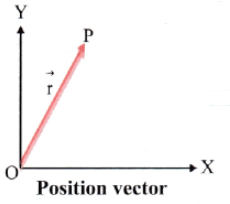
v. Position vector:
A vector which gives the position of a particle at a point with respect to the origin of chosen co-ordinate system is called position vector.
Image
In the given figure $\overrightarrow{ OP }$ represents position vector of $\vec{P}$ with respect to O .

Need a full question paper?

Generate a complete, print-ready paper with questions like this in minutes — across 16+ boards, with answer keys.

Start Generating Free

Similar questions