Question
Explain electric field produced by the point electric charge.

Answer

Image
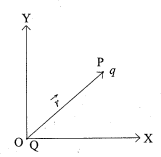
►Let us consider a point charge $Q$ placed in vacuum, at the origin $O$. If we place another point charge q at a point P , where $\overrightarrow{ OP }=\vec{r}$, then the charge $Q$ will exert a force on $q$ as per Coulomb's law.
►The external effect which produces force on charge q , is called electric field of charge $Q$.
►Electric field at point ' P '
$\overrightarrow{ E }(r)=\frac{1}{4 \pi \varepsilon_0} \cdot \frac{ Q }{r^2} \cdot \hat{r}$
Where $\hat{r}$ is the unit vector in the direction of electric field.
►The area around any electric charge or electric charge system where its effect prevails is called the electric field of the electric charge or electric charge system.
OR
►"In the region of an electric charge, or a system of charge, the electrostatic force acting on a unit positive charge placed at some point is called
the electric field of the given electric charge / system of charges."
►Electric field is a vector quantity.
►Its unit is $N / C$ or $V / m .\left( M ^1 L^1 T^{-3} A^{-1}\right)$

Need a full question paper?

Generate a complete, print-ready paper with questions like this in minutes — across 16+ boards, with answer keys.
Start Generating Free

Similar questions

Which of the following can act as a source of electromagnetic waves:
  1. A charge moving with a constant velocity.
  2. A charge moving in a circular orbit.
  3. A charge at rest.
Give reason.
Given a uniform electric field $\overrightarrow{\text{E}} = 2 \times 10^3\ \hat{i}\  N/C$ find the flux of this field through a square of side $20 \ cm,$ whose plane is parallel to the $y-z$ plane. What would be the flux through the same square, if the plane makes an angle of $30^{\circ}$ with the$ x-$axis?
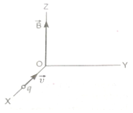
As shown in figure, a charge q moving along the X -axis with a velocity $\vec{v}$ is subjected to a uniform magnetic field $\vec{B}$ acting along the Z-axis as it crosses the origin O.
Image
i. Trace its trajectory.
ii. Does the charge gain kinetic energy, as it enters the magnetic field? Justify your answer.
Provide explanation of Energy bands, valence band and conduction band.
A force F facts on a point charge placed on the axis of an electric dipole. If the distance of a point charge from the dipole is doubled, what will be the force on it? Explain the reason also.
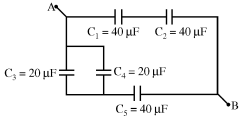
If five capacitors $C_1, C_2, C_3, C_4, C_5$ are connected in an electric circuit as shown in the figure, then calculate the equivalent capacitance of this network between point $A$ and point $B$.
Image
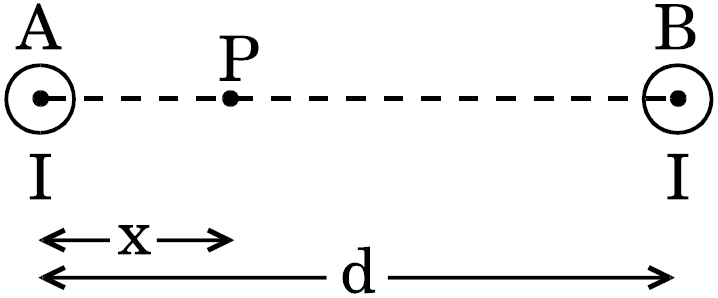
Two long straight parallel wires A and B separated by a distance d, carry equal current I flowing in same direction as shown in the figure.
  1. Find the magnetic field at a point P situated between them at a distance x from one wire.
  2. Show graphically the variation of the magnetic field with distance x for 0 < x < d.
In Ampere's $\oint\overrightarrow{\text{B}}.\text{d}\overrightarrow{\text{l}}=\mu_0\text{i},$ the current outside the curve is not included on the right hand side. Does it mean that the magnetic field B calculated by using Ampere's law, gives the contribution of only the currents crossing the area bounded by the curve?
Distinguish between the terms 'average value' and 'rms value' of an alternating current. The instantaneous current from an a.c. source is I = 5 sin (314 t) ampere.
What are the average and rms values of the current?
A spectroscopic instrument can resolve two nearby wavelengths $\lambda$ and $\lambda+\Delta\lambda$ if $\frac{\lambda}{\Delta\lambda}$ is smaller than 8000. This is used to study the spectral lines of the Balmer series of hydrogen. Approximately how many lines will be resolved by the instrument?