Questions

3 Marks Question

🎯

Test yourself on this topic

7 questions · timed · auto-graded

Question 13 Marks
Derive the formula $($equation$)$ of capacitance for a paralled plate capacitor.
Answer
Image
$\rightarrow$ A capacitor made up of two large parallel conducting plates kept at a small distance is called parallel plate capacitor.
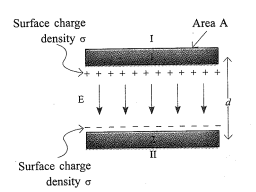
$\rightarrow$ Two parallel conducting plates are arranged parallel to each other as shown in figure. Area of each plate is $A$ and perpendicular distance between the two plates is $d$. Charge on them is $+ Q$ and $- Q$ respectively.
$\rightarrow$ Surface charge density on both the plates is $\sigma\left(=\frac{ Q }{ A }\right)$ and $-\sigma$ respectively.
$\rightarrow$ Here the separation $(d)$ between two plates is very small compared to the area of the plates. $( d^2 \ll < A) $
Therefore, the electric field between the two plates can be considered uniform $($So that we can use the formula $E=\frac{\sigma}{2 \varepsilon_0}$ to find out electric field due to both plates.$)$ Electric field in the region above plate $I , E ^{\prime}=\frac{\sigma}{2 \varepsilon_0}-\frac{\sigma}{2 \varepsilon_0}=0$
$\rightarrow$ Electric field in the region below plate $II, E ^{\prime \prime}=\frac{\sigma}{2 \varepsilon_0}-\frac{\sigma}{2 \varepsilon_0}=0$
$\rightarrow$ Electric field in the region above plate $I,$
$E ^{\prime}=\frac{\sigma}{2 \varepsilon_0}-\frac{\sigma}{2 \varepsilon_0}=0$
$\rightarrow$ Electric field in the region below plate $\Pi$,
$E ^{\prime \prime}=\frac{\sigma}{2 \varepsilon_0}-\frac{\sigma}{2 \varepsilon_0}=0$
$\rightarrow$ Electric field in the region between two plates,
$\therefore E =\frac{\sigma}{2 \varepsilon_0}+\frac{\sigma}{2 \varepsilon_0}$
$\therefore E =\frac{\sigma}{\varepsilon_0}$
$\therefore E =\frac{ Q }{\varepsilon_0 A}$
$\left(\because \sigma=\frac{ Q }{ A }\right)$
$\rightarrow$ Direction of this electric field is from $+ve$ plate to $-ve$ plate.
$\rightarrow$ The electric field is limited to the region between two plates and is uniform in that entire region.
View full question & answer
Question 23 Marks
Explain the series connection of capacitors.
Answer
Image

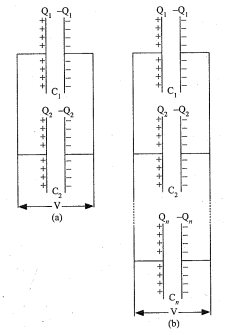
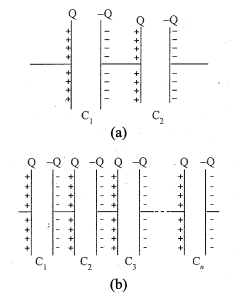
$\rightarrow$ As shown in fig. $(a)$, two capacitors $C _1$ and $C _2$ are connected in series.
$\rightarrow$ The left plate of $C _1$ and the right plate of $C _2$ are connected to two terminals of a battery, and have charges $Q$ and $-Q$ on them, respectively.
$\rightarrow$ Consequently the right plate of $C _1$ has charge $-Q$ and left plate of $C_2$ has charge $Q$ induced on it.
$\rightarrow$ Like this, even though the capacitors may have different capacitance, the charge on them $($the charge on each capacitor plate$)$ is same.
$\rightarrow$ Suppose, the potential difference between two terminals of $C_1$ and $C_2$ is $V_1$ and $V_2$ respectively.
$\rightarrow$ The total potential drop $V$ across the combination will be :
$V = V _1+ V _2$
$\text { but } C _1 =\frac{ Q }{ V _1}$
$\therefore V _1 =\frac{ Q }{ C _1}$
Similarly we get $V_2=\frac{Q}{C_2}$
$\therefore \text { From eq }{ }^{ n } \text { (1) }$
$V =\frac{ Q }{ C _1}+\frac{ Q }{ C _2}$
$\therefore \frac{ V }{ Q }=\frac{1}{ C _1}+\frac{1}{ C _2}$
$\rightarrow$ Suppose, the equivalent capacitance for the given combination of capacitors is $C$ , then,
$\therefore C =\frac{ Q }{ V }$
$\therefore \frac{1}{ C }=\frac{ V }{ Q }$
$\therefore$ From equation $(2)$ and $(3)$
$\therefore \frac{1}{ C }=\frac{1}{ C _1}+\frac{1}{ C _2}$
$\rightarrow$ As shown in fig. $(b), n$ capacitors are connected in series.
$\rightarrow$ Their capacitance are $C _1, C _2, C _3$
$C _n$ respectively. Electric charge on each of those, is $Q .$
$\rightarrow$ Suppose the $p.d.$ across these capacitors, are $V _1$, $V _2, V_3 \ldots . V _n$
$\rightarrow$ The total p.d. of the series combination will be :
$V = V _1+ V _2+ V _3+\ldots .+ V _n$
$\therefore V =\frac{ Q }{ C _1}+\frac{ Q }{ C _2}+\frac{ Q }{ C _3}+\ldots .+\frac{ Q }{ C _n}$
$\therefore \frac{ V }{ Q } =\frac{1}{ C _1}+\frac{1}{ C _2}+\frac{1}{ C _3}+\ldots .+\frac{1}{ C _n}$
$\rightarrow$ Suppose, the equivalent $($ effective$)$ capacitance for the given series combination of capacitors is $C .$
$\therefore C =\frac{ Q }{ V }$
$\therefore \frac{1}{ C }=\frac{ V }{ Q }$
$\rightarrow$ From equations $(4)$ and $(5),$
$\therefore \frac{1}{ C }=\frac{1}{ C _1}+\frac{1}{ C _2}+\frac{1}{ C _3}+\ldots .+\frac{1}{ C _n}$
$\rightarrow$ Suppose, the capacitance of each capacitor is same.
Then we get the equivalent capacitance.
$C _{\text {eq }}=\frac{ C }{n}$
View full question & answer
Question 33 Marks
Explain the parallel connection of capacitors.
Answer
Image
$\rightarrow$ As shown in the fig. $(a) $ two capacitors $C _1$ and $C _2$ are connected in parallel.
$\rightarrow$ For such connection, the $p.d$. across each capacitor is same, suppose its value is $V$ .
$\rightarrow$ The charge on the plate of capacitor $' 1\ '$ is $\left(+Q_1\right)$ and the charge on the plate of capacitor $ ' 2\ '$ is $\left(+Q_2\right)$
$\rightarrow Q=C V$ for first capacitor $Q_1=C_1 V$ and for second capacitor $Q _2= C _2 V$
$\rightarrow$ Hence, the total charge $( $charge of the equivalent capacitor$)$
$Q =Q_1+Q_2$
$\therefore Q =C_1 V+C_2 V$
$\therefore Q =V\left(C_1+C_2\right)$
$\therefore \frac{Q}{V} =C_1+C_2$
$\rightarrow$ Suppose, the equivalent capacitance for the given parallel connection is $C$ .
$\therefore C =\frac{ Q }{ V } \ldots$
$\therefore C = C _1+ C _2 ($From $(1)$ and $(2))$
$\rightarrow $ As shown in fig. $(b), C_1, C_2, C_3 \ldots . . C_n$ total n capacitors are connected in parallel. $P.d$. for each is $V$ and the charge on each capacitor is $Q _1, Q _2, Q _3 \ldots . . Q _n$
$\rightarrow$ Hence, the total charge,
$Q=Q_1+Q_2+Q_3+\ldots .+Q_n$
$\therefore Q = C _1 V+ C _2 V+ C _3 V+\ldots .+ C _n V$
$\therefore \frac{ Q }{ V }= C _1+ C _2+ C _3+\ldots . .+ C _n$
$\rightarrow$ Suppose, the equivalent capacitance for the given parallel connection is $C$ .
Where $\therefore C =\frac{ Q }{ V }$
$\rightarrow $ So, from eq $(3)$ and $(4),$
$\rightarrow C = C _1+ C _2+ C _3+\ldots . .+ C _n$
$\rightarrow$ Suppose, the capacitance of each capacitor is same and it is ' $C ^{\prime}$
$\therefore$ Equivalent capacitance,
$C _{e q} = C + C + C +\ldots . .+ C \text { (n times) }$
$\therefore \quad\left( C _{e q}\right. =n C )$
View full question & answer
Question 43 Marks
Explain the behaviour of non polar molecule and polar molecule in uniform electric field.
Answer
Image
• Non-polar molecule :
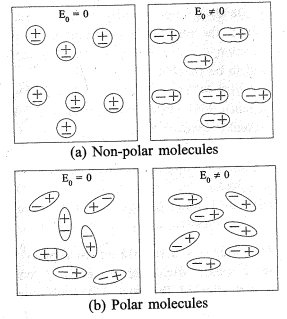
As shown in figure (a) when a non-polar dielectric is placed in an external electric field, forces act on the positive and negative charges in mutually opposite direction, due to which they exprience displacement in the direction of the force.
When the external force acting on the electric charges of molecules is balanced by the restoring force (acting because of internal field inside the molecule) displacement of the charges stops.
In this way induced dipole moment is produced in non-polar molecules. So, the molecule is said to be polarized.
→Linear Isotropic Dielectric : "For a non polar molecule placed in an external field, when the induced dipole moment is in the direction of the electric field and is proportional to the field intensity, such a dielectric is called linear isotropic dielectric."
 In the presence of external electric field, by adding the dipole moments of different molecules, we get the net dipole moment of the dielectric.
• Polar Molecule :
Polar molecules possess permanent dipole moment but, in normal condition the dipole moments are oriented randomly due to thermal agitation. So the total dipole moment is zero.
As shown in fig. (b), when such a material is placed in external electric field, all these dipoles try (tend) to align parallel to the electric field. Hence, the resultant dipole moment is in the direction of electric field. Such a dielectric is said to be polarized.
The extent of polarization of the dielectric depends on the relative strengths of two mutually opposite factors :
(i) The dipole potential energy in the external field tending to align the dipoles with the field.
(ii) The thermal energy tending to disrupt the alignment.
View full question & answer
Question 53 Marks
Explain electric potential energy difference and discuss its important points.
Answer
Image

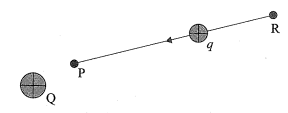
→As shown in the figure, consider a charge $Q$ at the origin (of the cartesian coordinate system.) At each point in the electric field of charge Q , particle having charge $q$ possesses some potential energy.
→Work needs to be done on this charge $q$, in taking it from point R (initial positionl) to point P (final position.)
→This work increase the potentical energy of $q$ which will be equal to the potential energy difference between points R and P .
So, the potential energy difference
$\Delta U=U_P-U_R=W_{R P}$
→Here, the displacement is in the opposite direction to the electric force, hence the work done by electric force is negative $\left(- W _{ RP }\right)$, which is called electric potential energy at point $P$ with respect to point $R$.
→For the electric field of a random electric charge, the electric potential energy difference, between two points, can be defined as the work done by external force in taking the given charge $q$ from one point to the other point without acceleration.
Important points :
(1) The right hand side term of the equation $\Delta U$ $= U _{ P }- U _{ R }$ shows that the work done by the electric field to move the electric charge from one point to another in the electric field depends only on the intial position and the final position. It does not depend on the path joining them, which is a fundamental characteristic of conservative force.
(2) There is no importance of absolute value of electrostatic potential energy. It is only the difference of electrostatic potential energy that matters.
(3) If a random constant $\alpha$ is added to the potential energy at each point, it doesn't make any difference to the potential energy difference between two points. Means, it will be :
$\left( U _{ P }+\alpha\right)-\left( U _{ R }+\alpha\right)= U _{ P }- U _{ R }$
(4) For the sake of ease, the potential energy at infinite distance is taken zero. Suppose, Point $R$ is at infinity. then, $U _{ R }= U _{\infty}=0$
$\therefore W _{ RP }= W _{\infty P }= U _{ P }- U _{\infty}= U _{ P }$
(5) The potential energy of a charge $q$ at any point, is the work done by external force in bringing that charge from infinite distance to that point only.
View full question & answer
Question 63 Marks
Explain electrostatic potential.
Answer
The work done in taking the test charge from one point to the other point in the electric field created by an electric charge distribution is stored in the form of potential energy and is proportional to charge $q$.
If this work is divided by $q$, then the resulting quantity does not depend on $q$. In this way, work done per unit charge is the characteristic of electric field, which can be defined as static electric potential.
The work done by external force in taking unit positive charge from $R$ to P ,
$\frac{ W _{ RP }}{q}=\frac{ U _{ P }- U _{ R }}{q}= V _{ P }- V _{ R }=\Delta V$ Where, $V _{ P }$ and $V _{ R }$ are electrostatic potential at points $P$ and $R$ respectively.
There is no importance of absolute value of electric potential. It is only the difference of electric potential between two points, which is important.
If electric potential at infinite distance is taken zero then,
"Work done in bringing unit positive charge from infinity to the given point in the electric field, against the electric field is called electro static potential (V) at that point".
OR
→"In the region of static electric field, electric potential at any point, means work done by external force in bringing unit positive charge from infinity to that point, without acceleration."
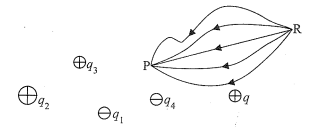
The work done in taking the test charge $q$ in the given electric field, does not depend on path. It depends only on the initial position and final position.

Image

As shown in the fig., in the resultant (net) electric field of electric charges $q_1, q_2, q_3$, $q_4$, the work done in taking the test charge $q$ from point R to P , on different paths, is found same which indicates that the work done is independent of path.
View full question & answer
Question 73 Marks
Explain Electro static potential energy.
Answer
→Electro static potential energy :

Image
→As shown in the fig. electric charge $Q$ is placed on the origin. Electric field created by it is $\vec{E}$.
→In this electric field, a test charge $q$ is to be taken from R to P , against the repulsive force acting on $q$ by Q .
→The repulsive force between electric charges $q$ and $Q$ can act only when both the charges are either positive or negative. Suppose, both the electric charges are positive.
→Here, test charge $q$ is so small that it doesn't disturb electric charge Q .
→Test charge $q$ is to be taken from point R to P , at a very small and constant velocity. This can become possible only when the external force exerted on charge $q$ is equal and opposite to the electric force exerted on charge $q$ by charge Q . Which means,
$\overrightarrow{ F }_e=-\overrightarrow{ F }_{e xt }$
→In this situation, the work done by the external force on $q$ is stored in the form of potential energy.
→If the external force is removed after taking the charge $q$ at point P , the electric force of repulsion takes the charge $q$ away from Q . Charge $q$ gains kinetic energy.
→We can say that the potential energy stored in charge $q$ at point P , is converted into kinetic energy. In this process, the sum of kinetic energy and potential energy remains constant.
→For the sake of ease, the test charge is taken at infinite distance, initially. (Point - R is at infinite distance)
→The work done by the external force in bringing the test charge from infinity to the point P in the given electric field
$W _{\infty \rightarrow P }=\int_{\infty}^{ P } \overrightarrow{ F }_{e x t} \cdot \overrightarrow{d r}$ →Where the direction of $\overrightarrow{d r}$ will be from $\infty$ towards P .
$\therefore W _{\infty \rightarrow P }=-\int_{\infty}^{ P } \overrightarrow{ F }_e \cdot \overrightarrow{d r}\left(\because \overrightarrow{ F }_e=-\overrightarrow{ F }_{\text {ext }}\right)$
This work is done against the electrostatic repulsion force, which is stored in charge q in the form of potential energy.
Static electric energy (electro static potential energy) : "The work required to be done against the electric field in bringing a given test charge(q), from infinite distance to the given point in the electric field is called the electric potential energy of that charge at that point."
View full question & answer