Question
Explain electric potential energy difference and discuss its important points.

Answer

Image

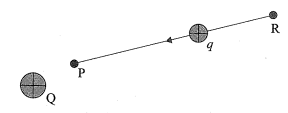
→As shown in the figure, consider a charge $Q$ at the origin (of the cartesian coordinate system.) At each point in the electric field of charge Q , particle having charge $q$ possesses some potential energy.
→Work needs to be done on this charge $q$, in taking it from point R (initial positionl) to point P (final position.)
→This work increase the potentical energy of $q$ which will be equal to the potential energy difference between points R and P .
So, the potential energy difference
$\Delta U=U_P-U_R=W_{R P}$
→Here, the displacement is in the opposite direction to the electric force, hence the work done by electric force is negative $\left(- W _{ RP }\right)$, which is called electric potential energy at point $P$ with respect to point $R$.
→For the electric field of a random electric charge, the electric potential energy difference, between two points, can be defined as the work done by external force in taking the given charge $q$ from one point to the other point without acceleration.
Important points :
(1) The right hand side term of the equation $\Delta U$ $= U _{ P }- U _{ R }$ shows that the work done by the electric field to move the electric charge from one point to another in the electric field depends only on the intial position and the final position. It does not depend on the path joining them, which is a fundamental characteristic of conservative force.
(2) There is no importance of absolute value of electrostatic potential energy. It is only the difference of electrostatic potential energy that matters.
(3) If a random constant $\alpha$ is added to the potential energy at each point, it doesn't make any difference to the potential energy difference between two points. Means, it will be :
$\left( U _{ P }+\alpha\right)-\left( U _{ R }+\alpha\right)= U _{ P }- U _{ R }$
(4) For the sake of ease, the potential energy at infinite distance is taken zero. Suppose, Point $R$ is at infinity. then, $U _{ R }= U _{\infty}=0$
$\therefore W _{ RP }= W _{\infty P }= U _{ P }- U _{\infty}= U _{ P }$
(5) The potential energy of a charge $q$ at any point, is the work done by external force in bringing that charge from infinite distance to that point only.

Need a full question paper?

Generate a complete, print-ready paper with questions like this in minutes — across 16+ boards, with answer keys.
Start Generating Free

Similar questions

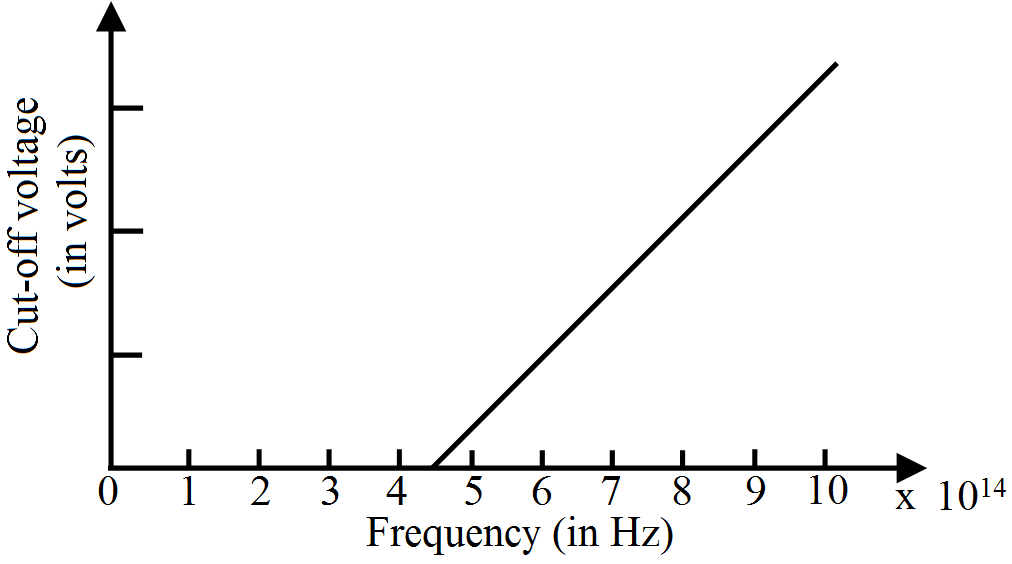
For photoelectric effect in sodium, the figure shows the plot of cut-off voltage versus frequency of incident radiation. Calculate,

  1. Threshold frequency.
  2. Work function for sodium.
A magnetic flux of 8 × 10⁻⁴ weber is linked with each turn of a 200-turn coil when there is an electric current of 4A in it. Calculate the self-inductance of the coil.
Suppose the spheres A and B in Exercise 1.12 have identical sizes. A third sphere of the same size but uncharged is brought in contact with the first, then brought in contact with the second, and finally removed from both. What is the new force of repulsion between A and B?
In Joly's differential steam calorimeter, 3g of an ideal gas is contained in a rigid closed sphere at 20°C. The sphere is heated by steam at 100°C and it is found that an extra 0.095g of steam has condensed into water as the temperature of the gas becomes constant. Calculate the specific heat capacity of the gas in Jg-1 K-1. The latent heat of vaporisation of water = 540cal-g-1.
Explain ground wave and sky wave.
A vertical cylinder of height 100cm contains air at a constant temperature. The top is closed by a frictionless light piston. The atmospheric pressure is equal to 75cm of mercury. Mercury is slowly poured over the piston. Find the maximum height of the mercury column that can be put on the piston.
Suppose the platform with the kid in the previous problem is rotating in anticlockwise direction at an angular speed $\omega.$ The kid starts walking along the rim with a speed v relative to the platform also in the anticlockwise direction. Find the new angular speed of the platform.
A particle starts from the origin, goes along the X-axis to the point (20m, 0) and then returns along the same line to the point (-20m, 0). Find the distance and displacement of the particle during the trip.
If the horizontal force needed for the turn in the previous problem is to be supplied by the normal force by the road, what should be the proper angle of banking?
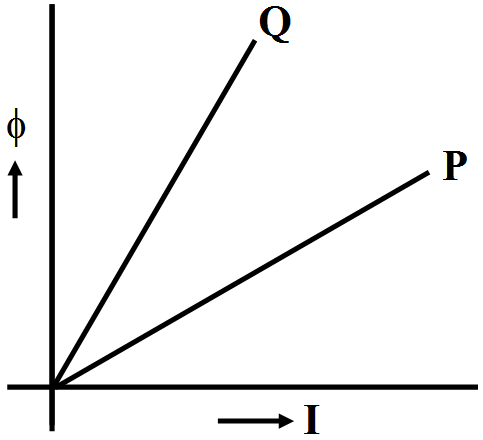
The given graph shows a plot of magnetic flux $(\phi)$ and the electric current (I) flowing through two inductors P and Q. Which of the two inductors has smaller value of self-inductance?