Question
Explain electrical energy and power.

Answer

Image
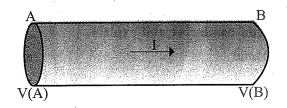
As shown in figure, consider a conductor with end points A and B . In this conductor, current I is flowing from A to B .
The potential at A and B are $V ( A )$ and $V ( B )$ respectively. Since current is flowing from $A$ to $B, V(A)>V(B)$.
The potential difference across $A B$
$V = V ( A )- V ( B )>0$
In time interval $\Delta t$, an amount of charge $\Delta Q =$ I $\Delta t$ flows from A to B .
The potential energy of the charge at $A$ is $\Delta Q . V ( A )$ and at B is $\Delta Q . V ( B )$.
Thus, change in potential energy.
$\begin{array}{l}
\Delta U =\text { final potential energy }- \text { initial potential } \\
\text { energy } \\
\therefore \Delta U=\Delta Q V(B)-\Delta Q V(A) \\
\therefore \Delta U=\Delta Q(V(B)-V(A)) \\
\therefore \Delta U=\Delta Q(-V) \quad\left(\because \text { from eq }{ }^{ n }(1)\right) \\
\therefore \Delta U=-\Delta Q . V \\
\therefore \Delta U =- IV \Delta t<0 \\
\end{array}$
According to law of conservation of energy,
$\begin{array}{l}
\Delta K +\Delta U =0 \\
\therefore \Delta K=-\Delta U \\
\therefore \Delta K =-(- IV \Delta t) \quad\left(\because \text { from eq }^{ n }(2)\right) \\
\therefore \Delta K = IV \Delta t \text { (positive) } \\
\end{array}$
Thus, from this equation it can be seen that a charge moving freely under the effect of an electric field acquires kinetic energy, it means kinetic energy increases.
But in reality, the charges in the conductor move with constant drift velocity, i.e. they gain no energy on an average.
This is because of the collisions with ions and atoms during the motion. During collisions, the energy gained by the charges is shared with the atoms, So the atoms vibrate more energetically, i.e. the conductor heats up.
Thus, kinetic energy of charge is converted in to heat energy.
Amount of energy dissipated as heat in the conductor during the time interval $\Delta t$ is
$\Delta W = VI \Delta t$
The energy dissipated per unit time is the dissipated power P .
$\begin{array}{l}
\therefore \quad P =\frac{\Delta W }{\Delta t} \\
\therefore P =\frac{ VI \Delta t}{\Delta t} \\
\therefore \quad P = VI \\
\end{array}$
Using ohm's law $V = IR$
$\therefore P = I ^2 R$
and also $P =\frac{ V ^2}{ R }$ can be derived.
The SI unit of electrical power is W (watt) OR J/s
Equations (5), (6) and (7) show dissipated power in conductor. (power loss or ohmic loss)
For example, when power is supplied to the coil of an electric bulb, this power is converted into heat and light.

Need a full question paper?

Generate a complete, print-ready paper with questions like this in minutes — across 16+ boards, with answer keys.

Start Generating Free

Similar questions

A parallel plate capacitor is charged by a battery. After some time the battery is disconnected and a dielectric slab of dielectric constant K is inserted between the plates. How would (i) the capacitance, (ii) the electric field between the plates and (iii) the energy stored in the capacitor, be affected? Justify your answer.
Figure. shows a cylindrical tube with adiabatic walls and fitted with a diathermic separator. The separator can be slid in the tube by an external mechanism. An ideal gas is injected into the two sides at equal pressures and equal temperatures. The separator remains in equilibrium at the middle. It is now slid to a position where it divides the tube in the ratio of 1 : 3. Find the ratio of the pressures in the two parts of the vessel.

Arrange the following electromagnetic waves in the order of their increasing wavelength:
  1. $\gamma- \text{rays}$.
  2. Microwaves.
  3. X-rays.
  4. Radio waves.
How are infra-red waves produced? What role does infra-red radiation play in (i) Maintaining the Earth’s warmth and (ii) Physical therapy?
  1. A giant refracting telescope has an objective lens of focal length 15 m. If an eye piece of focal length 1.0 cm is used, what is the angular magnification of the telescope?
  2. If this telescope is used to view the moon, what is the diameter of the image of the moon formed by the objective lens? The diameter of the moon is 3.48 × 10⁶ m and the radius of lunar orbit is 3.8 x 10⁸ m.
A person sitting on the top of a tall building is dropping balls at regular intervals of one second. Find the positions of the 3rd, 4th and 5th ball when the 6th ball is being dropped.
In the given circuit, the potential difference across the inductor L and resistor R are 200V and 150V respectively and the rms. value of current is 5A. Calculate (i) the impedance of the circuit and (ii) the phase angle between the voltage and the current.
(a) A closed loop is held stationary in the magnetic field between the north and south poles of two permanent magnets held fixed. Can we hope to generate current in the loop by using very strong magnets?
(b) A closed loop moves normal to the constant electric field between the plates of a large capacitor. Is a current induced in the loop (i) when it is wholly inside the region between the capacitor plates (ii) when it is partially outside the plates of the capacitor? The electric field is normal to the plane of the loop.
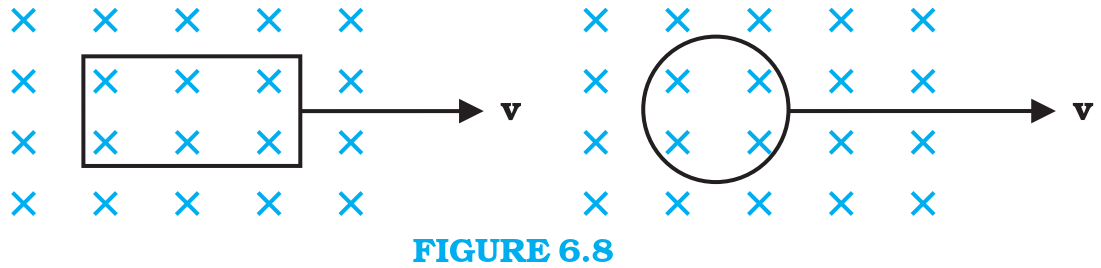
(c) A rectangular loop and a circular loop are moving out of a uniform magnetic field region (Fig. 6.8) to a field-free region with a constant velocity $v$. In which loop do you expect the induced emf to be constant during the passage out of the field region? The field is normal to the loops.
Image
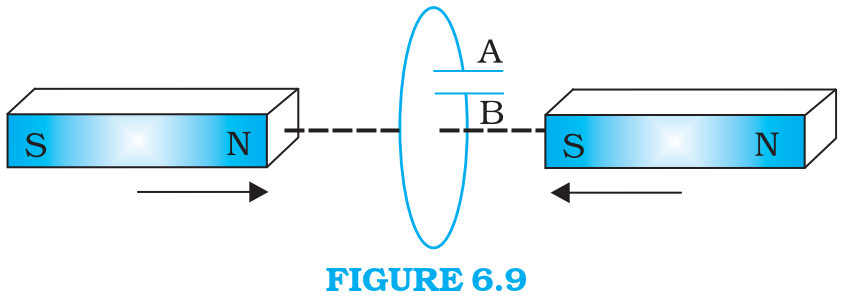
(d) Predict the polarity of the capacitor in the situation described by Fig. 6.9.

Image
When an inductor L and a resistor R in series are connected across a 12 V, 50 Hz supply, a current of 0.5 A flows in the circuit. The current differs in phase from applied voltage by $\pi/3$ radian. Calculate the value of R.
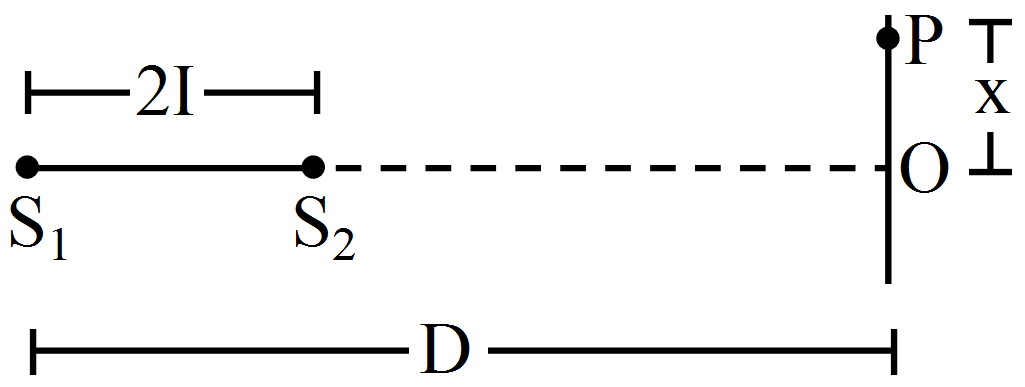
Two coherent narrow slits emitting sound of wavelength $\lambda$ in the same phase are placed parallel to each other at a small separation of $2\lambda.$ The sound is detected by moving a detector on the screen $\sum$ at a distance $\text{D}(>>\lambda)$ from the slit S1 as shown in figure. Find the distance x such that the intensity at P is equal to the intensity at 0.

A point source emitting light uniformly in all directions is placed 60cm above a table-top. The illuminance at a point on the table-top, directly below the source, is 15 lux. Find the illuminance at a point on the table-top 80cm away from the first point.