Question
Explain Electro static potential energy.

Answer

→Electro static potential energy :

Image
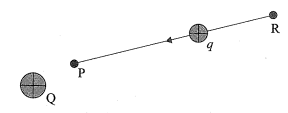
→As shown in the fig. electric charge $Q$ is placed on the origin. Electric field created by it is $\vec{E}$.
→In this electric field, a test charge $q$ is to be taken from R to P , against the repulsive force acting on $q$ by Q .
→The repulsive force between electric charges $q$ and $Q$ can act only when both the charges are either positive or negative. Suppose, both the electric charges are positive.
→Here, test charge $q$ is so small that it doesn't disturb electric charge Q .
→Test charge $q$ is to be taken from point R to P , at a very small and constant velocity. This can become possible only when the external force exerted on charge $q$ is equal and opposite to the electric force exerted on charge $q$ by charge Q . Which means,
$\overrightarrow{ F }_e=-\overrightarrow{ F }_{e xt }$
→In this situation, the work done by the external force on $q$ is stored in the form of potential energy.
→If the external force is removed after taking the charge $q$ at point P , the electric force of repulsion takes the charge $q$ away from Q . Charge $q$ gains kinetic energy.
→We can say that the potential energy stored in charge $q$ at point P , is converted into kinetic energy. In this process, the sum of kinetic energy and potential energy remains constant.
→For the sake of ease, the test charge is taken at infinite distance, initially. (Point - R is at infinite distance)
→The work done by the external force in bringing the test charge from infinity to the point P in the given electric field
$W _{\infty \rightarrow P }=\int_{\infty}^{ P } \overrightarrow{ F }_{e x t} \cdot \overrightarrow{d r}$ →Where the direction of $\overrightarrow{d r}$ will be from $\infty$ towards P .
$\therefore W _{\infty \rightarrow P }=-\int_{\infty}^{ P } \overrightarrow{ F }_e \cdot \overrightarrow{d r}\left(\because \overrightarrow{ F }_e=-\overrightarrow{ F }_{\text {ext }}\right)$
This work is done against the electrostatic repulsion force, which is stored in charge q in the form of potential energy.
Static electric energy (electro static potential energy) : "The work required to be done against the electric field in bringing a given test charge(q), from infinite distance to the given point in the electric field is called the electric potential energy of that charge at that point."

Need a full question paper?

Generate a complete, print-ready paper with questions like this in minutes — across 16+ boards, with answer keys.
Start Generating Free

Similar questions

  1. Draw a ray diagram for the formation of image by a compound microscope.
  2. You are given the following three lenses. Which two lenses will you use as an eyepiece and as an objective to construct a compound microscope?
Lenses Power (D) Aperture (cm)
$L_1$ 3 8
$L_2$ 6 1
$L_3​​​​​​​$ 10 1
  1. Define resolving power of a microscope and write one factor on which it depends.
A proton and an alpha particle are accelerated through the same potential. Which one of the two has (i) greater value of de-Broglie wavelength associated with it, and (ii) less kinetic energy? Justify your answers.
Answer the following questions:
  1. In a double slit experiment using light of wavelength 600 nm, the angular width of the fringe formed on a distant screen is $0.1^\circ$. Find the spacing between the two slits.
  2. Light of wavelength 5000 Å. Propagating in air gets partly reflected from the surface of water. How will the wavelengths and frequencies of the reflected and refracted light be affected?
  1. Drive the expression for electric field at a point on the equatorial line of an electric dipole.
  2. Depict the orientation of the dipole in (i) stable, (ii) unstable equilibrium in a uniform electric field.
A particle is released from the top of an incline of height h. Does the kinetic energy of the particle at the bottom of the incline depend on the angle of incline? Do you need any more information to answer this question in Yes or No?
Write some properties of electromagnetic waves.
Obtain the relationship between object distance $(u),$ image distance $(v)$ and focal length $(f)$ for a concave mirror.$\#\#\#$ Obtain $\frac{1}{f}=\frac{1}{v}+\frac{1}{u}$ formula for a concave mirror.
The output of an OR gate is connected to both the inputs of a NAND gate. Draw the logic circuit of this combination of gates and write its truth table.
Find the speed of the electron in the ground state of a hydrogen atom. The description of ground state is given in the previous problem.
(a) Which of the following can be a source for origin of electromagnetic waves? Give reason.
(i) A charge moving with constant speed
(ii) Charge undergoing circular motion
(iii) Fixed charge.
(b) Name that part of electromagnetic spectrum with which waves of frequency
(i) $10^{20} Hz$,
(ii) $10^9 Hz$ associated.