Question
Explain Electro static potential energy.

Answer

→Electro static potential energy :

Image
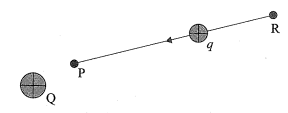
→As shown in the fig. electric charge $Q$ is placed on the origin. Electric field created by it is $\vec{E}$.
→In this electric field, a test charge $q$ is to be taken from R to P , against the repulsive force acting on $q$ by Q .
→The repulsive force between electric charges $q$ and $Q$ can act only when both the charges are either positive or negative. Suppose, both the electric charges are positive.
→Here, test charge $q$ is so small that it doesn't disturb electric charge Q .
→Test charge $q$ is to be taken from point R to P , at a very small and constant velocity. This can become possible only when the external force exerted on charge $q$ is equal and opposite to the electric force exerted on charge $q$ by charge Q . Which means,
$\overrightarrow{ F }_e=-\overrightarrow{ F }_{e xt }$
→In this situation, the work done by the external force on $q$ is stored in the form of potential energy.
→If the external force is removed after taking the charge $q$ at point P , the electric force of repulsion takes the charge $q$ away from Q . Charge $q$ gains kinetic energy.
→We can say that the potential energy stored in charge $q$ at point P , is converted into kinetic energy. In this process, the sum of kinetic energy and potential energy remains constant.
→For the sake of ease, the test charge is taken at infinite distance, initially. (Point - R is at infinite distance)
→The work done by the external force in bringing the test charge from infinity to the point P in the given electric field
$W _{\infty \rightarrow P }=\int_{\infty}^{ P } \overrightarrow{ F }_{e x t} \cdot \overrightarrow{d r}$ →Where the direction of $\overrightarrow{d r}$ will be from $\infty$ towards P .
$\therefore W _{\infty \rightarrow P }=-\int_{\infty}^{ P } \overrightarrow{ F }_e \cdot \overrightarrow{d r}\left(\because \overrightarrow{ F }_e=-\overrightarrow{ F }_{\text {ext }}\right)$
This work is done against the electrostatic repulsion force, which is stored in charge q in the form of potential energy.
Static electric energy (electro static potential energy) : "The work required to be done against the electric field in bringing a given test charge(q), from infinite distance to the given point in the electric field is called the electric potential energy of that charge at that point."

Need a full question paper?

Generate a complete, print-ready paper with questions like this in minutes — across 16+ boards, with answer keys.
Start Generating Free

Similar questions

Answer the following questions.
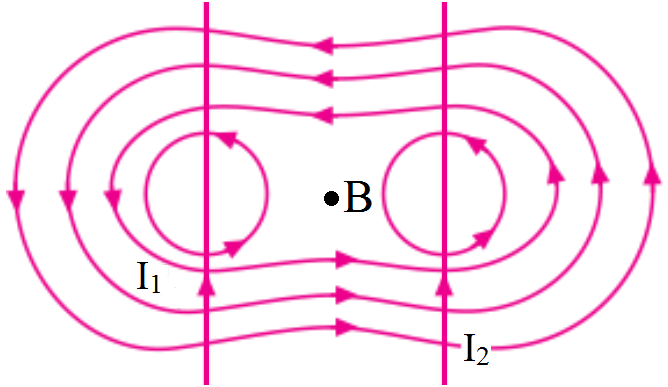
  1. Draw the magnetic field lines due to two straight, long, parallel conductors carrying currents $I_1$ and $I_2$ in the same direction. Write an expression for the force acting per unit length on one conductor due to other. Is this force attractive or repulsive?
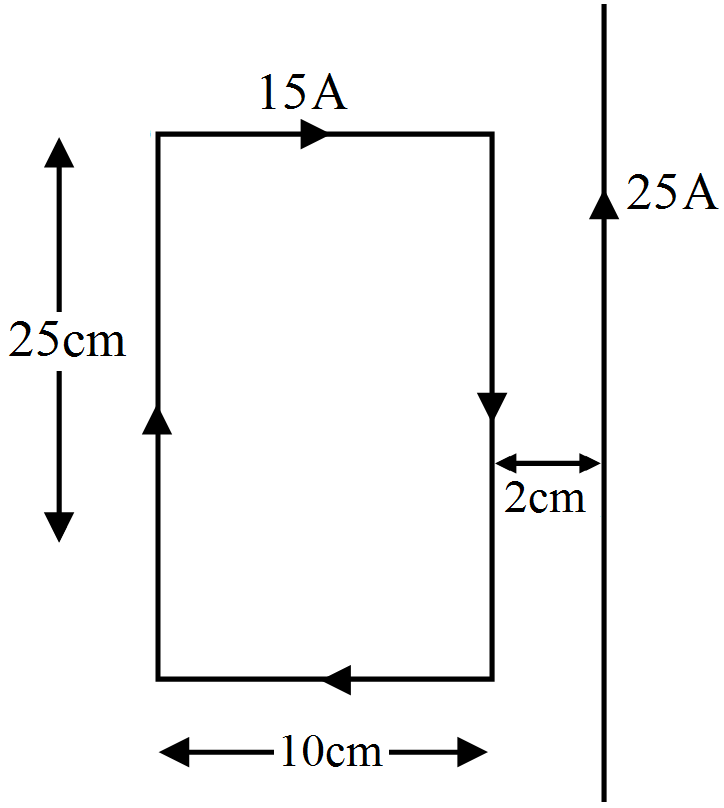
  1. Figure shows a rectangular current$-$carrying loop placed $2\ cm$ away from a long, straight, current$-$carrying conductor. What is the direction and magnitude of the net force acting on the loop?
What is the shape of the wavefront in each of the following cases:
  1. Light diverging from a point source.
  2. Light emerging out of a convex lens when a point source is placed at its focus.
  3. The portion of the wavefront of light from a distant star intercepted by the Earth.
A tank is filled with water to a height of $12.5 \ cm$. The apparent depth of a needle lying at the bottom of the tank is measured by a microscope to be $9.4 \ cm$. What is the refractive index of water? If water is replaced by a liquid of refractive index $1.63$ up to the same height, by what distance would the microscope have to be moved to focus on the needle again?
The index of refraction of fused quartz is 1.472 for light of wavelength 400nm and is 1.452 for light of wavelength 760nm. Find the speeds of light of these wavelengths in fused quartz.
A point charge causes an electric flux of$-1.0 \times 10^3 Nm ^2 / C$ to pass through a spherical Gaussian surface of 10.0 cm radius centred on the charge.
(a) If the radius of the Gaussian surface were doubled, how much flux would pass through the sur-face?
(b) What is the value of the point charge?
The number density of free electrons in a copper conductor estimated in Example $3.1$ is $8.5 \times 10^{28}m^{-3}.$ How long does an electron take to drift from one end of a wire $3.0 m$ long to its other end? The area of cross$-$section of the wire is $2.0 \times 10^{-6} m^2$ and it is carrying a current of $3.0 A.$
The condition of air in a cloeed room is described as follows. Temperature $= 25^\circ C,$ relative humidity $= 60\%,$ pressure $= 104\ kPa$. lf all the water vapour is removed from the room without changing the temperature, what will be the new pressure? The saturation vapour pressure at $25^\circ C = 3.2\ kPa$.
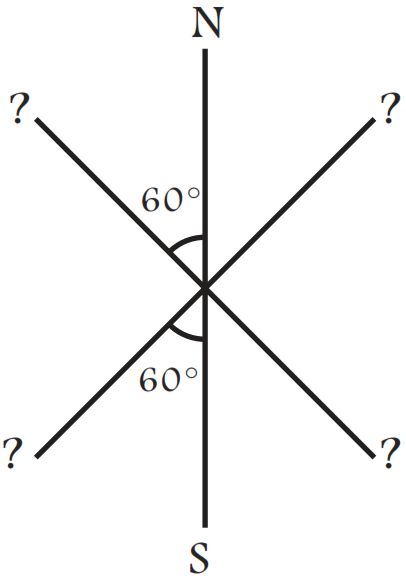
Three identical bar magnets are rivetted together at centre in the same plane as shown in Fig. This system is placed at rest in a slowly varying magnetic field. It is found that the system of magnets does not show any motion. The north-south poles of one magnet is shown in the Fig. Determine the poles of the remaining two.
A piece of wire carrying a current of 6.00A is bent in the form of a circular arc of radius 10.0cm, and it subtends an angle of 120° at the centre. Find the magnetic field B due to this piece of wire at the centre.
Two long parallel wires are 8 cm apart. Currents of magnitudes $i$ and $3 i$ are flowing in them respectively in the same direction. Where the resultant magnetic field due to two will be zero?