Question
Explain Electro static potential energy.
Answer

→Electro static potential energy :

Image
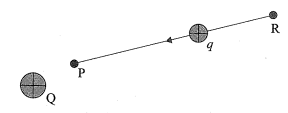
→As shown in the fig. electric charge $Q$ is placed on the origin. Electric field created by it is $\vec{E}$.
→In this electric field, a test charge $q$ is to be taken from R to P , against the repulsive force acting on $q$ by Q .
→The repulsive force between electric charges $q$ and $Q$ can act only when both the charges are either positive or negative. Suppose, both the electric charges are positive.
→Here, test charge $q$ is so small that it doesn't disturb electric charge Q .
→Test charge $q$ is to be taken from point R to P , at a very small and constant velocity. This can become possible only when the external force exerted on charge $q$ is equal and opposite to the electric force exerted on charge $q$ by charge Q . Which means,
$\overrightarrow{ F }_e=-\overrightarrow{ F }_{e xt }$
→In this situation, the work done by the external force on $q$ is stored in the form of potential energy.
→If the external force is removed after taking the charge $q$ at point P , the electric force of repulsion takes the charge $q$ away from Q . Charge $q$ gains kinetic energy.
→We can say that the potential energy stored in charge $q$ at point P , is converted into kinetic energy. In this process, the sum of kinetic energy and potential energy remains constant.
→For the sake of ease, the test charge is taken at infinite distance, initially. (Point - R is at infinite distance)
→The work done by the external force in bringing the test charge from infinity to the point P in the given electric field
$W _{\infty \rightarrow P }=\int_{\infty}^{ P } \overrightarrow{ F }_{e x t} \cdot \overrightarrow{d r}$ →Where the direction of $\overrightarrow{d r}$ will be from $\infty$ towards P .
$\therefore W _{\infty \rightarrow P }=-\int_{\infty}^{ P } \overrightarrow{ F }_e \cdot \overrightarrow{d r}\left(\because \overrightarrow{ F }_e=-\overrightarrow{ F }_{\text {ext }}\right)$
This work is done against the electrostatic repulsion force, which is stored in charge q in the form of potential energy.
Static electric energy (electro static potential energy) : "The work required to be done against the electric field in bringing a given test charge(q), from infinite distance to the given point in the electric field is called the electric potential energy of that charge at that point."

Need a full question paper?

Generate a complete, print-ready paper with questions like this in minutes — across 16+ boards, with answer keys.
Start Generating Free

Similar questions

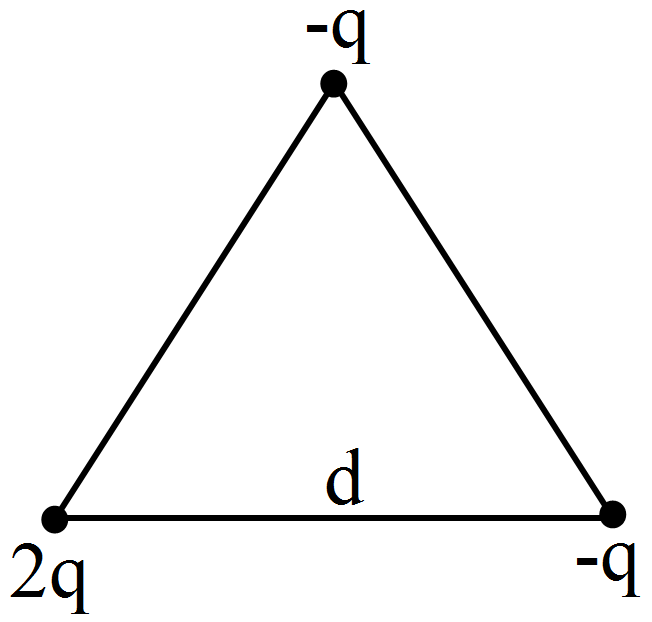
Three charges are arranged on the vertices of an equilateral triangle as shown in figure. Find the dipole moment of the combination.

Calculate the ratio of energies of photons produced due to transition of electron of hydrogen atom from its;
  1. Second permitted energy level to the first level.
  2. Highest permitted energy level to the second permitted level.
The magnifying power of a converging lens used as a simple microscope is $\Big(1+\frac{\text{D}}{\text{f}}\Big).$ A compound microscope is a combination of two such converging lenses. Why don't we have magnifying power $\Big(1+\frac{\text{D}}{\text{f}_\text{o}}\Big) \Big(1+\frac{\text{D}}{\text{f}_\text{o}}\Big)?$ In other words, why can the objective not be treated as a simple microscope but the eyepiece can?
Write the difference between alternating current and voltage.
What is forward bias ? Explain the change happening in the junction under the effect of forward bias.
A hydrogen atom in state n = 6 makes two successive transitions and reaches the ground state. In the first transition a photon of 1.13eV is emitted. (a) Find the energy of the photon emitted in the second transition (b) What is the value of n in the intermediate state?
A sample of paramagnetic salt contains 2.0 × 1024 atomic dipoles each of dipole moment 1.5 × 10⁻²³ J T–1. The sample is placed under a homogeneous magnetic field of 0.64 T, and cooled to a temperature of 4.2 K. The degree of magnetic saturation achieved is equal to 15%. What is the total dipole moment of the sample for a magnetic field of 0.98 T and a temperature of 2.8 K? (Assume Curie’s law)
Derive the expression for force per unit length between two long straight parallel current carrying conductors. Hence define one ampere.
A particle is subjected to two simple harmonic motions, one along the X-axis and the other on a line making an angle of 45° with the X-axis, The two motions are given by,

$\text{x}=\text{x}_0\sin\omega\text{t}$ and $\text{s}=\text{s}_0\sin\omega\text{t}$

Find the amplitude of the resultant motion.

Derive an expression for the electric field intensity at a point on the equatorial line of an electric dipole of dipole moment $\overrightarrow{\text{P}}$and length 2a. What is the direction of this field?